Relative/Adjectival Clause; The Structure of an Essay: Concluding; Poetry: Identification of Common Themes Across Poems Explained for SHS 2 English Language (Sem. 1 – Week 6)
How English Helps Us Describe, Conclude and Interpret
Good communication depends on more than correct spelling and a large vocabulary. Writers need to explain exactly whom or what they mean, bring their arguments to a satisfying close, and recognise the ideas communicated through literary language. These abilities are connected by a shared concern: helping readers understand meaning.
A relative clause can identify a person or add useful information about an object. An essay conclusion can bring several supporting points together and leave readers with a clear final message. Poetry analysis asks readers to look beyond a poem’s immediate subject and consider its deeper concerns. Together, these skills strengthen reading, writing and interpretation.
1. Relative Clauses: Making Description More Precise
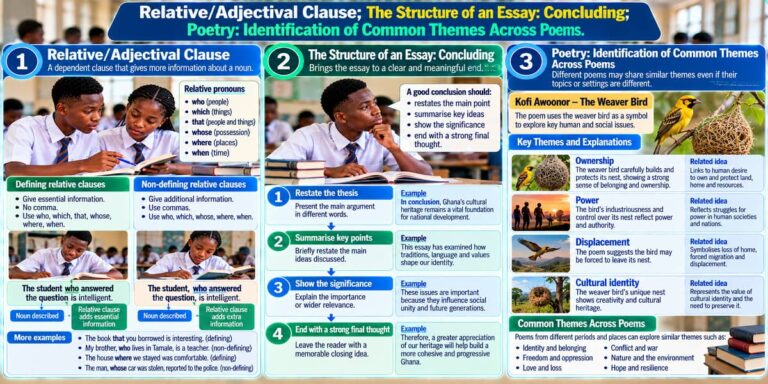
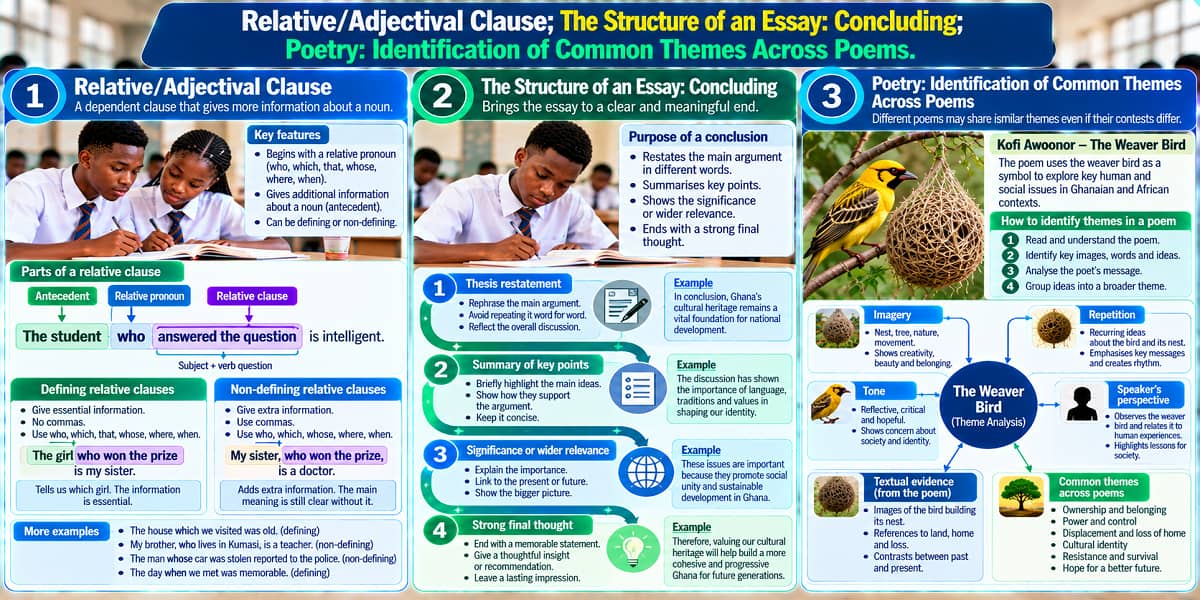
Imagine telling a friend, “The student received a prize.” If several students are present, your friend may ask which student you mean. You could answer, “The student who answered the question received a prize.” The words who answered the question help identify the student. This group of words is a relative clause, also known as an adjectival clause.
A relative clause is a subordinate clause that describes or identifies a noun or pronoun in a larger sentence. The noun being described is called the antecedent. Relative clauses commonly begin with words such as who, whom, whose, which and that. They allow writers to include relevant details without having to place every description in a separate sentence.
Different relative pronouns, different roles
- Who commonly refers to a person performing the action in the clause: The learner who spoke was confident.
- Whom refers to a person receiving an action, especially in formal usage: The person whom I met was helpful.
- Whose expresses possession or a relationship: The learner whose book was missing reported it.
- Which refers to a thing or animal: The tape which measures distance belongs to Simon.
- That can refer to a person or thing in a defining clause: The book that she read was important.
Knowing the relative pronoun is only the beginning. Readers should also identify the clause and ask what noun it describes. In the sentence about the learner whose book was missing, the clause helps identify the learner through the relationship with the book.
Essential details and additional information
Some relative clauses identify which person or thing the writer means. These are called defining or restrictive clauses. For example, “The student who sits at the back of the class asks a lot of questions” uses the clause to identify the student.
Other relative clauses add information about a noun that is already identified. These are called non-defining or non-restrictive clauses. They are set apart by commas. In “My sister, who is a doctor, is very smart,” the clause gives additional information about the sister.
| Example | What the clause contributes |
|---|---|
| The book that is on the table is mine. | Identifies which book is meant. |
| The book, which is on the table, is mine. | Adds information about a book already identified. |
| The person whose car is red is my neighbour. | Identifies the person through a relationship with the car. |
Punctuation is therefore part of meaning, not merely a finishing detail. Commas signal that a non-defining clause provides additional information. A defining clause is normally kept close to the noun it identifies without being separated by commas.
Why relative clauses matter beyond grammar exercises
Relative clauses help make descriptions clearer, more specific and more vivid. They can establish relationships between people and objects, provide background information and help a reader distinguish one person or thing from another. In a narrative, they may introduce a character’s actions or distinguishing features. In an explanation, they can identify the object or idea under discussion.
To recognise one in a passage, read the full sentence, look for a relative pronoun or expression, identify the group of words giving information, and find the noun being described. Then decide whether the clause identifies that noun or adds information about it. This approach is more reliable than memorising a list of pronouns without examining how they work in context.
2. The Conclusion: Giving an Essay a Sense of Completion
Readers expect an essay to lead somewhere. The introduction presents the subject and central argument; the body develops the supporting ideas; the conclusion brings the discussion together. Without a clear ending, even a well-developed essay can feel unfinished.
A conclusion is not simply the final paragraph in which a writer stops writing. It is the opportunity to show how the essay’s main points support its central message. A strong conclusion reminds readers of the argument, draws together the key ideas and explains why the discussion matters.
Four jobs of an effective conclusion
- Return to the main argument. Restate the thesis in fresh language rather than copying the introduction word for word.
- Bring the main points together. Briefly summarise the most important ideas developed in the body.
- Show significance. Explain why the issue or argument deserves attention.
- Leave a final impression. End with a meaningful insight, a strong statement or an appropriate call to action.
These jobs should be completed without introducing a major new argument. If an idea needs explanation or evidence, it usually belongs in the body of the essay rather than appearing for the first time in the conclusion. The ending should be concise, relevant and consistent with the essay’s purpose.
A conclusion in practice
Consider an essay on keeping the school environment clean. Its central argument might be that a clean school creates a better atmosphere for learning and requires the cooperation of everyone in the school community.
A possible conclusion is:
In conclusion, a clean school environment supports a better atmosphere for teaching and learning. By disposing of rubbish properly, caring for shared spaces and working together, learners and staff can help maintain the school. Cleanliness is therefore not the responsibility of one person alone; it is a shared commitment that should be practised every day.
This paragraph does more than repeat the topic. It restates the central point, brings together practical actions and finishes by emphasising shared responsibility. It gives the reader a clear understanding of the argument’s significance.
Common mistakes and how to avoid them
One common weakness is repeating the introduction word for word. A conclusion should return to the central idea but express it in a way that reflects the discussion already developed. Another weakness is introducing a new point that has not been explained in the body. Such a point can leave readers with questions rather than a sense of completion.
A conclusion can also become ineffective when it repeats every detail of the essay. A brief summary should select the most important points, not reproduce the whole discussion. Finally, a strong ending must suit the subject and tone. A dramatic statement or call to action is useful only when it follows naturally from the argument.
Writers should proofread the conclusion for grammar, spelling, punctuation and clarity. They should also consider whether the final paragraph connects naturally with the introduction. A reference to the opening idea can create a satisfying sense of closure when it is relevant.
The same principle of matching form to purpose applies to letters. A formal letter uses a suitable formal greeting and closing, while an informal letter can use a more personal style. The recipient and purpose determine the appropriate language and format. The final lines should complete the communication politely and clearly.
3. Poetry: Moving from Subject Matter to Theme
Poetry often communicates through images, symbols, repetition, tone and the speaker’s perspective. A poem may describe a bird, a household, a journey or a personal experience, yet its significance can extend beyond the event being described. Readers need to distinguish between the poem’s immediate subject matter and its broader theme.
Subject matter is what a poem presents or discusses. A theme is the central idea, concern or message developed through that material. A poem’s subject matter might be a person’s experience of loss; its theme may concern memory, grief or the difficulty of moving forward. The theme should emerge from evidence in the poem rather than from a guess based only on the title.
Common themes found in poetry
Poems can explore love, nature, identity, mortality, social justice, memory, hope, loss and freedom. These themes reflect experiences and questions that people encounter in different circumstances. Two poems can share a theme while presenting different situations or reaching different conclusions about it.
For example, two poems about freedom might present freedom as personal independence in one case and as a cultural or social concern in another. To compare them effectively, readers must explain both what they share and how their treatment of the theme differs.
How to identify a theme with evidence
- Read more than once. A first reading gives an overall impression; later readings help reveal details and patterns.
- Notice images and symbols. Ask whether repeated objects, comparisons or descriptions suggest ideas beyond their literal meaning.
- Consider tone. The speaker’s attitude and emotions can reveal how the poem approaches its subject.
- Look for repetition. Repeated words, phrases or ideas may emphasise an important concern.
- Examine the speaker’s perspective. Consider the experiences and feelings through which the subject is presented.
- State the central idea. Explain what the poem suggests about the subject, rather than simply naming a broad theme.
- Use textual evidence. Quote or refer to specific words, images or lines that support the interpretation.
- Compare with another poem. Identify shared concerns and explain how each poem develops them.
Historical and cultural context can also help explain a poem’s concerns when that context is relevant and supported. Context should deepen the interpretation, not replace close attention to the poem itself.
Reading “The Weaver Bird” by Kofi Awoonor
In Kofi Awoonor’s The Weaver Bird, a weaver bird builds a nest in the household’s tree. The people allow it to build and lay eggs. Later, the bird returns “in the guise of the owner” and preaches to the people who had allowed it into their space. The speaker also refers to the search for new homes and the effort to rebuild old shrines that have been defiled.
These images invite consideration of power, ownership, displacement and cultural identity. The reversal in which the bird appears as the owner is especially significant: the visitor seems to have gained control over the space of the people who first accommodated it. The references to new homes and old shrines strengthen the sense that the relationship has changed and that something important has been damaged.
These are interpretations, so they should be supported by the poem’s language. A strong response does not merely state “the theme is power.” It explains how the image of the bird becoming the owner suggests a change in control and why the references to homes and shrines matter. The poem’s imagery becomes evidence for the reader’s reasoning.
4. Comparing Poems Without Losing Their Differences
When comparing poems, begin by identifying a theme that is present in both. Then consider the images, tone, speaker and situations through which each poem develops it. A useful comparison explains both similarity and difference. Saying that two poems share a theme is only the beginning; a thoughtful response shows how each poem treats that theme.
| Feature | Question to guide your reading |
|---|---|
| Subject matter | What experience, situation or event does the poem present? |
| Theme | What central idea or concern develops from that material? |
| Imagery and symbols | Which images help communicate the idea? |
| Tone | What attitude or feeling does the speaker convey? |
| Evidence | Which words or lines support the interpretation? |
| Comparison | How does each poem develop the shared theme differently? |
This method encourages readers to explain rather than merely label. It also makes discussion more productive: learners can have different interpretations while still grounding their views in textual evidence and listening respectfully to one another.
5. Putting the Skills into Practice
These three areas can be developed through short, focused activities. For grammar, identify a relative clause in a passage, name its antecedent and explain whether it defines the noun or adds information. For writing, choose an essay topic and draft a conclusion that restates the main argument, summarises key points and finishes with a meaningful final sentence. For poetry, select a theme and support it with two images or lines from the poem.
Peer review can strengthen each task. A partner can check whether a relative clause clearly describes its noun, whether the conclusion introduces an unrelated idea, or whether the evidence actually supports the stated theme. Feedback should identify the specific point that needs improvement and suggest a clear way to improve it.
When interpreting literature, respect for other readers’ opinions matters. Different interpretations can prompt useful discussion, but they should be tested against the poem’s words and images. The goal is not simply to agree with the loudest speaker; it is to build a reasoned explanation.
Conclusion
Relative clauses help writers describe and identify people or things with precision. Essay conclusions bring arguments to a clear and meaningful close. Poetry appreciation develops the ability to recognise themes, examine imagery and explain interpretations with evidence. Each skill requires readers and writers to move beyond isolated words and consider how language creates meaning.
Whether you are analysing a sentence, finishing an essay or comparing poems, ask three questions: What does this expression describe? How does this ending complete the argument? Which details support my interpretation? These questions encourage more accurate grammar, stronger writing and deeper literary understanding.
Access NaCCA-aligned Support Packs
Download your structured NaCCA-aligned Teacher Support Pack and Student Learning Pack, designed for clarity, practicality, and reliable teaching and learning.