Identifying and Explaining Themes, Style and Language in Drama Texts
Introduction: Looking Beyond the Events of a Play
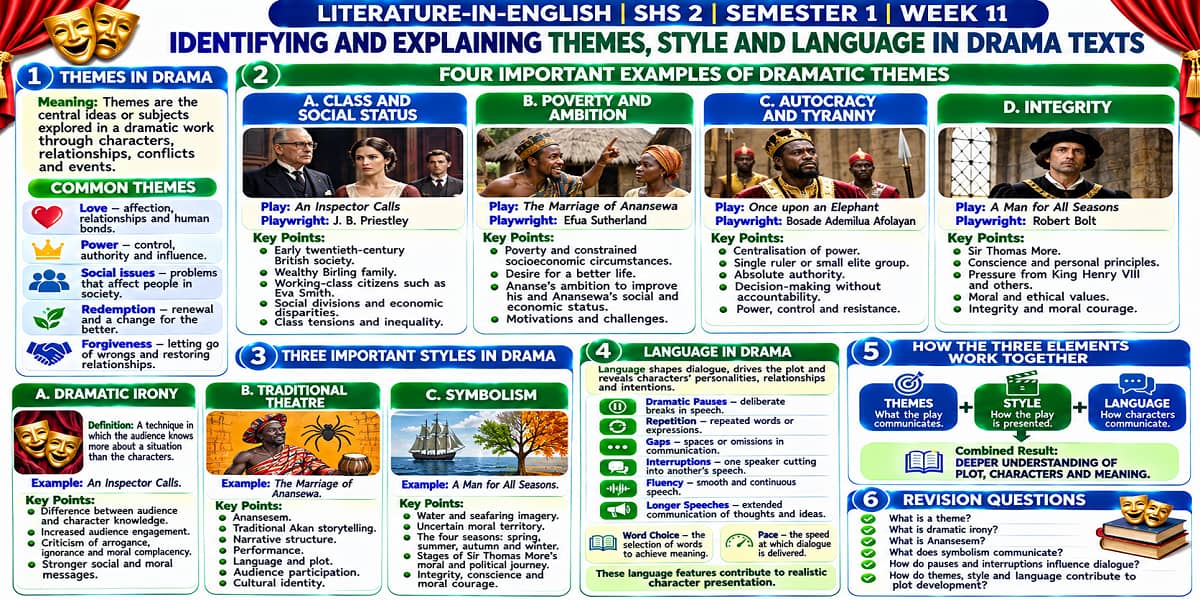
When reading a play, it is easy to concentrate on what happens to the characters. We may follow their conversations, observe their actions and try to understand how the story ends. However, a deeper appreciation of drama requires us to look beyond the events and examine what the playwright communicates through the work.
Why does a playwright present certain characters as wealthy and others as poor? Why might a character struggle to maintain personal principles despite pressure from powerful individuals? Why does an audience sometimes know information that the characters themselves do not know?
These questions lead us to three important areas of dramatic analysis: themes, style and language.
Themes communicate the important ideas explored in a play. Style refers to the distinctive ways in which a dramatic work is written, performed and presented. Language is the means through which characters express their thoughts, relationships, intentions and experiences.
These three elements work together to develop the plot, reveal character personalities and communicate the playwright’s ideas. Understanding them makes it possible to interpret dramatic texts more carefully and explain how they influence an audience.
PART ONE: UNDERSTANDING THEMES IN DRAMA
1. What Are Themes in Drama?
Themes are the central ideas, subjects or messages explored in a literary work. In drama, themes are communicated through the experiences of characters, their relationships, conflicts, decisions and interactions.
A theme is not simply an event in a play. It is the broader idea that an event or a series of events helps communicate.
For example, when a play presents differences between wealthy and working-class individuals, it may explore the theme of class and social status. When a character struggles to maintain personal principles despite external pressure, the work may explore integrity.
Themes can also be interconnected. A dramatic work exploring poverty may simultaneously examine ambition, social status and the challenges people encounter while pursuing a better life.
2. Common Themes Explored in Drama
Several themes frequently appear in dramatic works. Their presentation depends on the situations, characters and relationships developed by the playwright.
Love
Love explores emotional relationships and the connections between individuals. It may influence the decisions characters make and shape their interactions throughout a dramatic work.
Power
Power concerns the ability to influence, control or make decisions affecting others. In drama, it may be explored through relationships between individuals, groups or those occupying positions of authority.
Social Issues
Social issues involve conditions and challenges affecting individuals and communities. These may include inequality, poverty, class differences and the unequal distribution of opportunities.
Redemption
Redemption concerns the possibility of recovering from wrongdoing or overcoming a negative past. It may involve personal change and efforts to address previous mistakes.
Forgiveness
Forgiveness involves releasing resentment or accepting the possibility of reconciliation after wrongdoing. It can influence relationships and the development of conflicts.
These themes provide different ways of examining human experiences. A careful reader should identify the particular ideas developed in a play and explain how the events and characters communicate them.
3. Theme of Class and Social Status
Class and social status concern the differences in social and economic positions occupied by individuals and groups within society.
This theme is explored in J. B. Priestley’s An Inspector Calls. The play examines class divisions in early twentieth-century Britain and highlights the disparities and tensions between the wealthy Birling family and working-class citizens such as Eva Smith.
Social Division
The difference between the wealthy family and working-class individuals illustrates how people may experience society differently because of their economic and social positions.
Inequality
The contrast between the Birling family and Eva Smith highlights disparities within society. These differences provide an important basis for examining social inequality.
Social Tensions
The relationship between wealthy and working-class individuals reveals tensions associated with class divisions. The play therefore provides an opportunity to examine how social position influences human relationships.
When analysing this theme, identify the groups represented, examine their different circumstances and explain how the contrast communicates the issue of class and social status.
4. Theme of Poverty and Ambition
Poverty and ambition are explored in Efua Sutherland’s The Marriage of Anansewa.
The play examines the motivations and challenges of individuals striving for a better life within a constrained socioeconomic environment. Ananse’s ambition to improve his and Anansewa’s social and economic status is central to this theme.
Poverty
Poverty refers to a condition in which individuals experience limited economic resources and opportunities. It can influence their circumstances and the choices available to them.
Ambition
Ambition refers to a strong desire to achieve particular goals or improve one’s circumstances. In the play, Ananse’s ambition is connected to improving the social and economic position of himself and Anansewa.
Challenges and Motivation
The combination of poverty and ambition reveals the difficulties individuals may encounter while pursuing a better life. It also highlights the motivations behind their decisions.
The theme demonstrates that economic circumstances and personal aspirations can influence character behaviour and the direction of a dramatic narrative.
5. Theme of Autocracy and Tyranny
Autocracy and tyranny are explored in Bosade Ademilua Afolayan’s Once upon an Elephant.
Autocracy involves a system in which power is concentrated in the hands of a single ruler or a small elite group. Such authority may allow decisions to be made without adequate accountability.
Centralisation of Power
The play portrays a society in which power is concentrated in the hands of a ruler or a small group of influential individuals.
Absolute Authority
Autocratic rule allows those in control to exercise extensive authority over decisions affecting society.
Control and Resistance
The theme provides an opportunity to examine the relationship between those who exercise power and those who experience its effects. It also draws attention to resistance against concentrated authority.
When studying this theme, consider how power is distributed, who makes important decisions and whether those exercising authority are accountable for their actions.
6. Theme of Integrity
Integrity is the quality of remaining committed to moral and ethical principles, even when doing so becomes difficult.
Robert Bolt’s A Man for All Seasons examines the challenges and consequences of maintaining personal principles in the face of external pressure.
Sir Thomas More demonstrates unwavering commitment to his conscience and beliefs despite immense pressure from King Henry VIII and others.
Personal Principles
Integrity requires individuals to remain committed to the values and beliefs they consider morally right.
External Pressure
Characters may experience pressure from powerful individuals or difficult circumstances. Such pressure tests their willingness to maintain their principles.
Conscience and Moral Courage
Conscience concerns an individual’s sense of right and wrong. Moral courage involves maintaining one’s beliefs despite possible suffering or opposition.
The play demonstrates how commitment to ethical values may require individuals to endure serious difficulties.
PART TWO: UNDERSTANDING STYLE IN DRAMA
7. What Is Style in Drama?
Style refers to the distinctive ways in which plays are written, performed and interpreted. It influences the tone, structure and overall presentation of a dramatic work.
Style helps determine how the audience encounters the story. A playwright may use dramatic irony to allow the audience to understand more than the characters, employ traditional theatre techniques to involve cultural storytelling practices, or use symbolism to communicate deeper meanings through images and objects.
Style is therefore an important part of dramatic expression. It affects how ideas are communicated and how audiences interpret the events of a play.
8. Dramatic Irony
Dramatic irony occurs when the audience knows more about a situation than one or more characters in the play.
This difference in knowledge creates a special relationship between the audience and the dramatic events. Viewers may understand the significance of a situation while the characters remain unaware of important information.
In J. B. Priestley’s An Inspector Calls, dramatic irony is used to strengthen the themes and moral lessons of the play.
Audience Knowledge
The audience receives information that may not be available to the characters. This creates opportunities for anticipation and deeper interpretation.
Criticism of Social Attitudes
Dramatic irony helps reinforce criticism of arrogance, ignorance, moral complacency and societal attitudes.
Social and Moral Messages
The technique strengthens the impact of the play’s social and moral messages while encouraging the audience to become more engaged and reflective.
When identifying dramatic irony, examine what the audience knows, what the characters understand and how the difference in knowledge influences the dramatic experience.
9. Traditional Theatre and Anansesem
Traditional theatre incorporates cultural storytelling and performance practices into dramatic presentation.
In Efua Sutherland’s The Marriage of Anansewa, the style of Anansesem, a traditional Akan storytelling form from Ghana, plays an important role.
Narrative Structure
Anansesem influences how the narrative is organised and presented. It provides a traditional storytelling foundation for the development of the play.
Performance Elements
The traditional style influences the way the dramatic work is performed and experienced. It contributes to the presentation of the story beyond the written words alone.
Language and Plot
The influence of Anansesem can be observed in the language and plot. These elements contribute to the play’s distinctive cultural character.
Audience Participation
Audience participation contributes to a vibrant and engaging performance. It helps establish a connection between the dramatic presentation and the audience.
Cultural Identity
The use of traditional storytelling gives the play a culturally rich character that resonates with audiences within and beyond Ghana.
10. Symbolism
Symbolism is the use of objects, images or representations to communicate ideas and meanings beyond their immediate or literal appearance.
In Robert Bolt’s A Man for All Seasons, imagery associated with water and seafaring is used symbolically. The imagery represents uncertain moral territory and the unknowable realm of God and the devil.
Water and Seafaring Imagery
The references to water and seafaring suggest uncertainty in the moral territory explored in the play. They contribute to the presentation of difficult spiritual and ethical questions.
The Four Seasons
Spring, summer, autumn and winter are used metaphorically to reflect the stages of Sir Thomas More’s moral and political journey.
Deeper Meaning
Symbolic imagery enriches the exploration of integrity, conscience and moral courage. It also helps audiences understand the characters’ inner conflicts and the wider social and political circumstances.
When examining symbolism, identify the image or object, consider its meaning beyond its literal appearance and explain how it contributes to the themes and characterisation.
PART THREE: IDENTIFYING LANGUAGE IN DRAMA
11. Understanding Language in Dramatic Texts
Language is a critical element of drama. It shapes the dialogue of characters, drives the plot and communicates themes.
Through language, playwrights reveal personalities, relationships and intentions. The way characters speak can also contribute to the style of a dramatic work.
For example, a character’s choice of words may reveal confidence, uncertainty, authority or emotional distress. Similarly, the pace and structure of dialogue can influence how audiences understand relationships and dramatic situations.
12. Important Language Features in Drama
Dramatic Pauses
A dramatic pause is a deliberate break in speech or conversation. It may draw attention to an important moment, reveal hesitation or create an opportunity for the audience to consider what has been said.
Repetition
Repetition occurs when words, phrases or expressions are used more than once. It can emphasise particular ideas, reveal a character’s emotional state or make an important statement more noticeable.
Gaps
Gaps are breaks or spaces within communication. They may leave information unstated and require the audience to consider what is missing from a conversation or dramatic exchange.
Interruptions
Interruptions occur when one speaker cuts into another person’s speech or prevents a conversation from continuing as expected. They can reflect the relationships and interactions between characters.
Fluency
Fluency refers to the smooth and continuous flow of speech. It may reveal how comfortably a character communicates or expresses thoughts during a conversation.
Longer Speeches
Longer speeches provide opportunities for characters to communicate extended thoughts and explanations. They may reveal intentions, attitudes and important aspects of personality.
These features help make dramatic characters appear more realistic because they reflect aspects of communication found in everyday human interactions.
13. Word Choice and Pace
Two additional considerations are important when evaluating the language structure of a dramatic text: word choice and pace.
Word Choice
Word choice refers to the specific words selected by a playwright or character. The words used can communicate attitudes, relationships, intentions and emotional responses.
When analysing word choice, consider whether the expressions reveal respect, hostility, confidence, uncertainty or another aspect of a character’s personality.
Pace
Pace refers to the speed and flow of communication or dramatic development. The movement of dialogue can influence how an audience experiences a conversation and understands the events.
Pauses, interruptions, repetitions and longer speeches all contribute to the way dialogue develops. Studying these features helps readers explain how language structure improves their understanding of a dramatic text.
14. How Themes, Style and Language Work Together
Themes, style and language are closely connected. They should not be treated as unrelated elements when analysing a dramatic work.
Themes Communicate Ideas
Themes establish the important issues explored in the play, such as poverty, ambition, integrity, power and social status.
Style Shapes Presentation
Style determines how the playwright presents those ideas. Dramatic irony, traditional theatre and symbolism provide different approaches to communicating meaning.
Language Brings Characters to Life
Language communicates the thoughts, relationships and intentions of characters. Pauses, repetition, interruptions and speech patterns contribute to realistic character presentation.
The Combined Effect
When these elements work together, they influence the development of the plot and deepen the audience’s understanding of the dramatic work.
PART FOUR: PRACTICAL APPLICATION AND ASSESSMENT
15. Practice Questions and Model Answers
Attempt each question before reading the model answer. Where a question requires explanation, provide complete sentences and relevant examples.
Question 1: What is a theme in drama?
Model Answer: A theme is a central idea or subject explored in a dramatic work through the experiences, relationships, conflicts and actions of its characters.
Question 2: Mention five common themes explored in drama.
Model Answer:
- Love.
- Power.
- Social issues.
- Redemption.
- Forgiveness.
Question 3: Explain the theme of poverty and ambition in The Marriage of Anansewa.
Model Answer: The theme examines the challenges faced by individuals seeking a better life within a constrained socioeconomic environment. Ananse’s ambition to improve his and Anansewa’s social and economic status is central to this theme.
Question 4: What is dramatic irony?
Model Answer: Dramatic irony is a dramatic technique in which the audience knows more about a situation than one or more characters in the play.
Question 5: Explain the importance of Anansesem in The Marriage of Anansewa.
Model Answer: Anansesem is a traditional Akan storytelling form that influences the play’s narrative structure, performance, language, plot and audience participation. It gives the play a distinctive cultural character.
Question 6: How is symbolism used in A Man for All Seasons?
Model Answer: Water and seafaring imagery symbolise uncertain moral territory and the unknowable realm of God and the devil. The four seasons represent stages of Sir Thomas More’s moral and political journey. These images strengthen the exploration of integrity, conscience and moral courage.
Question 7: State six language features commonly found in dramatic texts.
Model Answer:
- Dramatic pauses.
- Repetition.
- Gaps.
- Interruptions.
- Fluency.
- Longer speeches.
Question 8: Explain how language helps develop characters in drama.
Model Answer: Language reveals characters’ personalities, relationships and intentions. Their word choices, pauses, repetitions, interruptions and speech patterns help audiences understand their behaviour and make the characters appear more realistic.
Question 9: Distinguish between theme, style and language.
Model Answer: Theme is the central idea explored in a dramatic work. Style refers to the distinctive way the play is written, performed and presented. Language is the means through which characters communicate thoughts, relationships and intentions.
16. Extended Application Activities
Activity 1: Identifying Themes in a Dramatic Text
Select a prescribed dramatic text and read a scene or act carefully. Identify at least three themes and explain how the characters, events and conflicts communicate each theme.
Activity 2: Examining Dramatic Style
Study a selected dramatic text and identify the distinctive style employed by the playwright. Examine dramatic irony, traditional theatre or symbolism where applicable. Explain how the selected technique influences the presentation and meaning of the play.
Activity 3: Analysing Language and Dialogue
Select a conversation between characters and examine the word choices, pace, pauses, repetitions and interruptions. Explain how these features reveal personalities, relationships and intentions.
Activity 4: Collaborative Literary Discussion
Work in mixed-ability groups to discuss how themes, style and language contribute to the development of the plot. Present your findings using clear examples from the dramatic text.
Activity 5: Flip-Chart Presentation
Prepare a flip-chart presentation showing the themes, distinctive style and language used in a prescribed play. Organise your findings into separate sections and explain how the elements work together.
Activity 6: Comparative Research
Select one African and one non-African dramatic text. Research a theme, a distinctive stylistic technique and the use of language in each work. Compare the texts and explain how their authors communicate meaning through these elements.
Conclusion: Reading Drama with Deeper Understanding
Understanding drama requires more than following the events of a play. Readers must examine the themes, style and language through which playwrights communicate their ideas.
Themes such as class and social status, poverty and ambition, autocracy and tyranny, and integrity reveal important aspects of human experience. Dramatic irony, traditional theatre and symbolism demonstrate how different stylistic techniques shape the presentation of a play.
Language brings these elements together through dialogue, pauses, repetitions, gaps, interruptions, fluency and longer speeches. Word choice and pace also influence how characters and situations are understood.
When themes, style and language are examined together, readers gain a deeper understanding of the plot, characters and messages of dramatic works.
Final Self-Check
Confirm that you can:
- Define themes in drama.
- Identify and explain love, power, social issues, redemption and forgiveness.
- Explain the themes illustrated in the four prescribed plays.
- Define style and identify dramatic irony, traditional theatre and symbolism.
- Explain the importance of Anansesem in Ghanaian traditional theatre.
- Identify the symbolic use of water and the four seasons in A Man for All Seasons.
- Identify dramatic pauses, repetitions, gaps, interruptions, fluency and longer speeches.
- Explain how word choice and pace influence understanding.
- Discuss how themes, style and language contribute to the development of plot.
Final Application: Choose one African and one non-African dramatic text. Identify a theme, a distinctive stylistic technique and an important language feature in each. Prepare a research-based presentation explaining how these elements contribute to the development and meaning of the two plays.
Access NaCCA-aligned Support Packs
Download your structured NaCCA-aligned Teacher Support Pack and Student Learning Pack, designed for clarity, practicality, and reliable teaching and learning.