
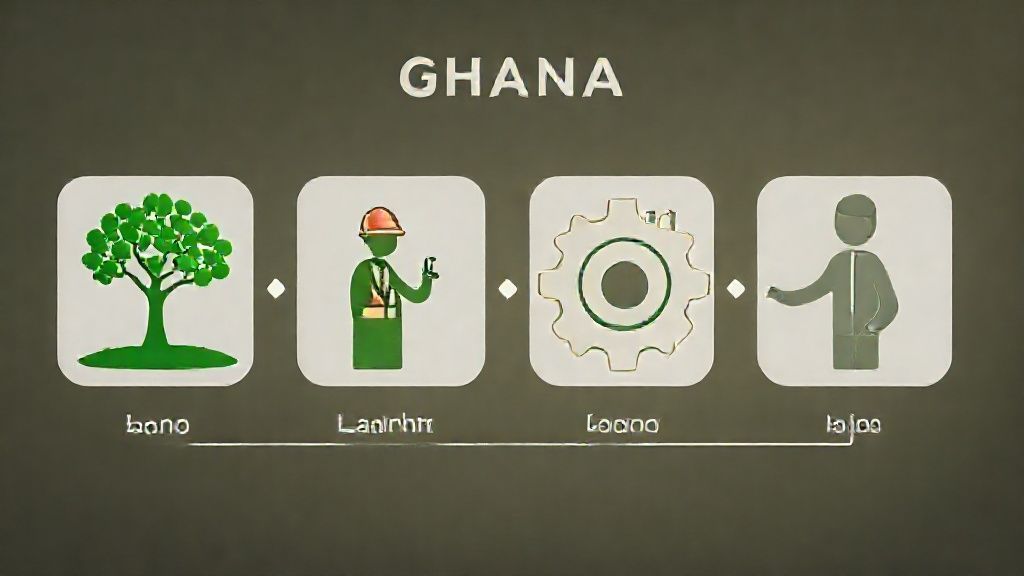
The Four Pillars of Production: Land, Labour, Capital, and Entrepreneurship | Economics SHS 1 SEM 1 WEEK 8 (WASSCE & NaCCA Aligned)
100% NaCCA ALIGNED: Official SHS 1 Curriculum Standard.
Understanding Production: The Economist’s Recipe
Welcome to Week 8! This week, we are moving beyond the basic problem of scarcity and choice, and asking a fundamental question: How are goods and services actually made? The answer lies in understanding the Factors of Production (FOP).
Production is defined as the process of transforming inputs (resources) into outputs (goods or services). Every single item you use—from your phone to the kenkey you eat—required a specific combination of resources to be created. These essential ingredients are the Factors of Production.
This lesson is fully aligned with the NaCCA Content Standard 2.1: Demonstrating knowledge and understanding of factors of production. Our goal is to evaluate the relevance and interdependence of these factors.
The Essential Four Factors of Production
Economists categorize all resources required for production into four core groups:
1. Land (The Gifts of Nature)
In economics, ‘Land’ is far broader than just the soil we walk on. It encompasses all natural resources—the free gifts of nature—that are used in the production process. The key characteristic of land is that its supply is essentially fixed by nature.
- Physical Land: The site for a factory or school.
- Natural Resources: Minerals (gold, bauxite), crude oil, water bodies (Volta Lake), forests, and even climate factors like sunlight and rain.
- Return to Land: The income earned by the owner of the land factor is called Rent.
(Self-Check: Is the air we breathe ‘Land’? Yes, if it is used in a productive process, such as separating gases for medical purposes.)
2. Labour (Human Effort)
Labour refers to the human effort, both physical and intellectual, used in the production of goods and services. Labour involves the application of human skills, energy, and time.
- Physical Labour: Manual tasks like farming, digging, or operating a machine.
- Intellectual Labour: Mental tasks requiring specialized knowledge, such as teaching, accounting, engineering, or medical diagnosis.
- Return to Labour: The income earned by labour is called Wages or Salaries.
It is crucial to differentiate the worker (Labour) from the tool they use (Capital).
3. Capital (Man-Made Resources)
Capital comprises man-made goods used specifically to produce other goods and services. Capital is not consumed directly; rather, it facilitates production.
- Physical Capital: Tangible assets like machinery, tools, factories, delivery vehicles, and computers.
- Financial Capital: The money (funds, savings, loans) used to acquire physical capital. While money itself is not productive, it is essential for procuring the physical resources. In core economic theory, the focus is on physical capital.
- Fixed Capital: Assets that last a long time (e.g., buildings).
- Working Capital: Assets used up quickly (e.g., raw materials, fuel).
- Return to Capital: The payment for capital use is called Interest.
4. Entrepreneurship (The Organizer and Risk-Taker)
Entrepreneurship is arguably the most crucial factor today. It is the special human capacity to organize the other three factors (Land, Labour, Capital), bear the risks associated with starting a business, and introduce innovation and new methods of production.
- Risk-Bearing: Taking financial and operational risks.
- Innovation: Developing new products or improving existing processes.
- Decision-Making: Determining what to produce, how much, and for whom.
- Return to Entrepreneurship: The reward for successful organization and risk-taking is Profit.
The Role of Technology in Modern Production
While the traditional four factors remain foundational, Technology is often cited as the fifth, indispensable factor of the 21st century. Technology represents the knowledge, techniques, and systems that allow resources to be used more efficiently, boosting productivity and enabling innovation. Technology is often embodied in capital (e.g., advanced machinery), but the intellectual property and knowledge behind it are separate assets.
WASSCE Success Strategy: Mastering Interdependence
WASSCE questions frequently test your understanding of how these factors relate. Do not define them in isolation. Always emphasize their interdependence. For instance, Labour requires Capital (tools) to work, Capital requires Entrepreneurship to be organized effectively, and Entrepreneurship requires Land (raw materials) to create a tangible product. A strong analysis often involves showing that if one factor is missing or inefficient, the entire production process suffers. Always use clear, Ghanaian examples in your analysis to demonstrate practical understanding.
Section 3: The Local Laboratory
The Local Production Lab: Waakye, Tema Harbour, and 1D1F
To see the Factors of Production in action, let’s analyze the creation of Ghana’s favorite dish: Waakye.
1. Land: The rice, beans, and millet leaves grow on agricultural land. The water used for boiling is also Land.
2. Labour: The woman cooking the Waakye, the assistant who peels the onion, and the sellers who package it all represent Labour.
3. Capital: The metal cooking pot, the gas cylinder, the wooden stall, and the spoon are all Capital.
4. Entrepreneurship: The owner who decided the location, set the price, and risked their initial savings is the Entrepreneur.
Now consider the Tema Harbour (Landmark). The port land itself is Land. The enormous cranes, ships, and storage sheds are Capital. The dockworkers, managers, and customs officials are Labour. The successful implementation of the One District One Factory (1D1F) Policy requires all four factors to be strategically combined to turn local raw materials (Land) into competitive outputs.
Section 4: Self-Check Quiz
Struggling with these? Click to Reveal the Answer Key
The full Semester Mastery Pack has 50+ practice questions for this topic.
Unlock Full Academic Mastery
Master the entire SEM 1 syllabus with our NaCCA-aligned resources.
DOWNLOAD TEACHER’S PREP SUITE (GHS 70)
DOWNLOAD STUDENT’S MASTERY PACK (GHS 70)
Includes 12 Weeks of Lessons + Revision + Examination prep (14 Weeks Total).