
Matter and Safety: Mastering the Foundation of Ghanaian Industrial Science | Chemistry SHS 1 SEM 1 WEEK 1 (WASSCE & NaCCA Aligned)
Learning Objectives (NaCCA Aligned Standards)
This foundational week sets the stage for mastering the scientific practices essential for chemical problem-solving and understanding atomic structure (1.1.1.CS.1). By the end of this module, you will be able to:
- Describe chemical processes around us and their vital applications in everyday Ghanaian life (1.1.1.LI.1).
- Discuss and explain fundamental safety rules and interpret the universal language of hazard symbols used in a chemistry laboratory (1.1.1.LI.2).
- Answer the Essential Questions: Where do we see chemistry in our daily lives, and how can we explore the exciting world of chemistry safely?
The Concept: Decoding Chemistry and Non-Negotiable Safety
Chemistry is often called the ‘central science’ because it is fundamentally the study of matter—anything that has mass and occupies space—and the profound changes that matter undergoes. If you can explain what happens to palm oil when heated, or how common salt (sodium chloride) dissolves in water, you are explaining chemistry.
To study these changes effectively and safely, we use a controlled environment: the laboratory. Safety is not a suggestion; it is a critical skill for any successful chemist. The Feynman Technique demands that we simplify safety rules into common-sense principles:
Safety Rules: Why They Matter (Simple Explanation)
- The Dress Code: If you wear goggles, a lab coat, and closed shoes, you create a shield. If a chemical splashes, it hits the coat or the goggles, not your skin or eyes. Your eyes are irreplaceable.
- Handling Chemicals: Always add Acid to Water (A/W). Imagine adding sand to a bucket of water versus adding water to a bucket of sand. When you add concentrated acid directly to water, the reaction is vigorous, producing heat. If you pour water onto concentrated acid, the heat generated is so intense and localised that the liquid can violently splash back into your face (exothermic reaction).
- No Tasting, Smelling, or Eating: Chemicals can look like water or sugar but be highly poisonous. The rule ‘No food or drink’ prevents accidental ingestion of toxic substances.
- Wafting: If you must smell a substance (rarely), do not put your nose near the opening. Use your hand to gently wave (waft) the vapour towards your nose. This minimizes the concentration of harmful fumes you inhale.
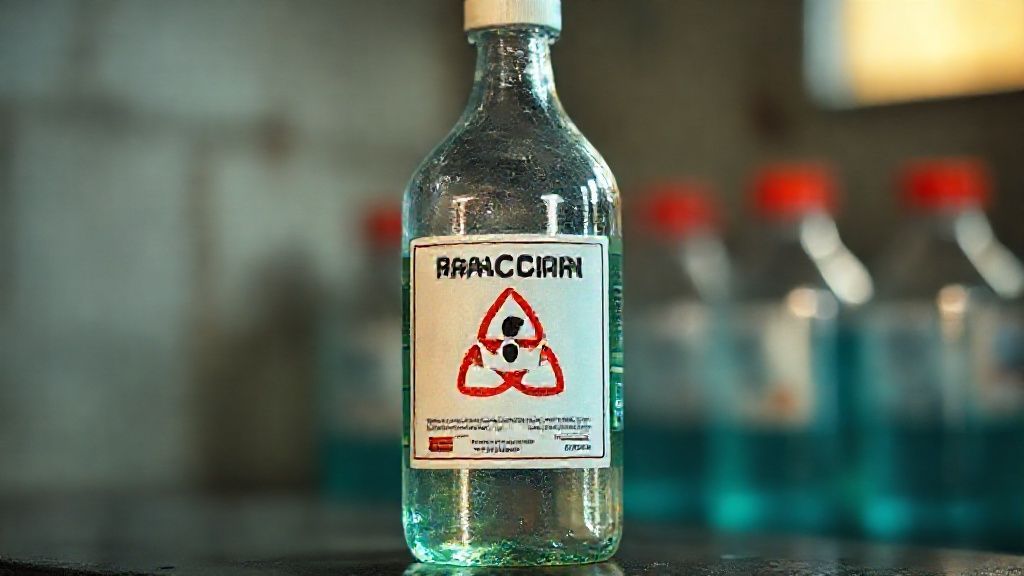
Hazard Symbols: The Universal Language
Since chemicals are often imported, we rely on universal hazard symbols (pictograms) that communicate danger instantly, regardless of the language written on the bottle. Think of these as traffic signs for chemicals. For instance, the symbol of a dead tree and fish indicates environmental hazards. The symbol of liquid pouring onto a hand or metal means Corrosive—it can eat away at tissue or surfaces.
Ghanaian Real-World Case: Chemistry Driving the Economy
Chemistry is not abstract; it is the engine powering Ghana’s development, impacting everything from your plate of Jollof to the electricity keeping your lights on.
1. The Energy Sector (Tema Oil Refinery – TOR)
The crude oil pumped from Ghana’s Jubilee field is a complex mixture of hundreds of hydrocarbons. At TOR, physical chemistry principles—specifically fractional distillation—are used to separate this crude oil into useful products: cooking gas (LPG), petrol (gasoline), diesel, and kerosene. Each product is simply a different ‘fraction’ or length of the hydrocarbon chain, separated based on its unique boiling point. Without chemistry, crude oil would be useless.
2. Agriculture and Food Processing
Consider the production of gari. The fermentation of cassava involves microbial chemistry, converting starch into simpler compounds and changing the pH to produce the characteristic sour taste and preservation. In large-scale farming, inorganic chemistry provides the essential NPK (Nitrogen, Phosphorus, Potassium) fertilizers necessary to enrich Ghana’s soil and ensure high yields of cocoa, maize, and rice. The chemical composition is manipulated to feed the nation.
3. Pharmaceuticals and Healthcare
When you take paracetamol for a headache, you are relying entirely on chemistry. Pharmaceutical companies like Tobinco or Kinapharma employ chemists to synthesize (manufacture) new drug compounds, ensure the correct dosage (stoichiometry), and test the purity (analytical chemistry) of every tablet. Chemistry keeps us healthy.
WASSCE Strategy: Mastering Application Questions
WASSCE often tests your understanding of chemistry’s relevance at the application level (DoK Level 2 and 3). You will rarely be asked simply to define chemistry. Instead, expect questions that follow the pattern of the Key Assessment for this week:
“State and explain three ways that chemistry is important to the Ghanaian society. Use specific examples in your explanation.”
Pro-Tips for High Marks:
- Specific Naming: Do not just say “it helps farming.” Say: “Chemistry aids agriculture through the formulation of inorganic fertilizers (NPK) which replenish soil nutrients, directly increasing the yield of Ghanaian staple crops like maize.”
- Citing Ghanaian Context: Always use local examples (TOR, Cocoa Processing Company, local pharmaceutical names) to demonstrate deep understanding and relevance.
- The Safety Question: If a question involves the lab, always prioritize safety. For example, if asked about heating a chemical, ensure you mention ‘use a fume hood’ or ‘wear safety goggles’ to demonstrate mastery of protocol. When explaining hazard symbols, relate the symbol (e.g., Flammable) directly to a real-world consequence (e.g., catching fire if exposed to an open flame, like petrol).
Understanding chemistry’s importance and the bedrock of laboratory safety is the essential first step toward becoming a successful scientific mind in Ghana.
100% NaCCA ALIGNED
For Teachers: Purchase our Premium Package to simplify your lesson preparation.
For Students: Get the Premium Handout for easy-to-follow explanations and Q&A packages.


![[Introduction to Economics]: Why Scarcity Forces Every Ghanaian to Choose | Economics SHS 1 SEM 1 WEEK 1 (WASSCE & NaCCA Aligned)](https://schoolsupport.lavadanstech.com/wp-content/uploads/2025/12/school_support_697-768x432.jpg)