Types Of Profits In Each Market Structure
Introduction
Firms operate in different market structures and aim to earn profits from their business activities. Depending on market conditions, firms may earn normal profit, super-normal profit, or sub-normal profit. The nature of competition, entry and exit conditions, and pricing power influence the type of profit a firm can achieve in the short run and long run.
Key Concepts
- Profit: The financial gain earned when total revenue exceeds total costs.
- Normal Profit: The minimum level of profit required to keep a firm operating in the market.
- Super-Normal Profit: Profit earned above the normal profit level.
- Sub-Normal Profit: A situation where total revenue is less than total costs, including explicit and implicit costs.
- Perfect Competition: A market structure with many firms and free entry and exit.
- Monopoly: A market structure where a single firm dominates the market.
- Monopolistic Competition: A market structure with many firms selling differentiated products.
- Economic Loss: Another term for sub-normal profit.
Explanation
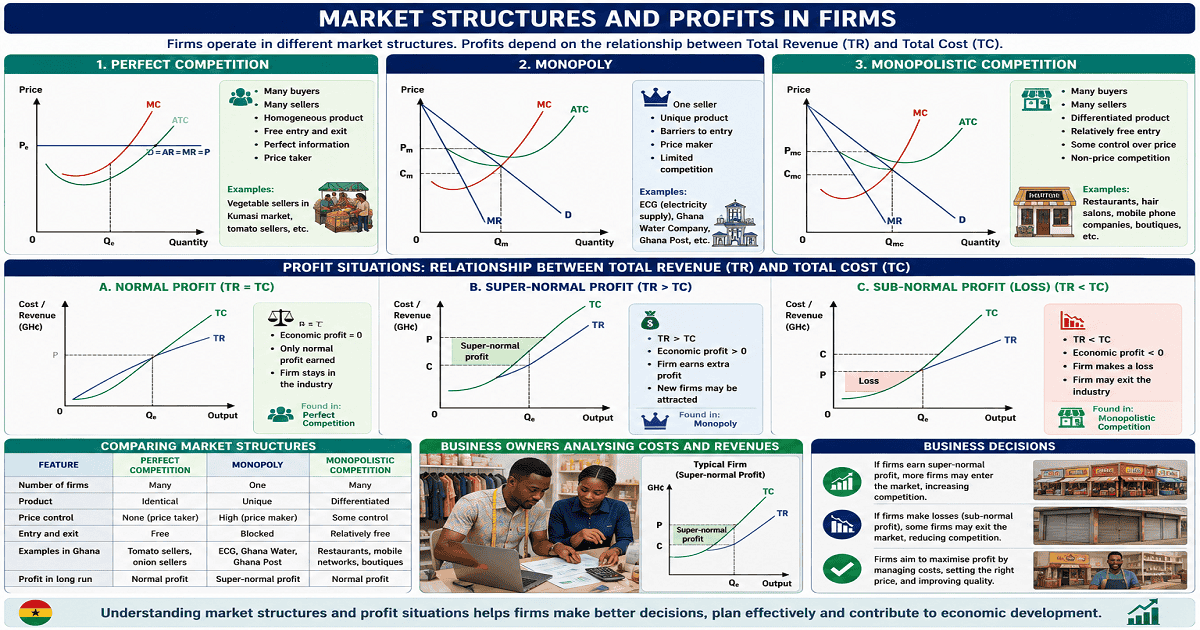
Different market structures influence the type of profits firms can earn. The three main types of profit are normal profit, super-normal profit, and sub-normal profit.
Normal profit is the minimum level of profit required for a firm to remain in business. It covers all opportunity costs and allows the firm to continue operating without incentives to enter or leave the market.
Super-normal profit refers to profit earned above the normal profit level. It represents excess earnings beyond what is necessary to keep a firm in operation.
Sub-normal profit, also known as an economic loss, occurs when a firm’s total revenue is less than its total costs, including both explicit and implicit costs.
In a perfectly competitive market, firms earn normal profit in the long run because free entry and exit eliminate economic profits. Firms may earn super-normal profits in the short run due to temporary advantages, but competition eventually reduces these profits to normal levels. Firms may also experience sub-normal profits in the short run due to changes in demand or costs. If losses persist, firms exit the market, reducing supply and restoring normal profits for the remaining firms.
In a monopoly, the monopolist always earns at least normal profit and may sustain super-normal profits in both the short run and long run. This is possible because high barriers to entry prevent competitors from entering the market. The monopolist can set prices above marginal cost and maintain excess profits.
In a monopolistically competitive market, firms can earn super-normal profits in the short run because of product differentiation and some degree of market power. However, the entry of new firms attracted by these profits increases competition and eventually reduces profits to normal levels in the long run. Firms may also experience sub-normal profits in the short run due to intense competition and changing consumer preferences. Firms that continue making losses eventually leave the market.
Types Of Profits In Different Market Structures
| Market Structure | Normal Profit | Super-Normal Profit | Sub-Normal Profit |
|---|---|---|---|
| Perfect Competition | Earned in the long run | Possible in the short run | Possible in the short run |
| Monopoly | Always earned | Can be sustained in short and long run | Not emphasised in the market structure |
| Monopolistic Competition | Earned in the long run | Possible in the short run | Possible in the short run |
Short-Run And Long-Run Profit Comparison
| Market Structure | Short Run | Long Run |
|---|---|---|
| Perfect Competition | Normal, super-normal, or sub-normal profit | Normal profit only |
| Monopoly | Normal and super-normal profit | Normal and super-normal profit |
| Monopolistic Competition | Normal, super-normal, or sub-normal profit | Normal profit only |
Characteristics Of Profit Types
| Profit Type | Description | Business Outcome |
|---|---|---|
| Normal Profit | Covers opportunity costs | Firm remains in the market |
| Super-Normal Profit | Profit above normal profit | Attracts new firms where entry is possible |
| Sub-Normal Profit | Total revenue less than total costs | May cause firms to exit the market |
Examples
Example 1
Problem: Explain why firms in perfect competition earn only normal profit in the long run.
- Identify the conditions of perfect competition.
- Consider the effect of free entry and exit.
- Determine the impact on profits.
Final Answer: Free entry and exit attract competitors whenever super-normal profits exist, reducing profits until only normal profit remains.
Example 2
Problem: Explain why monopolists can sustain super-normal profits.
- Identify the market structure.
- Examine barriers to entry.
- Determine how pricing power affects profit.
Final Answer: Monopolists can sustain super-normal profits because high barriers to entry prevent competition and allow them to set prices above marginal cost.
Application and Activities
- Identify the different profit types in various market structures.
- Compare short-run and long-run profits in group discussions.
- Analyse examples of monopoly and competitive markets.
- Construct charts showing profit outcomes under different market conditions.
Practice Questions
- Define normal profit, super-normal profit, and sub-normal profit.
- Differentiate between profit outcomes in perfect competition and monopoly.
- Explain why firms exit a market when sub-normal profits persist.
Summary
Market structures influence the types of profits firms can earn. Perfect competition and monopolistic competition allow firms to earn normal, super-normal, or sub-normal profits in the short run, but only normal profits in the long run because of free entry and exit. Monopolies can sustain super-normal profits in both the short run and long run because of barriers to entry and pricing power. Understanding these profit types helps explain business behaviour and market dynamics.
Access NaCCA-aligned Support Packs
Download your structured NaCCA-aligned Teacher Support Pack and Student Learning Pack, designed for clarity, practicality, and reliable teaching and learning.