The Origin And Development Of The Earliest Domestic And External Forms Of Trade In Africa Explained for SHS 1 Social Studies (Semester 2, Week 1-2)
Trade played an important role in shaping African economies, cultures, and kingdoms long before colonial rule.
What You Will Learn
- The origin of trade in Africa
- The difference between internal and external trade
- The meaning of the Trans-Saharan Trade
- Factors that influenced trade in Africa
- The effects of trade on African kingdoms
Main Explanation
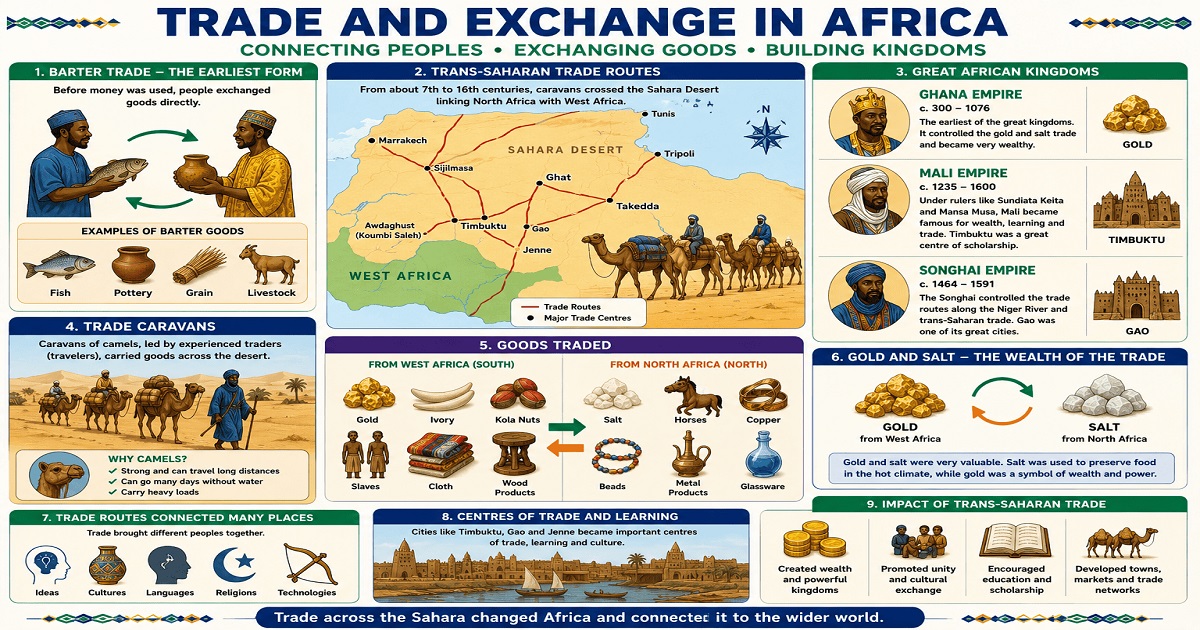
Trade in Africa began many thousands of years ago through the exchange of goods among local communities. Early African societies mainly used the barter system, where people exchanged goods directly without using money.
Internal trade involved the exchange of foodstuffs, livestock, minerals, cloth, salt, kola nuts, and craft products within local communities and regions.
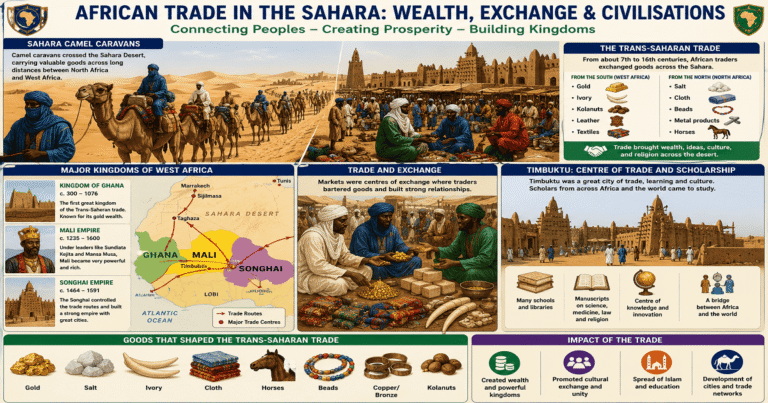
As trade expanded, African societies established external trade links with North Africa and the Mediterranean world. The most important long-distance trade network was the Trans-Saharan Trade.
The Trans-Saharan Trade connected West Africa with North Africa through desert trade routes. Important trade items included gold, salt, ivory, and slaves.
Several factors encouraged the growth of trade in Africa:
- Availability of resources such as gold and salt
- Presence of rivers, deserts, and coastlines
- Development of urban centres and kingdoms
- Cultural interactions and exchange of ideas
Trade routes became more organised and sophisticated over time. African kingdoms such as Ghana, Mali, and Songhai became wealthy because they controlled trade routes and collected taxes on traded goods.
The Trans-Saharan Trade also encouraged cultural exchange. Muslim traders introduced Islam into many African societies, leading to the spread of Islamic customs, education, and architecture.
Trade also influenced politics. Powerful rulers expanded their territories and established strong centralised governments through control of trade routes.
Urban centres developed as markets, mosques, and trading centres were built. Cities such as Timbuktu became famous for trade, scholarship, and learning.
Social changes also occurred because trade created opportunities for merchants and encouraged migration and interaction among different groups of people.
Domestic And External Trade In Africa
| Trade Type | Description | Examples |
|---|---|---|
| Domestic Trade | Trade within African communities | Foodstuffs and livestock |
| External Trade | Trade between Africa and other regions | Gold and salt exchange |
| Barter System | Exchange without money | Goods traded directly |
| Trans-Saharan Trade | Long-distance desert trade | Trade between West and North Africa |
Effects Of The Trans-Saharan Trade
| Effect | Explanation | Result |
|---|---|---|
| Economic Prosperity | Wealth from trade and taxes | Growth of kingdoms |
| Cultural Exchange | Spread of Islam and ideas | New customs and traditions |
| Political Power | Control of trade routes | Expansion of empires |
| Urbanisation | Development of trade cities | Growth of Timbuktu |
| Social Change | Movement and interaction of people | Diverse societies developed |
Worked Examples
Example 1
Scenario: A trader exchanges salt for gold in a West African market.
Explanation: This is an example of barter trade because goods are exchanged directly without the use of money.
Example 2
Scenario: A kingdom controls an important desert trade route.
Explanation: Control of trade routes increases wealth, political power, and influence, as seen in kingdoms such as Mali and Songhai.
Why This Topic Matters
Understanding early African trade helps learners appreciate Africa’s economic history, cultural interactions, and political development. It also explains how trade influenced modern ideas about economic justice, trade relations, and cultural diversity.
Quick Practice
- Define the barter system.
- List two goods traded during the Trans-Saharan Trade.
- Explain one effect of trade on African kingdoms.
Summary
Trade in Africa developed from local barter exchanges into organised domestic and external trade networks. The Trans-Saharan Trade connected West Africa with North Africa and contributed to economic prosperity, political influence, cultural exchange, urbanisation, and social change. African kingdoms such as Ghana, Mali, and Songhai became powerful through their involvement in trade.
Access NaCCA-aligned Support Packs
Download your structured NaCCA-aligned Teacher Support Pack and Student Learning Pack, designed for clarity, practicality, and reliable teaching and learning.