Supply And Types Of Supply Explained for SHS 1 Economics (Semester 2, Week 1).
Every day, goods appear in markets, but have you ever wondered how and why producers decide what to sell?
What You Will Learn.
- The meaning of supply.
- Different types of supply.
- How supply works in real-world situations.
Main Explanation.
Supply refers to the quantity of goods or services that producers are willing and able to offer for sale at different prices over a given period. It reflects how producers respond to price changes and market conditions. Supply can occur in the short-run, where some production factors are fixed, or in the long-run, where all factors can be adjusted.
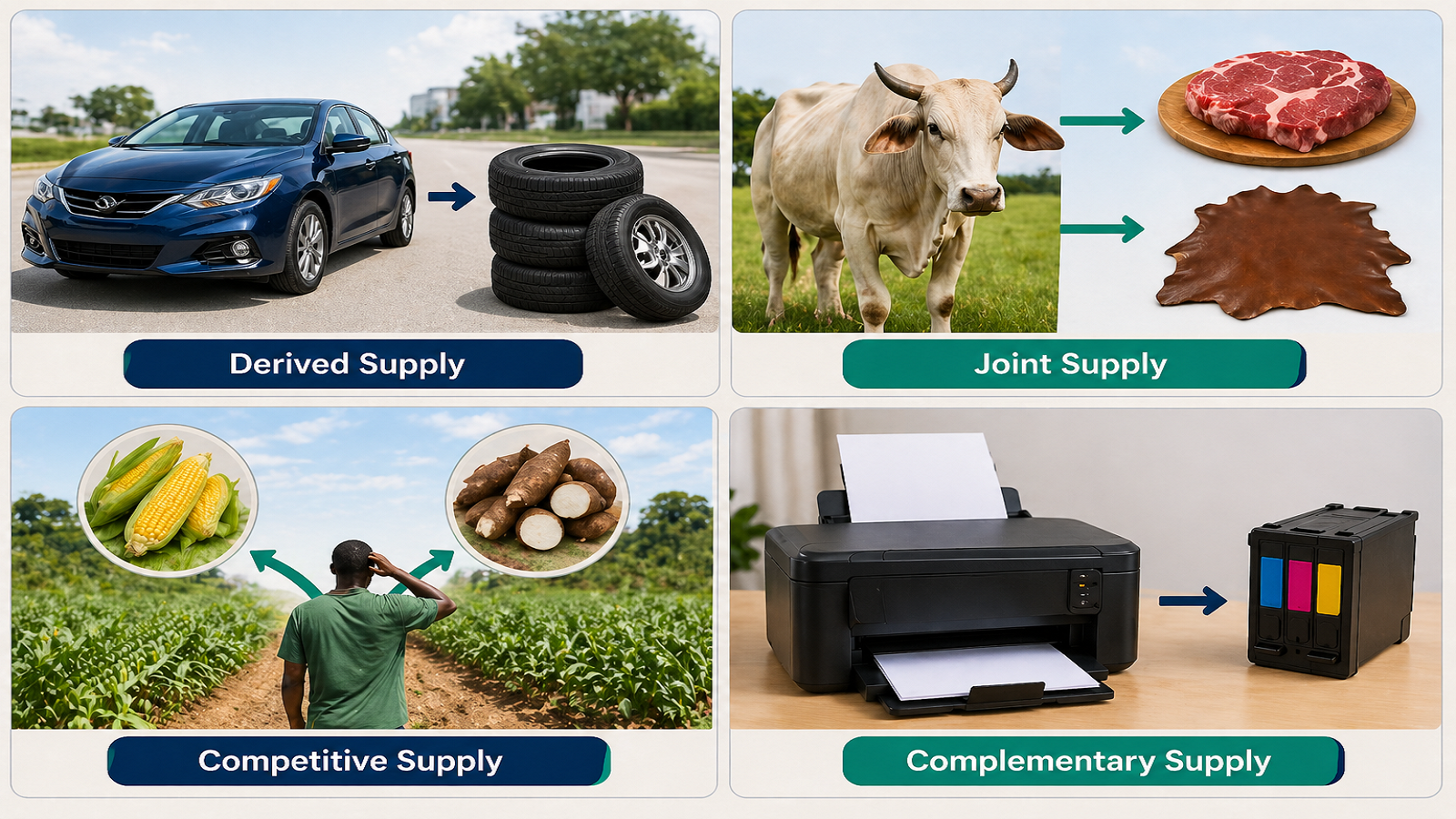
There are four main types of supply. Derived supply occurs when the production of a good depends on the demand for another good, such as car tyres depending on automobiles. Joint supply happens when one production process produces multiple outputs, like beef and hides. Competitive supply arises when producers shift resources between goods depending on profitability, such as farmers choosing between crops. Complementary supply exists when the production of one good supports another, like printers and ink cartridges.
In Ghana, supply is seen in cocoa production, gold mining, agriculture, electricity generation, and textile manufacturing. These examples show how producers respond to prices in both local and international markets.
Worked Examples
Example 1
Scenario: A cattle farm produces meat, hides, and bones at the same time.
Explanation: Since multiple products are produced from a single process, this is an example of joint supply.
Example 2
Scenario: A farmer decides to grow maize instead of cassava because maize prices are higher.
Explanation: The farmer is reallocating resources based on profitability, which demonstrates competitive supply.
Why This Topic Matters
Understanding supply helps individuals and businesses make better decisions about production and pricing. It also helps governments plan resource allocation and economic policies. In everyday life, supply affects the availability and cost of goods in markets.
Quick Practice
- What is supply?
- Name and explain two types of supply.
- Give one example of supply from Ghana.
Summary
Supply describes how much producers are willing and able to sell at different prices. It includes different forms such as derived, joint, competitive, and complementary supply. Understanding these types helps explain how goods are produced and distributed in the economy.
Access NaCCA-aligned Support Packs
Download your structured NaCCA-aligned Teacher Support Pack and Student Learning Pack, designed for clarity, practicality, and reliable teaching and learning.
Teacher Support Packs Student Learning Packs