Weathering And Processes Of Weathering Explained for SHS 1 Geography (Semester 2, Week 2)
Weathering is a natural process that breaks down rocks and helps shape the earth’s surface over time.
What You Will Learn
- The meaning of weathering
- Factors affecting weathering
- The three main weathering processes
- Examples of physical, chemical, and biological weathering
- The importance of weathering in geography
Main Explanation
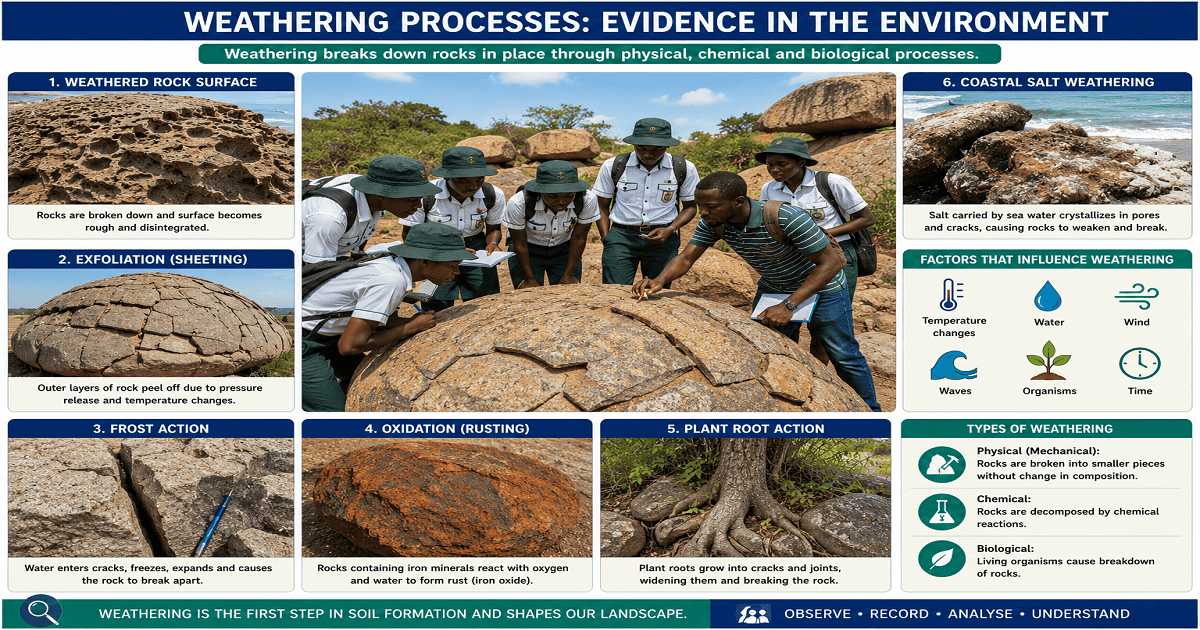
Weathering is the physical disintegration or chemical decomposition of rocks in situ, which means “in the same place.” Weathering changes landscapes and contributes to soil formation.
Several agents cause weathering, including water, acids, temperature changes, wind, plants, animals, and human activities.
The remains of weathered rocks are called regolith, while broken rock fragments collected at the base of rocks are called talus or screes.
Many factors affect weathering. These include climate, vegetation, rock type, mineral composition, topography, time, human activities, and the action of plants and animals.
There are three major weathering processes:
- Physical weathering
- Chemical weathering
- Biological weathering
Physical weathering breaks rocks without changing their chemical composition. Common examples include unloading, exfoliation, frost action, slaking, and salt weathering.
In deserts, repeated heating and cooling cause rocks to expand during the day and contract at night. Continuous stress causes rocks to crack and peel off in layers through exfoliation.
Frost action occurs when water enters rock cracks and freezes. Frozen water expands, widening the cracks and eventually breaking the rocks into fragments.
Salt weathering or haloclasty occurs in coastal and arid areas where salt crystals grow in rock pores and create stress.
Chemical weathering changes the chemical composition of rocks. Common processes include dissolution, oxidation, and hydrolysis.
Dissolution occurs when weak acids in rainwater dissolve rocks such as limestone. Oxidation happens when iron minerals react with oxygen and water, producing rust and weakening rocks.
Hydrolysis occurs when water reacts with minerals like feldspar and changes them into clay minerals.
Biological weathering involves living organisms breaking rocks apart. Plant roots widen cracks in rocks through root wedging, while animals such as termites and rodents burrow into rocks and soil.
Microorganisms such as fungi and bacteria also break down rocks through biodegradation, while lichens and mosses produce acids that decompose rock surfaces.
Factors Affecting Weathering
| Factor | Role | Effect |
|---|---|---|
| Climate | Controls temperature and rainfall | Determines weathering rate |
| Vegetation | Provides root activity | Increases biological weathering |
| Rock Type | Determines hardness | Affects resistance to weathering |
| Human Activities | Mining and construction | Accelerates weathering |
| Time | Length of exposure | Increases weathering effects |
Types Of Weathering
| Weathering Type | Example | Result |
|---|---|---|
| Physical | Frost action | Rock fragmentation |
| Chemical | Oxidation | Rusting and decomposition |
| Biological | Root wedging | Rock cracking |
| Salt Weathering | Haloclasty | Granular disintegration |
Worked Examples
Example 1
Scenario: Rocks in a desert crack after repeated exposure to hot days and cold nights.
Explanation: Repeated heating and cooling create stress in the rocks, leading to cracking and exfoliation.
Example 2
Problem: Explain how roots contribute to biological weathering.
- Roots grow into cracks in rocks.
- The roots expand as they grow.
- Pressure widens the cracks.
- The rocks eventually break apart.
Answer: Root growth causes rocks to crack and disintegrate through root wedging.
Why This Topic Matters
Weathering shapes landscapes, contributes to soil formation, and affects agriculture, construction, and environmental management. Understanding weathering helps learners explain natural landforms and environmental changes.
Quick Practice
- Define weathering.
- State two factors affecting weathering.
- Differentiate between physical and biological weathering.
Summary
Weathering is the breakdown of rocks through physical, chemical, and biological processes. Physical weathering causes mechanical breakdown, chemical weathering changes rock composition, and biological weathering involves living organisms. Weathering is influenced by climate, vegetation, rock type, human activities, and time, and it plays an important role in landscape development and soil formation.
Access NaCCA-aligned Support Packs
Download your structured NaCCA-aligned Teacher Support Pack and Student Learning Pack, designed for clarity, practicality, and reliable teaching and learning.