Weathering And Processes Of Weathering
Introduction
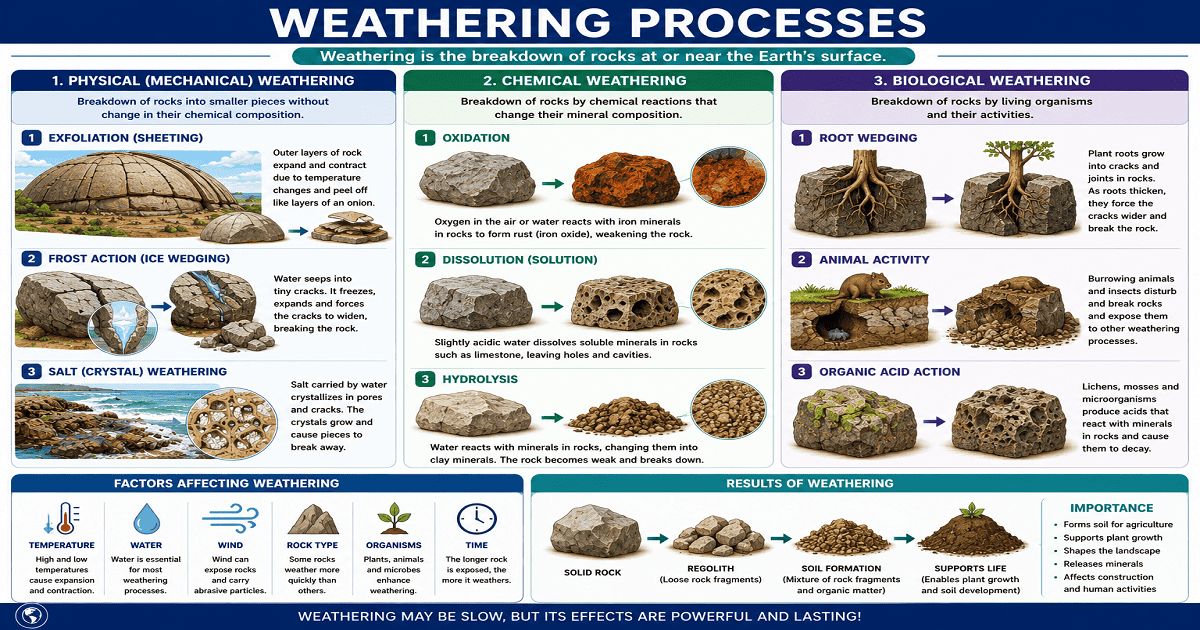
Weathering is an important geographical process that breaks down rocks and contributes to soil formation and landscape development. It involves physical disintegration and chemical decomposition of rocks in situ, meaning “in the same place.” Various agents such as water, temperature changes, plants, animals, wind, and acids contribute to weathering processes.
Key Concepts
- Weathering: The physical disintegration or chemical decomposition of rocks in situ.
- Denudation: The lowering and levelling of the earth’s surface.
- Regolith: The remains of a weathered environment.
- Talus Or Screes: Broken pieces of rocks collected at the base of a parent rock.
- Physical Weathering: Breakdown of rocks without changing their chemical composition.
- Chemical Weathering: Decomposition of rocks that changes their chemical composition.
- Biological Weathering: Breakdown of rocks through the activities of living organisms.
Explanation
Weathering is one of the major processes of denudation and contributes significantly to soil formation and landscape modification. The process occurs when rocks are exposed to weathering agents such as water, acids, wind, plants, animals, and changes in temperature.
Several factors affect the rate and intensity of weathering. These include:
- Climatic conditions
- Type of vegetation
- Type of rock and mineral composition
- Topography of the land
- Action of plants and animals
- Human activities
- Time
There are three major processes of weathering:
- Physical or mechanical weathering
- Chemical weathering
- Biological weathering
Physical weathering involves the breaking down of rocks without changing their chemical composition. This process is caused mainly by temperature changes, wetting and drying, frost action, unloading, and salt crystal growth.
Unloading occurs when surface materials are removed by erosion, reducing pressure on underlying rocks and causing expansion and fractures.
Repeated heating and cooling occur mostly in desert regions. During the day, rocks expand because of intense heat, and at night they contract rapidly due to falling temperatures. Continuous stress leads to cracking, exfoliation, and granular disintegration.
Repeated wetting and drying lead to slaking. Rocks absorb water and expand when wet, then shrink when dry. Repeated stress causes rocks to disintegrate or crumble.
Frost action or freeze-thaw action occurs when water enters cracks in rocks and freezes during cold conditions. Frozen water expands, widening the cracks and eventually breaking rocks into angular fragments.
Salt crystal growth, also called haloclasty, occurs mainly in coastal and arid areas. Salt crystals form in rock pores and expand when heated or saturated with water, creating stress that breaks down the rocks.
Chemical weathering involves the decomposition of rocks due to exposure to air and water, which changes the chemical composition of rocks. Processes of chemical weathering include dissolution, carbonation, oxidation, reduction, hydration, hydrolysis, and chelation.
Dissolution occurs when weak acids in rainwater dissolve rocks such as limestone and chalk. Carbonation is a form of dissolution affecting carbonate rocks.
Oxidation involves the reaction of iron minerals with oxygen and water, leading to rusting, discolouration, weakening, and fragmentation of rocks.
Hydrolysis occurs when hydrogen ions in water react with minerals such as feldspar, breaking them down into clay minerals like kaolinite.
Biological weathering involves living organisms breaking down rocks physically and chemically.
Examples include:
- Root wedging by plants
- Burrowing by animals such as termites and rodents
- Biodegradation by bacteria and fungi
- Lichen and moss growth
- Biomineralisation by organisms such as molluscs and corals
Factors Affecting Weathering
| Factor | Description | Effect On Weathering |
|---|---|---|
| Climate | Temperature and rainfall conditions | Controls rate of weathering |
| Vegetation | Plant cover and roots | Encourages biological weathering |
| Rock Type | Mineral composition and hardness | Determines resistance to weathering |
| Human Activities | Mining and construction | Accelerates rock breakdown |
| Time | Length of exposure | Increases degree of weathering |
Processes Of Weathering
| Type Of Weathering | Process | Result |
|---|---|---|
| Physical Weathering | Exfoliation and frost action | Rock fragmentation |
| Chemical Weathering | Oxidation and dissolution | Chemical decomposition |
| Biological Weathering | Root wedging and burrowing | Rock disintegration |
| Salt Weathering | Haloclasty | Granular disintegration |
Examples
Example 1
Problem: Explain how frost action causes weathering.
- Water enters cracks in rocks.
- Temperature falls and the water freezes.
- Frozen water expands and widens the cracks.
- Repeated freezing and thawing break the rock apart.
Final Answer: Frost action breaks rocks into angular fragments through repeated freezing and expansion of water in rock cracks.
Example 2
Problem: Explain the process of oxidation in weathering.
- Iron minerals react with oxygen and water.
- Rust forms on the rock surface.
- The rock becomes weak and discoloured.
Final Answer: Oxidation causes iron-bearing rocks to rust, weaken, and fragment.
Application and Activities
- Create a mind map showing the meaning, causes, effects, and factors affecting weathering.
- Observe weathering processes around the school environment.
- Discuss examples of physical, chemical, and biological weathering.
- Prepare field reports with photographs or sketches of weathered rocks.
Practice Questions
- Define weathering and explain its importance.
- Differentiate between physical and chemical weathering.
- Explain how biological weathering contributes to rock breakdown.
Summary
Weathering is the breakdown of rocks through physical, chemical, and biological processes. It contributes to soil formation, denudation, and landscape development. Physical weathering breaks rocks mechanically, chemical weathering changes rock composition, and biological weathering involves living organisms. Factors such as climate, vegetation, rock type, topography, and human activities influence weathering processes.
Access NaCCA-aligned Support Packs
Download your structured NaCCA-aligned Teacher Support Pack and Student Learning Pack, designed for clarity, practicality, and reliable teaching and learning.