Oral Language, Reading And Grammar Explained for SHS 2 English Language (Semester 2, Week 1)
Effective communication depends on how people speak, listen, read, summarise information, and construct sentences correctly.
What You Will Learn
- The meaning of stress and intonation
- How stress affects spoken meaning
- How intonation communicates emotion and purpose
- Steps involved in summary writing
- The difference between active and passive voice
- How to convert active sentences into passive sentences
Main Explanation
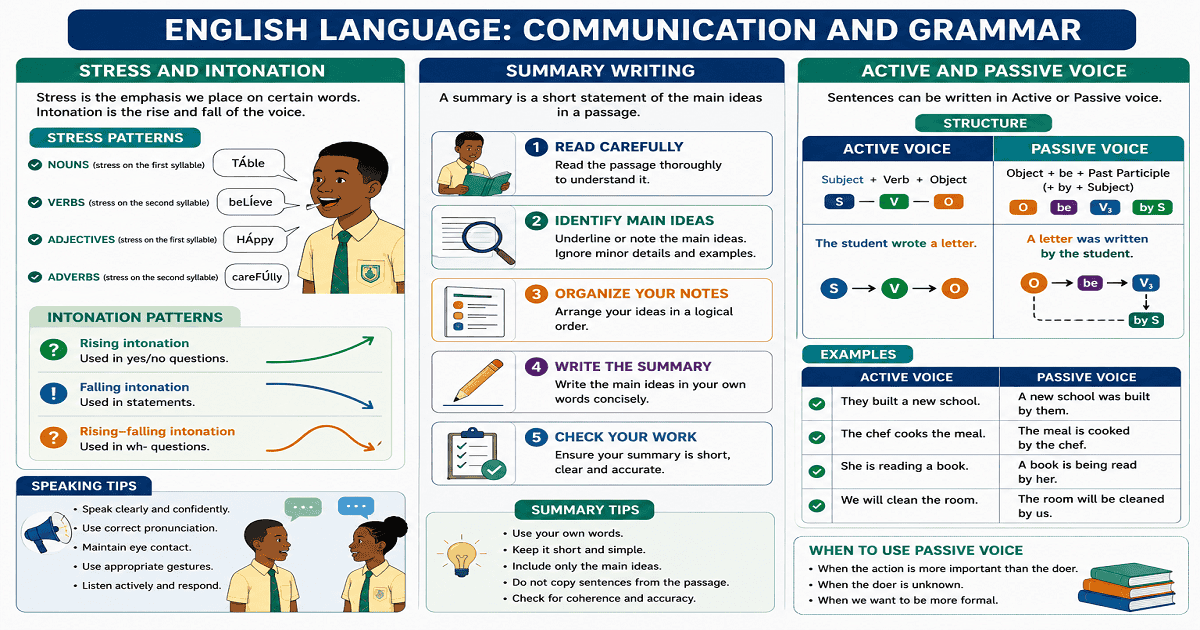
Stress in oral language refers to the emphasis placed on certain syllables or words. Stress can change meaning and improve understanding. For example, the word “record” changes meaning depending on which syllable is stressed.
Stress also changes sentence meaning. In spoken English, stressing different words can shift attention and emphasis. This helps listeners understand the speaker’s intention.
Intonation refers to changes in voice pitch during speech. Rising intonation is commonly used for questions, while falling intonation is often used for statements and commands.
Different intonation patterns express different emotions:
- Rising intonation may show uncertainty.
- Falling intonation may show certainty.
- Rise-fall intonation may express excitement or surprise.
- Fall-rise intonation may show politeness or hesitation.
Meaning in oral language involves understanding words, context, and speaker intention. Stress and intonation work together to make spoken communication clearer and more expressive.
Summary writing is the process of shortening a passage while preserving its main ideas. A good summary removes unnecessary details and presents information clearly and concisely.
The main steps in summary writing are:
- Read the passage carefully.
- Identify the key ideas.
- Ignore examples and extra details.
- Rewrite the important points briefly.
- Review the summary for accuracy.
Grammar also includes understanding active and passive voice. In active voice, the subject performs the action:
The girl swept the room.
In passive voice, the object receives the action:
The room was swept by the girl.
Converting active voice to passive voice involves changing the object into the subject and using the correct form of the verb “be” together with the past participle of the main verb.
Stress, Intonation, And Communication
| Feature | Description | Purpose |
|---|---|---|
| Stress | Emphasis on words or syllables | Changes focus and meaning |
| Intonation | Rise and fall of the voice | Expresses emotion and sentence type |
| Semantic Meaning | Literal word meaning | Communicates ideas |
| Pragmatic Meaning | Meaning from context | Shows speaker intention |
Active And Passive Voice Examples
| Active Voice | Passive Voice | Structure |
|---|---|---|
| I read that book. | That book was read by me. | Was/Were + V3 |
| He is writing a letter. | A letter is being written by him. | Is/Am/Are + being + V3 |
| She should help Sita. | Sita should be helped by her. | Should + be + V3 |
| They can help you. | You can be helped by them. | Can + be + V3 |
Worked Examples
Example 1
Scenario: A speaker says, “She’s coming?” with a rising intonation.
Explanation: The rising intonation changes the sentence into a question or expresses uncertainty.
Example 2
Problem: Convert the sentence “Ram loves Shyam” into passive voice.
- Identify the object “Shyam”.
- Move “Shyam” to the subject position.
- Use the correct form of “be”.
- Use the past participle “loved”.
- Add “by Ram”.
Answer: Shyam is loved by Ram.
Why This Topic Matters
Oral language, reading, and grammar are important for communication in school, work, and everyday life. Stress and intonation improve speaking and listening skills, summary writing helps learners process information effectively, and active and passive voice improve writing and grammatical accuracy.
Quick Practice
- Explain the difference between stress and intonation.
- List three steps involved in summary writing.
- Convert the sentence “He helped me” into passive voice.
Summary
Stress and intonation help speakers communicate meaning, emotion, and emphasis effectively. Summary writing focuses on condensing information into concise main points. Active and passive voice are important grammatical structures that improve sentence construction and communication skills. These concepts strengthen learners’ speaking, listening, reading, and writing abilities.
Access NaCCA-aligned Support Packs
Download your structured NaCCA-aligned Teacher Support Pack and Student Learning Pack, designed for clarity, practicality, and reliable teaching and learning.