
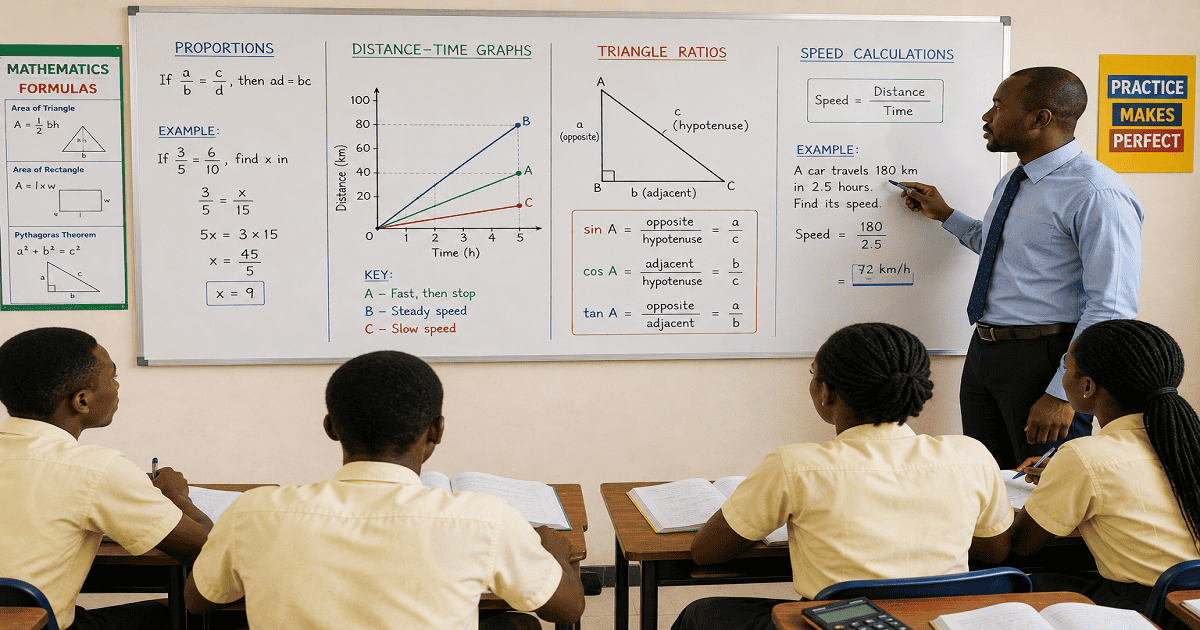
Applications Of Proportions Explained for SHS 2 Core Mathematics (Semester 2, Week 1)
Proportions are widely used in geometry, speed calculations, measurements, and many everyday activities.
What You Will Learn
- The meaning of proportions
- Applications of ratios in triangles
- How Pythagoras’ theorem relates to proportions
- How trigonometric ratios are used
- Interpretation of distance-time graphs
- How gradients represent speed
Main Explanation
Proportions compare two equal ratios or rates. They are useful in mathematics because they help describe relationships between quantities. Equivalent proportions may look different but still represent the same value.
One important application of proportions is in triangles. In a 30° : 60° : 90° triangle, the ratio of the interior angles is 1 : 2 : 3. The side lengths also follow the ratio 1 : √3 : 2.
For a 45° : 45° : 90° triangle, the angle ratio is 1 : 1 : 2, while the side lengths follow the ratio 1 : 1 : √2.
Pythagoras’ theorem is another important application:
a2 + b2 = c2
This theorem helps determine unknown sides in right-angled triangles.
Trigonometric ratios are also based on proportional relationships in triangles:
- sinθ = Opposite / Hypotenuse
- cosθ = Adjacent / Hypotenuse
- tanθ = Opposite / Adjacent
Proportions can also be used in practical situations such as mixing paint. For example, if paint colours are mixed in the ratio 3 : 1, every 3 parts of one colour require 1 part of another colour.
Distance-time graphs show how far an object travels over a period of time. Distance is plotted on the vertical axis while time is plotted on the horizontal axis.
The gradient of the graph represents speed:
Gradient = Change in distance / Change in time
A steeper graph means higher speed because more distance is covered in less time. A horizontal line means the object is not moving.
Applications Of Proportions And Graphs
| Concept | Formula/Ratio | Meaning |
|---|---|---|
| Pythagoras’ Theorem | a2 + b2 = c2 | Used in right-angled triangles |
| Gradient | Distance / Time | Represents speed |
| 30° : 60° : 90° Triangle | 1 : 2 : 3 | Angle ratio |
| 45° : 45° : 90° Triangle | 1 : 1 : 2 | Angle ratio |
| Trigonometric Ratios | sin, cos, tan | Ratios in triangles |
Worked Examples
Example 1
Problem: Godfred mixes red, blue, and white paint in the ratio 2 : 1 : 1 to make 20 litres of paint.
- Add the ratio parts: 2 + 1 + 1 = 4 parts.
- Each part = 20 / 4 = 5 litres.
- Red = 2 × 5 = 10 litres.
- Blue = 1 × 5 = 5 litres.
- White = 1 × 5 = 5 litres.
Answer: Red = 10 litres, Blue = 5 litres, White = 5 litres.
Example 2
Scenario: A runner covers 8 km in 40 minutes.
Explanation: The speed can be determined from the gradient of the distance-time graph. The speed is 12 km/h or 3.33 m/s.
Why This Topic Matters
Applications of proportions are useful in construction, transportation, engineering, sports, science, and business. Distance-time graphs help people understand movement, speed, and acceleration, while proportions are important in geometry, scaling, and measurements.
Quick Practice
- Calculate the speed of an object that travels 45 km in 3 hours.
- State what a horizontal line represents on a distance-time graph.
- Find the ratio of side lengths in a 30° : 60° : 90° triangle.
Summary
Applications of proportions involve comparing equal ratios and rates in mathematics and real-life situations. Proportions are used in triangles, trigonometry, paint mixing, and distance-time graphs. The gradient of a distance-time graph represents speed, while graph shapes help explain motion and acceleration. These concepts help learners solve practical mathematical problems.
Access NaCCA-aligned Support Packs
Download your structured NaCCA-aligned Teacher Support Pack and Student Learning Pack, designed for clarity, practicality, and reliable teaching and learning.