
Calculation, Uses And Importance Of National Income Explained for SHS 2 Economics (Semester 2, Week 6)
National income provides valuable information about a country’s economic performance, living standards, and development progress.
What You Will Learn
- The meaning of national income
- The income approach to calculating national income
- The expenditure approach to calculating national income
- The uses of national income
- The importance of national income in economic development
Main Explanation
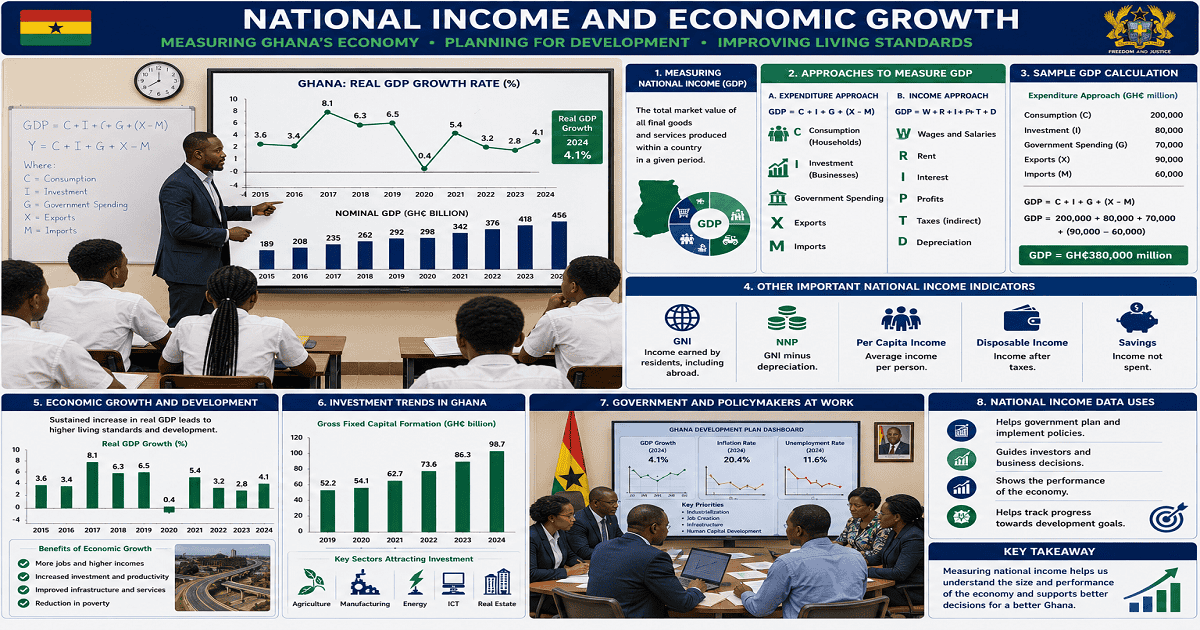
National income represents the total monetary value of goods and services produced and incomes earned within a country during a specific period. It includes wages, rent, interest, and profits generated by individuals, businesses, and government institutions.
Economists use different methods to calculate national income. One of the most common methods is the income approach, which adds together all incomes earned by factors of production. These incomes include wages and salaries, rents, interest, and profits. Adjustments are then made for indirect taxes, subsidies, depreciation, and net factor income from abroad.
The second major method is the expenditure approach, which measures total spending on final goods and services. This method includes consumption, investment, government expenditure, and net exports.
The GDP formula under the expenditure approach is:
GDP = C + I + G + (X − M)
Where consumption represents household spending, investment covers capital expenditure, government spending includes public sector purchases, and net exports represent exports minus imports.
National income has many practical uses. Governments use it to prepare budgets, formulate fiscal and monetary policies, allocate resources efficiently, and monitor economic growth.
National income also helps compare economic performance across countries and over time. Economists use per capita income derived from national income to assess standards of living and identify regional inequalities.
Businesses and investors use national income information to make investment decisions, while international organisations use it when assessing eligibility for loans, grants, and development assistance.
National income is equally important because it reflects the health of an economy, influences employment levels, supports public services, guides taxation policies, and promotes sustainable economic growth. Ghana uses national income data to support initiatives such as economic development programs, healthcare improvements, educational investments, and infrastructure projects.
Methods Of Calculating National Income
| Method | Calculation Basis | Main Components |
|---|---|---|
| Income Approach | Income earned | Wages, rents, interest, profits |
| Expenditure Approach | Total spending | Consumption, investment, government spending, net exports |
Uses Of National Income
| Use | Purpose | Benefit |
|---|---|---|
| Economic Planning | Policy formulation | Supports development |
| Performance Measurement | Assess economic growth | Tracks progress |
| Living Standards | Measure per capita income | Evaluates welfare |
| Investment Decisions | Guide resource allocation | Promotes growth |
| International Relations | Support aid and loan decisions | Improves cooperation |
Worked Examples
Example 1
Scenario: A government wants to evaluate whether economic growth targets have been achieved.
Explanation: National income data can be used to measure economic performance and compare actual growth with planned targets.
Example 2
Scenario: A country wants to determine whether living standards are improving.
Explanation: Economists can use national income and per capita income data to assess improvements in welfare and living standards.
Why This Topic Matters
National income is one of the most important indicators used by economists, governments, businesses, and international organisations. It helps guide economic planning, supports policy formulation, promotes development, and enables countries to measure progress over time.
Quick Practice
- State the formula for GDP using the expenditure approach.
- List two components of the income approach.
- Explain one importance of national income.
Summary
National income measures the total value of goods and services produced and incomes earned within an economy. It can be calculated using the income approach and the expenditure approach. National income supports economic planning, measures economic performance, assesses living standards, guides investment decisions, and promotes economic stability and growth. It remains an essential tool for understanding and managing economic development.
Access NaCCA-aligned Support Packs
Download your structured NaCCA-aligned Teacher Support Pack and Student Learning Pack, designed for clarity, practicality, and reliable teaching and learning.