
Oral Language, Grammar And Writing Explained for SHS 2 English Language (Semester 2, Week 2)
Effective communication depends not only on the words we use but also on how we use them. Understanding communication cues, registers, and persuasive writing helps learners communicate clearly and confidently.
What You Will Learn
- The meaning and types of communication cues
- Euphemistic expressions, proverbs, and idiomatic expressions
- The different types of registers
- The importance of using appropriate vocabulary
- The structure and features of debate writing
Main Explanation
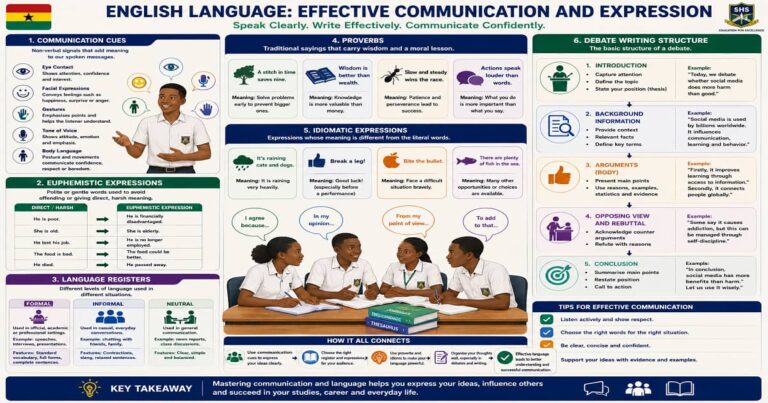
Communication involves more than spoken words. Communication cues help speakers and listeners understand messages effectively. These cues may be verbal, non-verbal, environmental, or social. They contribute to clarity, emotional expression, and successful interactions.
Euphemistic expressions are used to replace words that may sound harsh or offensive. Expressions such as “passed away” and “financially challenged” make communication more polite and socially acceptable.
Proverbs are expressions that communicate wisdom and moral lessons. They are often brief and metaphorical. Proverbs help speakers emphasise ideas and make communication memorable.
Idiomatic expressions are phrases with figurative meanings. Their meanings cannot be understood from the individual words alone. Examples include “Bite the bullet” and “Under the weather”. Idioms enrich language and improve fluency.
Registers refer to the style of language used in different situations. Formal, informal, technical, colloquial, frozen, and intimate registers serve different communication purposes. Choosing the correct register improves professionalism and clarity.
Debate writing is a structured and persuasive form of writing. It requires an introduction, supporting arguments, counter-arguments, and a conclusion. Good debate writing presents evidence and anticipates opposing viewpoints.
Communication Cues And Registers
| Concept | Function | Examples |
|---|---|---|
| Communication Cues | Improve understanding | Tone, body language, eye contact |
| Euphemisms | Promote politeness | Passed away, senior citizen |
| Proverbs | Communicate wisdom | Actions speak louder than words |
| Idioms | Enhance expression | Break the ice, bite the bullet |
| Registers | Suit communication contexts | Formal, technical, colloquial |
Worked Examples
Example 1
Scenario: A student says, “I am under the weather.”
Explanation: The statement is an idiomatic expression meaning the person is feeling unwell rather than describing the weather.
Example 2
Scenario: A speaker uses the proverb “Actions speak louder than words.”
Explanation: The proverb emphasises that people’s behaviour is more important than their promises or statements.
Why This Topic Matters
Mastering communication cues, vocabulary registers, and persuasive writing enables learners to communicate effectively in academic, professional, and social settings. It also improves cultural understanding and strengthens language proficiency.
Quick Practice
- State two types of communication cues.
- Differentiate between idioms and proverbs.
- List the four components of debate writing.
Summary
Oral language, grammar, and writing are essential components of effective communication. Communication cues, euphemisms, proverbs, idioms, and registers help speakers express ideas appropriately, while debate writing develops critical thinking and persuasive communication skills.
Access NaCCA-aligned Support Packs
Download your structured NaCCA-aligned Teacher Support Pack and Student Learning Pack, designed for clarity, practicality, and reliable teaching and learning.