Oral Language, Grammar And Writing
Introduction
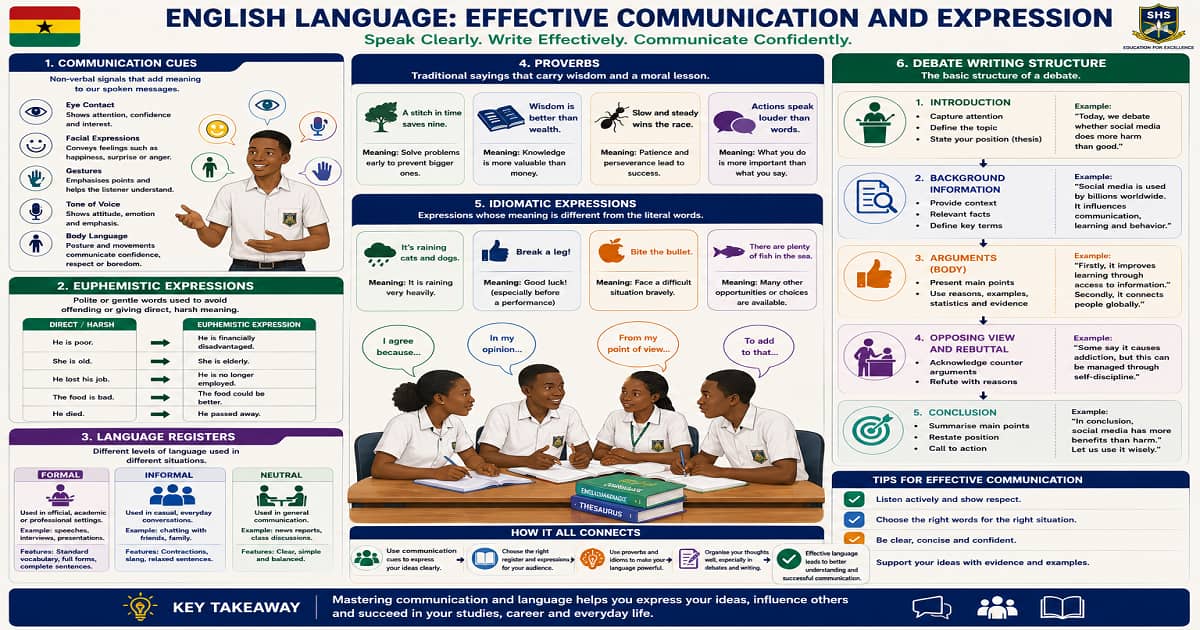
This week’s lessons focus on Oral Language, Grammar, and Writing. The oral language component covers cues in communication, euphemistic expressions, proverbs, and idiomatic expressions. The grammar aspect focuses on registers and appropriate vocabulary use in different contexts, while the writing component examines debate writing and its features. These areas help learners improve communication, vocabulary usage, and persuasive writing skills.
Key Concepts
- Communication Cues: Signals or indicators that provide information about a message being conveyed.
- Euphemistic Expressions: Words or phrases used to replace harsh, unpleasant, or offensive expressions.
- Proverbs: Short expressions that communicate wisdom, truths, or moral lessons.
- Idiomatic Expressions: Expressions whose meanings are figurative rather than literal.
- Register: A variety or style of language associated with a particular context or social setting.
- Debate Writing: A form of persuasive writing used to present and defend a position on a topic.
Explanation
Communication cues are verbal and non-verbal signals that help people understand messages and regulate interactions. They include verbal cues, non-verbal cues, environmental cues, and social cues. These cues improve communication by clarifying messages, expressing emotions, regulating interactions, building relationships, and reducing misunderstandings.
| Type Of Communication Cue | Examples | Purpose |
|---|---|---|
| Verbal Cues | Content, tone of voice, pace, volume | Convey emotions and meaning |
| Non-Verbal Cues | Body language, facial expressions, eye contact | Enhance understanding |
| Environmental Cues | Context, artefacts | Provide situational information |
| Social Cues | Social norms, cultural cues | Guide communication behaviour |
Euphemistic expressions soften unpleasant or offensive statements. Examples include “passed away” instead of “died”, “senior citizen” instead of “old person”, and “financially challenged” instead of “poor”. These expressions help maintain politeness and social acceptability.
Proverbs are concise expressions that communicate wisdom and practical advice. They often use figurative language and reflect cultural values. Examples include “Actions speak louder than words” and “A stitch in time saves nine”. Proverbs strengthen communication and make messages memorable.
Idiomatic expressions have meanings that cannot be understood from the literal meanings of individual words. Examples include “Break the ice”, “Kick the bucket”, and “Bite the bullet”. Idioms make language expressive but may present difficulties in understanding and translation.
Register refers to the variety of language used in different situations. The major types include formal, informal, technical, colloquial, frozen, and intimate registers. Appropriate register enhances effective communication and professionalism.
| Type Of Register | Description | Examples |
|---|---|---|
| Formal Register | Precise and professional language | Official documents, academic writing |
| Informal Register | Casual language | Conversations with friends |
| Technical Register | Specialised vocabulary | Scientific journals, manuals |
| Colloquial Register | Everyday conversational language | Slang and regional dialects |
| Frozen Register | Fixed expressions | National anthems and oaths |
| Intimate Register | Private communication | Terms of endearment |
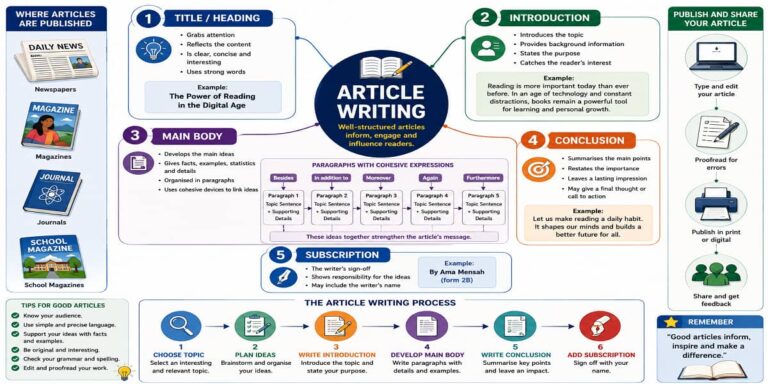
Debate writing is a persuasive form of writing used to defend a position on an issue. It consists of an introduction, arguments, counter-arguments, and conclusion. Effective debate writing requires critical thinking and strong supporting evidence.
| Component | Description | Purpose |
|---|---|---|
| Introduction | Presents the topic and position | Provides context |
| Arguments | Main supporting points | Defends the position |
| Counter-Arguments | Responds to opposing views | Weakens the opposition |
| Conclusion | Summarises the arguments | Leaves a lasting impression |
Examples
Example 1
Problem: Explain the meaning of the idiom “Break the ice”.
- Identify the expression.
- Determine its figurative meaning.
- Apply it in communication.
Final Answer: “Break the ice” means initiating conversation or reducing tension in a social setting.
Example 2
Problem: State two features of proverbs.
- Identify characteristics of proverbs.
- Explain their functions.
Final Answer: Proverbs are concise and often use metaphorical language to convey wisdom and practical advice.
Practice Questions
- Define communication cues.
- Differentiate between proverbs and idiomatic expressions.
- Explain the four components of debate writing.
Summary
The week focuses on oral language, grammar, and writing. Learners study communication cues, euphemistic expressions, proverbs, and idiomatic expressions. They also learn different registers and their uses in various contexts. The writing section introduces debate writing and its major components. These areas contribute to effective communication, vocabulary development, and persuasive writing skills.
Access NaCCA-aligned Support Packs
Download your structured NaCCA-aligned Teacher Support Pack and Student Learning Pack, designed for clarity, practicality, and reliable teaching and learning.