Oral Language And Grammar
Introduction
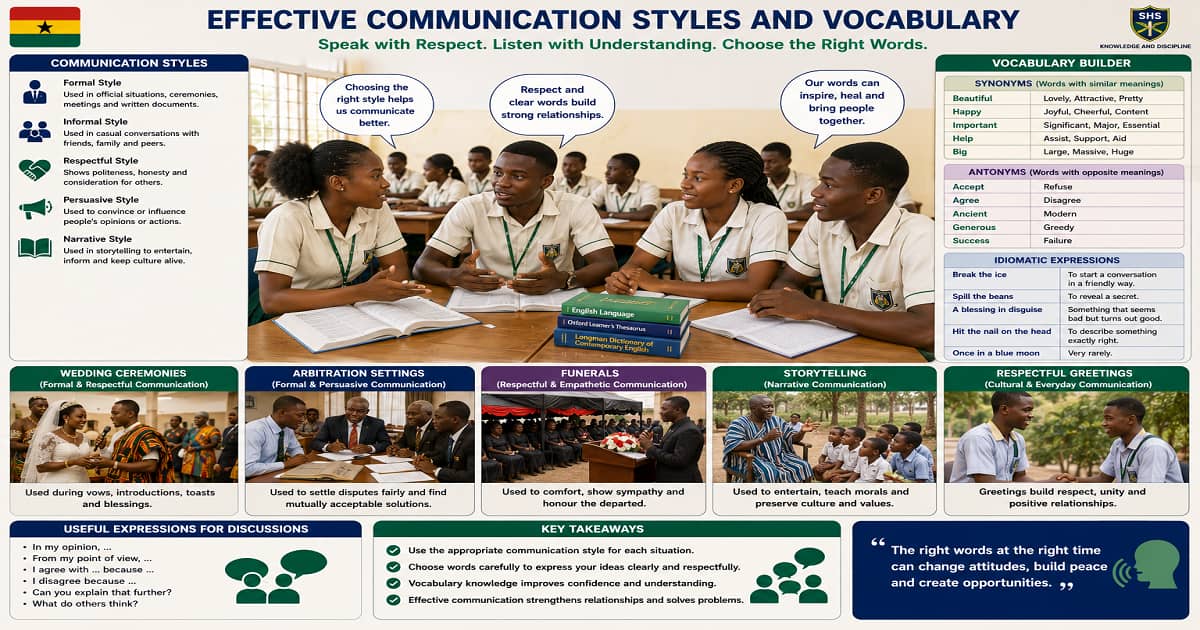
This week’s lessons focus on Oral Language and Grammar. The Oral Language component examines cultural perspectives in communication, particularly in contexts such as weddings, marriages, arbitration, and funerals. The Grammar component focuses on vocabulary in context and how vocabulary improves effective communication in speaking, writing, and reading.
Key Concepts
- Cultural Perspectives in Communication: Ways in which cultural backgrounds and values influence communication.
- High-Context Culture: A culture that relies heavily on relationships, shared experiences, and contextual meaning.
- Indirect Communication: A communication style used to avoid confrontation and maintain harmony.
- Vocabulary: The collection of words and expressions used to communicate effectively.
- Connotation: The emotional or cultural associations attached to words.
- Registers: Formal and informal language variations used in different contexts.
- Semantic Relationships: Connections among words, including synonyms, antonyms, and hyponyms.
Explanation
Cultural perspectives play a significant role in communication because people’s beliefs, traditions, and social values influence how they interpret messages. Communication styles differ across societies in areas such as directness, emotional expression, punctuality, power relationships, and the use of non-verbal cues. Understanding these differences helps individuals communicate effectively and build stronger relationships.
In Ghana, communication reflects cultural values such as collective living, respect for authority, politeness, hospitality, and harmony. Ghanaians often use indirect communication to avoid conflict and preserve relationships. Storytelling, non-verbal cues, and emotional expression are important aspects of communication in Ghanaian society.
| Aspect Of Ghanaian Communication | Description | Examples |
|---|---|---|
| Respect For Authority | Use of titles and honorifics | Nana, Nii, Torgbui |
| Indirect Communication | Avoiding confrontation | Please, Sorry, Calm down |
| Non-Verbal Cues | Body language and gestures | Bowing when greeting elders |
| Storytelling | Sharing wisdom and values | Marriage and traditional ceremonies |
| Hospitality | Welcoming guests warmly | Community gatherings |
Communication styles vary according to different ceremonies. Weddings combine formal and informal language and emphasize celebration and unity. Arbitration encourages active listening and indirect communication to promote compromise. Funerals require respectful and sympathetic expressions, while traditional festivals involve vibrant and celebratory communication. These communication styles help maintain social harmony and preserve cultural values.
| Ceremony | Communication Style | Main Emphasis |
|---|---|---|
| Wedding | Formal and informal communication | Unity and celebration |
| Arbitration | Indirect and respectful communication | Conflict resolution |
| Funeral | Sombre and respectful communication | Condolence and support |
| Traditional Festivals | Vibrant communication | Cultural celebration |
| Chiefs’ Gatherings | Formal communication | Respect and authority |
Cultural perspectives in communication are important because they preserve traditions, promote respect, strengthen social cohesion, express cultural identity, and facilitate effective communication. They also ensure cultural continuity and adaptability.
Vocabulary refers to the collection of words and phrases that individuals use to communicate effectively. Vocabulary includes meanings of words, word usage, contextualization, connotations, synonyms, antonyms, idioms, collocations, registers, and semantic relationships. A rich vocabulary enables individuals to express themselves accurately and improve comprehension in academic, professional, and social contexts.
| Vocabulary Component | Description | Example |
|---|---|---|
| Synonyms | Words with similar meanings | Happy and joyful |
| Antonyms | Words with opposite meanings | Hot and cold |
| Idioms | Expressions with figurative meanings | Break the ice |
| Collocations | Words commonly used together | Heavy rain |
| Semantic Relationships | Connections among words | Apple as a hyponym of fruit |
Examples
Example 1
Problem: Explain why indirect communication is commonly used in Ghana.
- Consider the purpose of indirect communication.
- Relate it to Ghanaian cultural values.
- Determine its effect on relationships.
Final Answer: Indirect communication helps avoid conflict, maintain harmony, and preserve relationships in Ghanaian society.
Example 2
Problem: Differentiate between synonyms and antonyms.
- Define synonyms.
- Define antonyms.
- Compare the two concepts.
Final Answer: Synonyms are words with similar meanings, while antonyms are words with opposite meanings.
Application and Activities
- Discuss communication styles used during weddings, funerals, and arbitration in your community.
- Identify examples of honorifics and respectful expressions used in Ghanaian society.
- Find synonyms and antonyms for selected words.
- Create dialogues that demonstrate appropriate vocabulary in context.
Practice Questions
- State three characteristics of Ghanaian communication.
- Explain the importance of cultural perspectives in communication.
- Differentiate between synonyms and antonyms.
Summary
The week’s lessons focus on cultural perspectives in communication and vocabulary in context. Cultural values influence communication styles and contribute to social harmony and cultural continuity. Vocabulary development improves comprehension and communication skills by enabling individuals to use words accurately and effectively in different contexts.
Access NaCCA-aligned Support Packs
Download your structured NaCCA-aligned Teacher Support Pack and Student Learning Pack, designed for clarity, practicality, and reliable teaching and learning.