Introduction To National Income And Calculation Using The Product Approach
Introduction
National income is a measure of the total economic activity of a country. It represents the total monetary value of all goods and services produced by a country over a specific period, usually one year. It includes wages, interest, rent, and profits earned by individuals, businesses, and government from home and abroad. National income is used to assess economic performance, formulate policies, make international comparisons, and evaluate the standard of living and economic well-being of the population.
Key Concepts
- National Income: The total monetary value of goods and services produced and incomes earned within a country over a specific period.
- Gross Domestic Product (GDP): The total value of all goods and services produced within a country’s borders.
- Gross National Product (GNP): GDP plus net income from abroad.
- Net National Product (NNP): GNP minus depreciation.
- Depreciation: The loss in value of fixed assets due to wear and tear, damage, or obsolescence.
- Indirect Taxes: Taxes imposed on goods and services such as VAT, excise duties, and NHIL.
- Subsidies: Financial assistance provided by government to reduce production costs.
- Product Approach: A method of calculating national income by measuring the value of output produced by different sectors of the economy.
- Gross Value Added (GVA): Gross output minus intermediate consumption.
- Net Factor Income From Abroad (NFIA): Income earned from abroad minus income paid abroad.
Explanation
National income can be measured using three approaches: the product or output approach, the income approach, and the expenditure approach. This lesson focuses on the product approach.
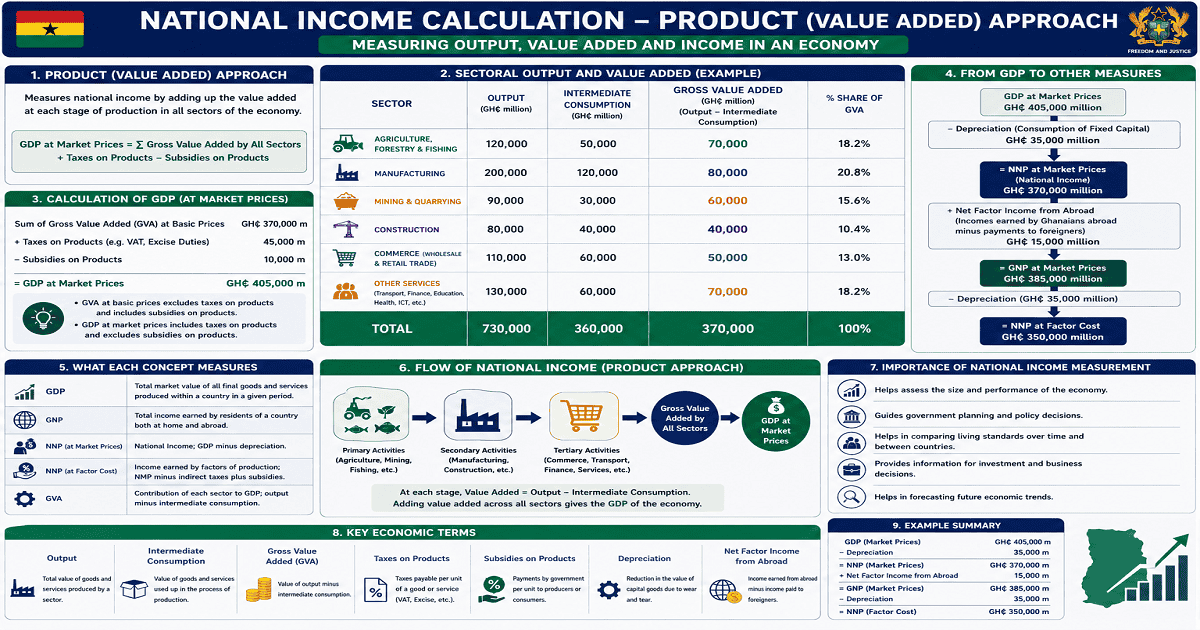
The product approach, also known as the output approach, calculates national income by measuring the total value of goods and services produced within a country during a specified period. It focuses on the output generated by various sectors of the economy.
The steps involved in the product approach are:
- Identify and classify production into sectors such as agriculture, manufacturing, construction, mining, commerce, and services.
- Measure the gross value of output produced by each sector.
- Determine the value of intermediate goods and services used in production.
- Subtract intermediate consumption from gross output to obtain Gross Value Added (GVA).
- Sum the GVA of all sectors to obtain Gross Domestic Product (GDP).
- Adjust for depreciation, net factor income from abroad, indirect taxes, and subsidies to obtain other national income measures.
The product approach avoids double counting by subtracting intermediate consumption from gross output. This ensures that only the value added at each stage of production is included in national income calculations.
The relationship among the various national income measures is as follows:
- GDP = Total Output + Net Indirect Taxes
- GNP = GDP + Net Factor Income From Abroad
- NNP = GNP − Depreciation
- NNP at Factor Cost = NNP − Net Indirect Taxes
National income provides information about the productive capacity of an economy and helps governments and economists assess economic growth and development.
National Income Measures
| Measure | Definition | Formula |
|---|---|---|
| GDP | Total output produced within a country | Total Output + Net Indirect Taxes |
| GNP | GDP plus income from abroad | GDP + NFIA |
| NNP | GNP after depreciation | GNP − Depreciation |
| NNP At Factor Cost | NNP adjusted for taxes and subsidies | NNP − Net Indirect Taxes |
Steps In The Product Approach
| Step | Activity | Purpose |
|---|---|---|
| 1 | Classify sectors | Identify production activities |
| 2 | Measure gross output | Determine production value |
| 3 | Calculate intermediate consumption | Avoid double counting |
| 4 | Compute GVA | Measure value added |
| 5 | Sum GVA | Obtain GDP |
| 6 | Make adjustments | Calculate GNP and NNP |
Worked Product Approach Example
| Sector | Output (Million GH¢) |
|---|---|
| Manufacturing | 840 |
| Mining | 420 |
| Agriculture | 350 |
| Construction | 200 |
| Commerce | 100 |
Total Sector Output = 840 + 420 + 350 + 200 + 100 = 1,910 million GH¢
Net Indirect Taxes = 80 − 100 = −20 million GH¢
GDP = 1,910 + (−20) = 1,890 million GH¢
GNP = 1,890 + 180 = 2,070 million GH¢
NNP = 2,070 − 90 = 1,980 million GH¢
NNP At Factor Cost = 1,980 + 20 = 2,000 million GH¢
Examples
Example 1
Problem: Calculate Gross National Product when GDP is 1,890 million GH¢ and Net Factor Income From Abroad is 180 million GH¢.
- Identify GDP.
- Identify NFIA.
- Add NFIA to GDP.
Final Answer: GNP = 1,890 + 180 = 2,070 million GH¢.
Example 2
Problem: Calculate Net National Product when GNP is 2,070 million GH¢ and depreciation is 90 million GH¢.
- Identify GNP.
- Subtract depreciation.
- Compute NNP.
Final Answer: NNP = 2,070 − 90 = 1,980 million GH¢.
Application and Activities
- Classify economic activities into productive sectors.
- Calculate GDP using sectoral output data.
- Determine GNP and NNP using national income statistics.
- Discuss the importance of avoiding double counting in national income calculations.
Practice Questions
- Define national income.
- Explain the product approach to calculating national income.
- State the differences between GDP, GNP, and NNP.
Summary
National income measures the total economic activity of a country. The product approach calculates national income by measuring the value of output produced by different sectors and summing the gross value added. Adjustments for net factor income from abroad, depreciation, indirect taxes, and subsidies help derive GDP, GNP, NNP, and NNP at factor cost. The approach provides important information for assessing economic performance and development.
Access NaCCA-aligned Support Packs
Download your structured NaCCA-aligned Teacher Support Pack and Student Learning Pack, designed for clarity, practicality, and reliable teaching and learning.