Introduction To National Income And Calculation Using The Product Approach Explained for SHS 2 Economics (Semester 2, Week 5)
How do economists determine the total value of goods and services produced in a country? One important method is the product approach to calculating national income.
What You Will Learn
- The meaning of national income
- The different measures of national income
- The product approach to calculating national income
- The concepts of GDP, GNP, and NNP
- How output data is used to measure economic performance
Main Explanation
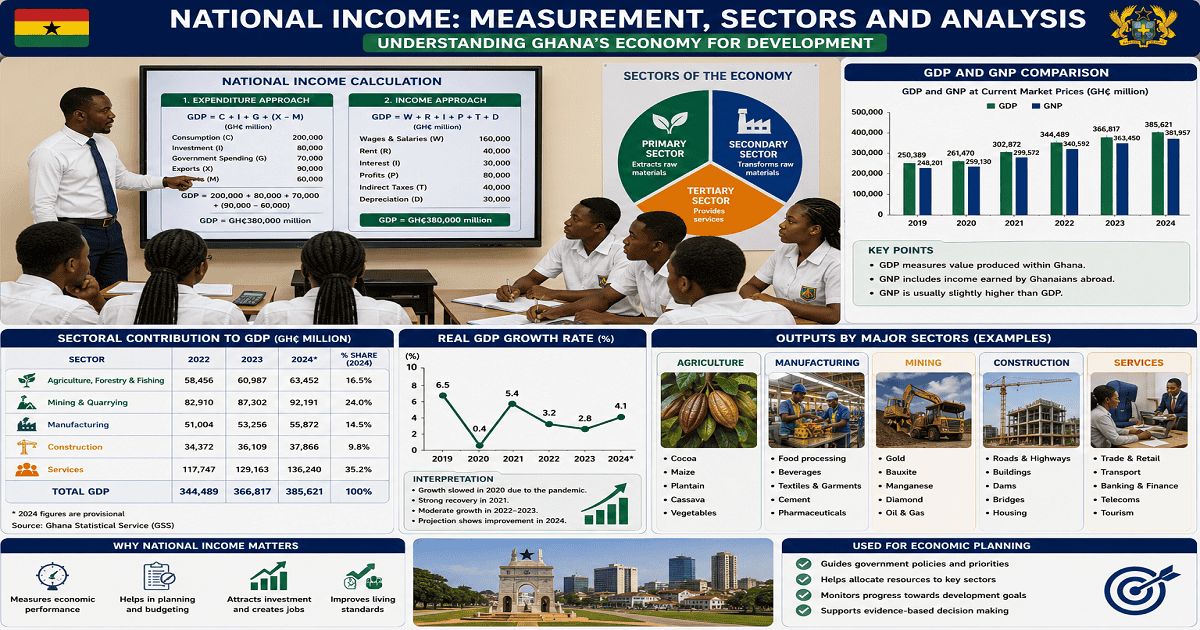
National income is a measure of the total economic activity of a country. It represents the total monetary value of all goods and services produced within a given period and includes incomes such as wages, rent, interest, and profits. Economists use national income to assess economic performance, compare economies, and evaluate standards of living.
There are three main approaches used to calculate national income:
- Product or Output Approach
- Income Approach
- Expenditure Approach
The product approach focuses on the value of output produced by different sectors of the economy. Sectors such as agriculture, mining, manufacturing, construction, commerce, and services contribute to national output.
To apply the product approach, economists first determine the gross value of output produced by each sector. They then subtract intermediate consumption to obtain Gross Value Added (GVA). The total GVA from all sectors gives the Gross Domestic Product (GDP).
Additional adjustments are made to derive other national income measures:
- GNP = GDP + Net Factor Income From Abroad
- NNP = GNP − Depreciation
- NNP At Factor Cost = NNP − Net Indirect Taxes
Depreciation represents the loss in value of fixed assets over time, while indirect taxes include taxes such as VAT, excise duties, and NHIL. Subsidies are government payments that support production and reduce costs.
By calculating national income, governments can monitor economic growth, formulate policies, and improve economic planning.
National Income Measures
| Measure | Description | Purpose |
|---|---|---|
| GDP | Total domestic production | Measures economic output |
| GNP | GDP plus foreign income | Measures national production |
| NNP | GNP after depreciation | Measures net production |
| NNP At Factor Cost | NNP adjusted for taxes and subsidies | Measures income earned by factors |
Product Approach Process
| Stage | Activity | Outcome |
|---|---|---|
| Sector Classification | Identify productive sectors | Organised output data |
| Output Measurement | Calculate sector output | Gross output value |
| Value Added Calculation | Subtract intermediate consumption | Gross Value Added |
| Aggregation | Add sector GVAs | GDP determination |
| Adjustments | Include taxes, subsidies, depreciation, and NFIA | GNP and NNP determination |
Worked Examples
Example 1
Problem: Calculate GNP when GDP is 1,890 million GH¢ and NFIA is 180 million GH¢.
- Identify GDP.
- Identify NFIA.
- Add NFIA to GDP.
Answer: GNP = 1,890 + 180 = 2,070 million GH¢.
Example 2
Scenario: A country experiences significant depreciation of capital assets.
Explanation: Depreciation reduces the value of Net National Product because part of the country’s production must be used to replace worn-out capital goods.
Why This Topic Matters
National income measurement helps governments understand economic performance and make informed decisions. The product approach provides valuable information about the contribution of different sectors to economic growth and helps identify areas requiring policy attention and investment.
Quick Practice
- Define GDP.
- State one difference between GDP and GNP.
- Explain why intermediate consumption is subtracted in the product approach.
Summary
National income measures the total economic activity of a country. The product approach calculates national income by measuring output from different sectors and determining the value added by each sector. Through adjustments for net factor income from abroad, depreciation, indirect taxes, and subsidies, economists derive GDP, GNP, NNP, and NNP at factor cost. These measures provide essential information for economic planning and development.
Access NaCCA-aligned Support Packs
Download your structured NaCCA-aligned Teacher Support Pack and Student Learning Pack, designed for clarity, practicality, and reliable teaching and learning.