Minutes Writing Structure And Format
Introduction
Minutes writing is an important writing skill used to record meetings, discussions, and decisions accurately and systematically. Learners study the structure, types, significance, and key features of minutes writing to develop effective communication and organisational skills. These skills promote teamwork, accountability, and accurate record keeping in various contexts.
Key Concepts
- Minutes Writing: A formal and structured way of recording meetings, discussions, and decisions.
- Verbatim Minutes: A word-for-word record of everything said during a meeting.
- Summary Minutes: A concise summary of discussions and decisions.
- Action Minutes: Minutes that focus on agreed actions and assigned tasks.
- Resolution Minutes: Minutes that focus on resolutions and decisions made.
- Formal Minutes: Official records used for legal or administrative purposes.
- Confirmed Minutes: Approved minutes regarded as the official record.
Explanation
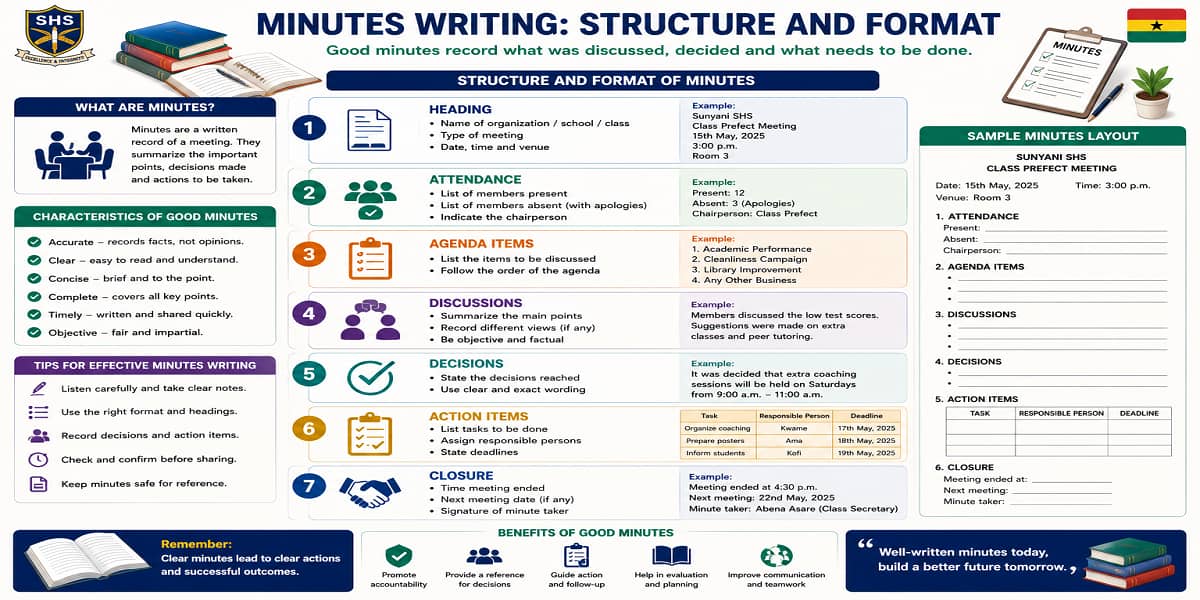
Minutes writing is a formal and structured way of recording meetings, discussions, and decisions. It ensures that information discussed during meetings is documented accurately and can be referred to in the future.
There are several types of minutes writing. These include verbatim minutes, summary minutes, action minutes, resolution minutes, informal minutes, formal minutes, draft minutes, confirmed minutes, Annual General Meeting minutes, and board meeting minutes. Each type serves a specific purpose depending on the nature of the meeting.
Types Of Minutes Writing
| Type | Description | Main Focus |
|---|---|---|
| Verbatim Minutes | Word-for-word recording | Everything said during the meeting |
| Summary Minutes | Concise account | Main points and decisions |
| Action Minutes | Assigned tasks | Actions and responsibilities |
| Resolution Minutes | Decisions taken | Resolutions passed |
| Formal Minutes | Official records | Legal and administrative purposes |
| Confirmed Minutes | Approved records | Official documentation |
The structure of minutes writing includes the heading, attendance, approval of previous minutes, agenda items, discussions, decisions, action items, next meeting, and closure. These sections ensure that information is presented clearly and logically.
Structure Of Minutes Writing
| Section | Content | Purpose |
|---|---|---|
| Heading | Date, time, venue, organisation, type of meeting | Provides meeting details |
| Attendance | Names of attendees and absentees | Records participation |
| Approval Of Previous Minutes | Confirmation of earlier minutes | Ensures accuracy |
| Agenda Items | Issues discussed | Provides focus |
| Discussions | Main points raised | Summarises deliberations |
| Decisions | Resolutions and responsibilities | Guides implementation |
| Action Items | Tasks and deadlines | Promotes accountability |
| Next Meeting | Date, time, and venue | Plans future meetings |
| Closure | Adjournment and signatures | Officially ends the meeting |
Minutes writing is significant because it promotes record keeping, accountability, clarity, transparency, follow-up, legal documentation, decision verification, organisational memory, professionalism, and efficiency. It also helps absent members stay informed about issues discussed and decisions taken.
Significance Of Minutes Writing
| Importance | Description |
|---|---|
| Record Keeping | Provides an official record of meetings |
| Accountability | Ensures commitments are fulfilled |
| Transparency | Reduces misunderstandings |
| Follow-Up | Facilitates implementation of decisions |
| Legal Documentation | Provides evidence where necessary |
| Efficiency | Makes future meetings more effective |
Effective minutes should possess qualities such as clarity, accuracy, brevity, structure, objectivity, completeness, timeliness, and proper identification of action items and attendance.
Examples
Example 1
Problem: State two sections of minutes writing.
- Identify the major sections.
- Select any two sections.
Final Answer: Heading and attendance are two important sections of minutes writing.
Example 2
Problem: Explain one importance of minutes writing.
- Identify the significance.
- Explain its function.
Final Answer: Minutes provide an official record of meetings and decisions for future reference.
Application and Activities
- Examine sample minutes and identify their key sections.
- Write minutes based on assigned scenarios.
- Conduct peer reviews of minutes prepared by classmates.
- Compare different types of minutes writing.
Practice Questions
- Define minutes writing.
- State four types of minutes writing.
- Explain three features of effective minutes writing.
Summary
Minutes writing is a structured method of recording meetings and decisions. Different types of minutes exist, including verbatim, summary, action, and formal minutes. Effective minutes follow a clear structure and possess qualities such as accuracy, clarity, objectivity, and completeness. Minutes writing promotes accountability, transparency, professionalism, and efficient record keeping.
Access NaCCA-aligned Support Packs
Download your structured NaCCA-aligned Teacher Support Pack and Student Learning Pack, designed for clarity, practicality, and reliable teaching and learning.