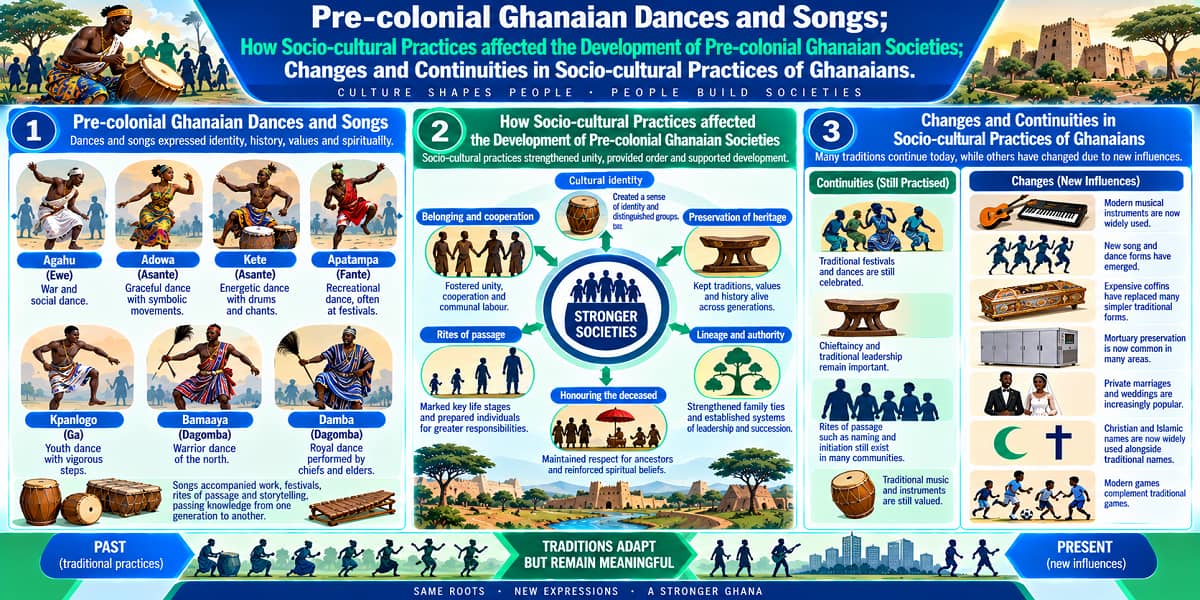
Pre-Colonial Ghanaian Dances and Songs; How Socio-Cultural Practices Affected the Development of Pre-Colonial Ghanaian Societies; Changes and Continuities in Socio-Cultural Practices of Ghanaians
Imagine entering a pre-colonial Ghanaian community and hearing drums, voices and movement. What could you learn about that society without reading a book? The answer is much more than you might expect. Dances, songs and other socio-cultural practices carried information about identity, beliefs, relationships, community life and the passage of time.
1. Dances and Songs as Historical Expressions
Traditional Ghanaian dances and songs were important parts of cultural life. They were preserved and passed from generation to generation, providing a window into the history, customs and beliefs of different ethnic groups. Dances were typically accompanied by corresponding songs, and many have continued to be celebrated.
| Dance | Group identified with the dance |
|---|---|
| Agahu | Ewe |
| Adowa | Asante |
| Kete | Asante |
| Apatampa | Fante |
| Agbadza | Ewe |
| Kpanlogo | Ga |
| Borborbor | Ewe |
| Bamaaya | Dagomba |
| Damba | Dagomba |
This list shows an important historical point: cultural expression can help distinguish and represent different communities. A dance is therefore not simply movement for entertainment. Its performance can preserve identity and connect people with their heritage.
What could a dance or song communicate?
- Cultural identity: performances could reflect the traditions of a particular ethnic group.
- Historical knowledge: songs and performances could tell stories and transmit knowledge about the past.
- Beliefs and values: lyrics, costumes, movements and instruments could carry symbolic meanings.
- Community connection: shared performance could connect individuals to their community and heritage.
- Life events: dances and songs could be associated with events such as birth, puberty and funerals.
Think: If people repeatedly teach younger generations through songs and performances, what happens to that knowledge? It can survive even when it is not written down.
2. Reading Culture as Historical Evidence
Historians need evidence to understand the past. For pre-colonial Ghanaian dances and songs, useful evidence can include oral traditions, historical accounts, recordings of traditional music, instruments and archaeological finds.
Each type of evidence needs careful interpretation. Oral traditions can preserve cultural memory, while physical objects can provide clues about material culture. Historical accounts can also contribute evidence, but their limitations must be considered.
When studying a performance, ask:
- What is being performed?
- Who performs it?
- What might the words, movements, costume or instruments communicate?
- What does the performance suggest about the society that preserved it?
- What other evidence could help us understand it?
3. From Individual Practices to Community Development
Dances and songs were part of a wider network of socio-cultural practices. These practices helped organise community life and shape how people understood themselves and their relationships with others.
Socio-cultural practices in pre-colonial Ghanaian societies could:
- foster a sense of belonging and cooperation;
- preserve cultural heritage;
- provide a basis for communal identity and shared values;
- help identify individuals;
- mark the transition from childhood to adulthood;
- emphasise unity and continuity of lineage; and
- honour the deceased and support beliefs concerning transition into the afterlife.
Notice the connection. A naming ceremony could identify a person within a community. A puberty rite could mark a transition into adulthood. Marriage could emphasise family relationships and lineage. Funeral practices could honour the deceased. Music and dance could reinforce shared identity. Together, such practices helped connect individuals to families, communities, values and cultural heritage.
4. Why These Practices Mattered
Socio-cultural practices did not operate separately. They were interconnected. Family life, rites of passage, music, dance and other practices could contribute to the organisation and stability of society.
| Practice or expression | Significance in society |
|---|---|
| Music and dance | Preserved cultural heritage and supported communal identity. |
| Rites of passage | Marked important stages in a person’s life. |
| Family and lineage practices | Emphasised relationships, unity and continuity of lineage. |
| Naming practices | Served as a way of identifying individuals. |
| Funeral practices | Honoured the deceased and reflected beliefs about transition into the afterlife. |
These connections show why culture is important in history. A society is not shaped only by rulers, wars or economic activities. The everyday practices through which people express identity, relationships and beliefs also contribute to social development.
5. Continuity and Change
Culture does not necessarily disappear when society changes. Some practices continue while their form changes. Historical thinking therefore asks two linked questions: What has remained? and What has changed?
| Socio-cultural practice | Change identified |
|---|---|
| Funerals | Use of expensive coffins and keeping the dead body in a mortuary. |
| Marriage and weddings | Private marriages and weddings. |
| Naming | Giving Christian and Islamic names to newborns. |
| Music | Use of modern musical instruments and new genres of songs. |
| Dance | Emergence of new dance types. |
| Games | Introduction and growth of modern games. |
These examples show that continuity and change can exist at the same time. A cultural practice may remain important while the way it is performed changes.
What can cause change?
The study of socio-cultural change considers factors such as colonialism, trade, technology and internal social movements. These influences can affect how practices are performed, preserved or adapted.
For example, the source identifies modern musical instruments and new genres of songs as changes in Ghanaian musical culture. This does not automatically mean that the cultural importance of music has disappeared. Instead, it shows that cultural expression can adapt over time.
6. Learner Challenge: Continuity or Change?
Consider the following statement:
“When the form of a cultural practice changes, the culture itself has been lost.”
Do you agree?
A strong historical response should distinguish between form and function. A practice may change in appearance while retaining an important role in identity, community or heritage. At the same time, some changes may represent the disappearance of older practices. The historian therefore needs evidence before making a judgement.
7. Quick Check
- What were two important features of traditional Ghanaian dances and songs?
They were important cultural expressions preserved across generations, and dances were typically accompanied by corresponding songs. - Name four dances and the groups identified with them.
Examples include Agahu—Ewe, Adowa—Asante, Apatampa—Fante and Bamaaya—Dagomba. - Give three ways socio-cultural practices contributed to society.
They fostered belonging and cooperation, preserved cultural heritage, and provided a basis for communal identity and shared values. - What is continuity?
Continuity refers to aspects of a practice that remain or endure over time. - What is change?
Change refers to aspects of a practice that evolve, are modified or are replaced over time.
8. Synthesis
Pre-colonial Ghanaian society can be understood partly through its socio-cultural practices. Dances and songs preserved heritage, expressed identity and transmitted knowledge. Other socio-cultural practices fostered belonging, cooperation, communal identity, lineage continuity and recognition of important stages of life.
Over time, these practices have also changed. Funerals, marriages, naming practices, music, dance and games provide examples of forms that have changed. The historical task is not simply to say that something is “old” or “modern”; it is to identify what continued, what changed, and what those developments reveal about Ghanaian society.
Key idea to remember: Socio-cultural practices are part of history because they show how people organised community life, expressed identity, transmitted knowledge and responded to change.
Access NaCCA-aligned Support Packs
Download your structured NaCCA-aligned Teacher Support Pack and Student Learning Pack, designed for clarity, practicality, and reliable teaching and learning.