Marriage Rites, Funeral Rites in Pre-colonial Ghana and Traditional Ghanaian Games Through Time Explained for SHS 1 History (Sem. 1 – Week 10)
How can we understand a society by looking at the moments people celebrate, mourn and play? Pre-colonial Ghanaian societies provide three particularly useful windows: marriage rites, funeral rites and traditional games.
These practices belonged to different parts of life, yet each reveals something about social relationships, cultural values, beliefs and the transmission of knowledge.
Marriage Was a Family Matter
Marriage in pre-colonial Ghana represented the merging of two families and the continuation of lineage. Although marriage practices differed among ethnic groups, several common stages were identified.
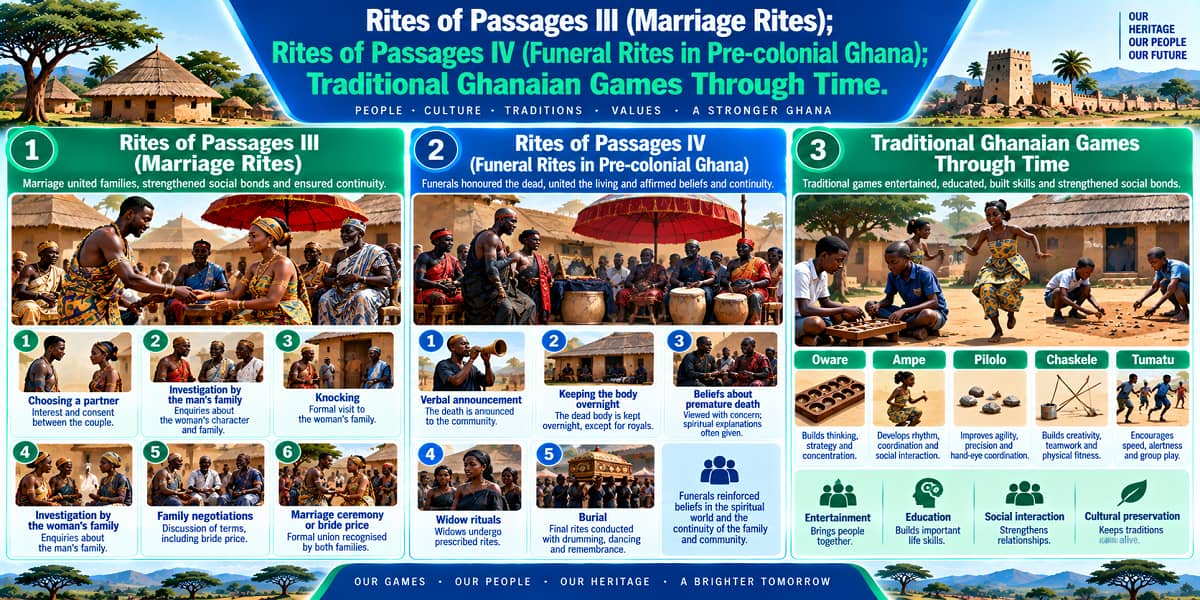
The process began with choosing a partner. The man’s family then carried out an investigation. This was followed by knocking, investigation by the woman’s family and family negotiations. The process concluded with the actual marriage ceremony or payment of the bride price.
| Stage | What the sequence shows |
|---|---|
| Choosing a partner | The process began with the selection of a prospective partner. |
| Investigation by the man’s family | Marriage involved family participation beyond the couple. |
| Knocking | The marriage process moved into a recognised family stage. |
| Investigation by the woman’s family | The woman’s family also participated in examining the proposed union. |
| Family negotiations | The two families discussed matters connected with the marriage. |
| Marriage ceremony or bride price | The process reached its formal conclusion. |
This structure shows why marriage had social and economic importance. It could strengthen family alliances, promote social order and establish economic partnerships.
Death Also Had a Social Structure
Funeral ceremonies were deeply rooted in the cultural fabric of various ethnic groups. They included a number of common practices, although funeral customs could vary between communities and social groups.
- Verbal funeral announcement.
- Keeping the dead body overnight, except for royals.
- Considering premature death a bad death.
- Rituals for the widow of a deceased husband.
- Burial of the deceased in a less expensive coffin.
These practices raise historical questions about how communities understood death, the afterlife and the spirit world. They also invite investigation into the relationship between funeral customs and social organisation.
Marriage and Funeral Rites as Historical Evidence
Both sets of practices demonstrate that major life events were socially organised. Marriage connected families and lineage; funeral rites organised communal responses to death.
But the historian must avoid assuming that one practice represented every Ghanaian community in exactly the same way. Comparison among ethnic groups and social classes is essential.
Then There Were Games
Games might appear less serious than marriage or funerals, but they can be valuable historical evidence. Traditional Ghanaian games existed for several centuries and contributed to socio-cultural development.
Among the games identified are Oware, Ampe, Pilolo, Chaskele, Tumatu, Antoakyire and Atɛ (Ntɛto).
Why Would Games Matter?
The historical importance of games goes beyond entertainment. Traditional games served as tools for education and skill-building, fostered social interaction, taught important life skills and helped preserve cultural heritage.
| Role of games | Historical significance |
|---|---|
| Entertainment | Games provided recreation within community life. |
| Education | Games could be used to teach and develop skills. |
| Strategy and problem-solving | Games could develop strategic and problem-solving abilities. |
| Social interaction | Playing created opportunities for interaction. |
| Cultural heritage | Games helped preserve cultural traditions. |
Games as Material and Oral History
How can we know about games from the past? Historians can investigate oral histories, rules passed down through generations, physical game boards and playing objects. Depictions in art can also provide evidence.
This makes traditional games an example of material culture. A game board or playing object is not simply an object used for recreation; it can provide clues about the society that made and used it.
Who Played and Why?
Historical investigation asks whether games were played by children, adults or both. It also asks how gender roles, age groups and community values influenced participation.
The answers can help researchers understand the social environment in which games were played.
Games Change Too
Traditional games can show both continuity and change. Colonialism, modernisation and the introduction of new games could influence traditional gameplay. New materials and technologies could also affect how games were played.
At the same time, games could continue to be transmitted through observation, participation and storytelling.
This creates an important historical pattern:
Transmission → continuation → adaptation → change
Reading Culture Through Everyday Practices
One of the most useful lessons from this topic is that history is not found only in political events. Social practices can be equally revealing.
A marriage ceremony can reveal ideas about family and lineage. Funeral practices can reveal attitudes towards death and social relationships. Games can reveal approaches to education, interaction, skill development and cultural preservation.
Preserving the Past Through Participation
Traditional games can be kept alive through participation and storytelling. The topic encourages learners to investigate games among groups such as the Guan, Mole-Dagbani, Ga-Adangbe, Ewe and Gonja, and to consider what these games reveal about their societies.
It also identifies Tumatu, Oware and Chaskele as games that learners can prepare and play in school.
A Historian’s Questions
- What did the practice involve?
- What social or cultural purpose did it serve?
- How did the practice differ among communities?
- What evidence allows us to study it?
- What has changed over time?
- What has continued?
Key Takeaway
Marriage rites, funeral rites and traditional games provide different but connected ways of understanding socio-cultural organisation in pre-colonial Ghana. Marriage brought families together and supported lineage continuity. Funeral rites structured community responses to death. Traditional games combined entertainment with education, skill-building, social interaction and cultural preservation.
Studying these everyday and ceremonial practices reminds us that history is also the study of how people organised relationships, expressed beliefs, developed skills and transmitted culture across generations.
Access NaCCA-aligned Support Packs
Download your structured NaCCA-aligned Teacher Support Pack and Student Learning Pack, designed for clarity, practicality, and reliable teaching and learning.