Formal Letter Writing Explained for SHS 2 English Language (Semester 2, Week 11)
A well-written formal letter can help you communicate an important message clearly, professionally and effectively. Whether you are addressing a school concern, applying for employment or communicating with an organisation, the way you organise your letter matters.
What You Will Learn
- What a formal letter is and where it is used.
- The main features of a formal letter.
- How the different parts of a formal letter work together.
- How to organise ideas clearly in a formal letter.
- How formal letters can be used to address real-life issues.
Main Explanation
A formal letter is a type of written communication commonly used in professional and business situations. It follows a specific structure and format so that the message is clear, professional and effective.
Formal letters can be written for different purposes. They can be used for employment, to communicate with organisations, or to raise social and environmental issues. They can also be used to communicate concerns and suggest changes that may improve a situation.
The Main Parts of a Formal Letter
A formal letter is made up of several parts. Each part has a particular purpose, and putting them in the appropriate places helps the reader understand the message easily.
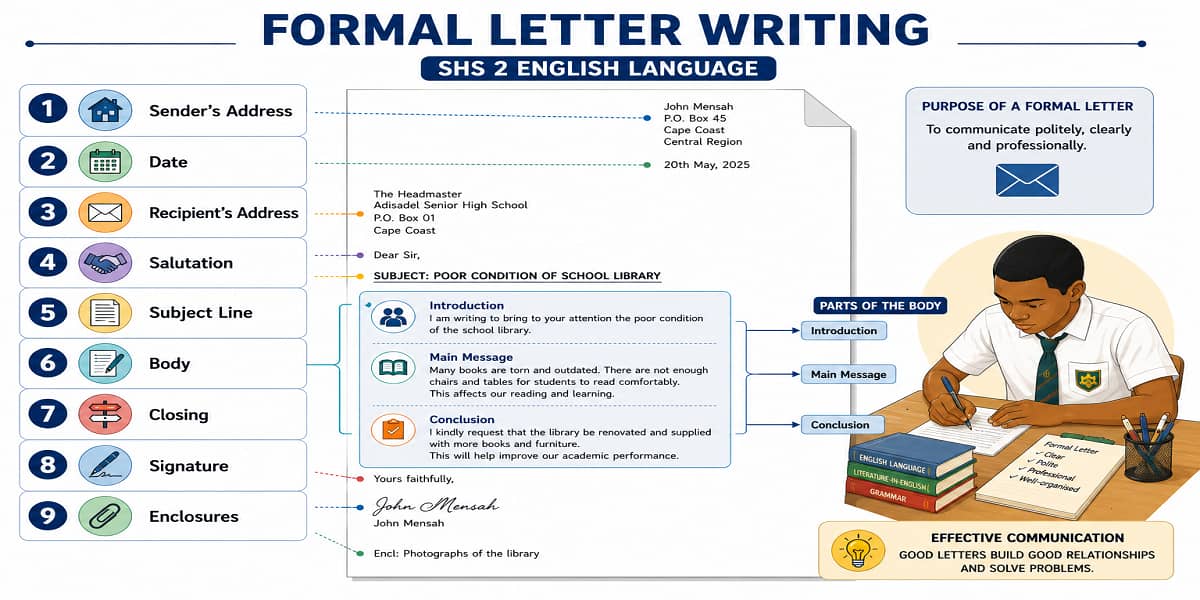
1. Sender’s Address
This is the address of the person writing the letter. It is placed at the top left or right corner of the page.
2. Date
The date tells the reader when the letter was written. It is placed below the sender’s address.
3. Recipient’s Address
This gives the address of the person or organisation receiving the letter. It is placed below the date, on the left side of the page.
4. Salutation
The salutation is the formal greeting used to address the recipient. Examples include Dear Mr. Smith and To Whom It May Concern.
5. Subject Line
The subject line gives a brief statement of what the letter is about. It is optional, but it can help the reader understand the purpose of the letter quickly.
6. Body
The body contains the main message. It is normally divided into paragraphs and includes an introduction, the main message and a conclusion. The ideas should be presented clearly and in a logical order.
7. Closing
The closing is the formal sign-off at the end of the letter. Examples include Sincerely, Yours faithfully and Best regards. Yours faithfully is used when the name of the addressee is not used in the letter.
8. Signature
The sender’s signature appears after the closing. It is followed by the sender’s typed name and, where applicable, the sender’s title and organisation.
9. Enclosures
An enclosure is an additional document included with the letter. If other documents are attached to the letter, they should be indicated as enclosures.
Putting the Parts Together
The different parts of a formal letter should work together as one clear message. The body is especially important because it carries the main ideas. It should have a suitable opening, a clear presentation of the main points and an appropriate conclusion.
Good paragraphing also helps the reader follow the message. When writing about an issue, arrange the points logically rather than presenting them randomly. Clear organisation makes the letter easier to read and gives the message greater effectiveness.
Worked Examples
Example 1
Scenario: A student wants to write to the head of the school about changes that could improve the school environment.
Explanation: This is a suitable situation for a formal letter because the student is communicating an issue to a school authority. The letter should identify the recipient clearly, use the appropriate formal structure and present the proposed changes in a logical order. The body should explain the main points clearly and end with a suitable conclusion.
Example 2
Scenario: A student wants to inform the editor of the school magazine about two urgent needs of students.
Explanation: The student should write a formal letter with the appropriate address, date, recipient’s details, salutation, body, closing and signature. The two urgent needs should be clearly presented in the body, with the ideas organised into two paragraphs as required by the task.
Why This Topic Matters
Formal letter writing is useful because it gives you a structured way to communicate important issues. A well-organised letter can be used to raise concerns, communicate with organisations, address social and environmental issues, or apply for employment.
The skill also prepares you for situations beyond the classroom. As you move into further education and the world of work, you may need to communicate information formally. Knowing how to organise your ideas and follow the accepted structure of a formal letter can help you communicate with greater clarity and confidence.
Quick Practice
- List the main features of a formal letter.
- Explain the purpose of the subject line in a formal letter.
- Write a two-paragraph formal letter to the editor of your school magazine about two urgent needs of students in your school.
- Research some changes you would like to see in your school and write a formal letter to the head of the school explaining those changes. Your letter should contain at least three paragraphs.
Summary
A formal letter is a structured form of written communication used mainly in professional and business contexts. Its important features include the sender’s address, date, recipient’s address, salutation, subject line where appropriate, body, closing, signature and enclosures where necessary.
The body of the letter should contain a suitable opening, clearly organised main points and an appropriate conclusion. Good formal writing also requires clear expression, logical organisation, suitable paragraphing and careful punctuation. With practice, formal letters can become an effective way of communicating ideas and addressing real-life issues.
Access NaCCA-aligned Support Packs
Download your structured NaCCA-aligned Teacher Support Pack and Student Learning Pack, designed for clarity, practicality, and reliable teaching and learning.