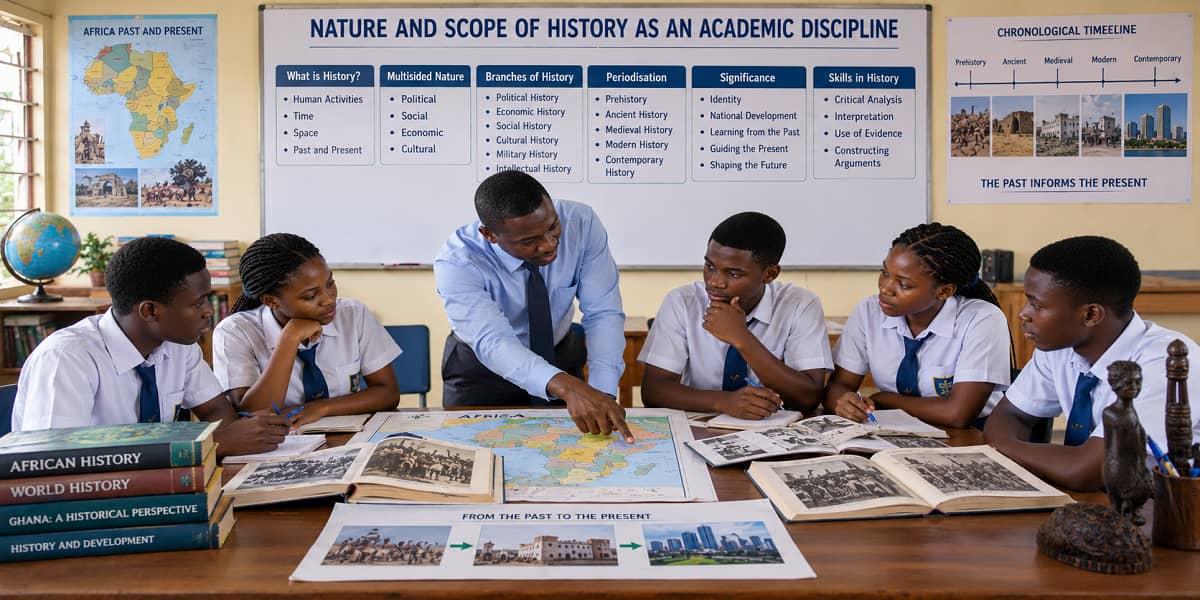
Nature and Scope of History as an Academic Discipline Explained for SHS 1 History (Sem. 1 – Week 2)
History is often imagined as a long list of names, dates and events. That picture misses something important: History is a way of investigating human life through time and space.
Once we understand this, the subject becomes much broader. Politics is part of History, but so are society, economic life, culture, the environment, human relationships and the many other dimensions through which people experience and shape their world.
History Begins With Human Experience
The central concern of History is human activity. It follows how people have lived and developed through different periods, how they have interacted with their environments and how institutions in the present have grown out of developments in the past.
This focus on human activity also explains why History is connected to time. Every historical event belongs to a particular point or period, and placing events in time allows us to see sequence and development.
But time alone is not enough. Human activity also takes place in space. The physical and geographical environment forms part of the context in which societies develop. History therefore considers the interaction between people and their environments.
Why “One Story” Is Not Enough
Imagine studying an important event only from its political dimension. You might learn about leadership or power, but you could miss the social, economic, cultural or environmental dimensions of the same development.
This is why History is described as multisided. Human life is interconnected, so historical developments can be understood from different angles.
| Perspective | Question it can help us explore |
|---|---|
| Political | What political developments and power structures shaped the period? |
| Social | How did people live and relate to one another? |
| Economic | What economic activities and developments were involved? |
| Cultural | What cultural dimensions shaped people’s experiences? |
| Environmental | How did people and their environment interact? |
These perspectives do not compete with one another. They can complement one another.
History Is an Investigation, Not Mere Storytelling
A story can tell us that one event happened after another. Historical thinking goes further.
It asks about relationships, causes, consequences, context and interpretation. Historical developments are therefore examined critically rather than simply repeated.
This is one reason historical study requires questioning. When examining an interpretation of the past, learners should ask what evidence supports it, what assumptions may be present and whether other interpretations are possible.
Comparison is also important. Different interpretations of the same event or period can be compared by considering their perspectives and contexts.
The Past and the Present Are Connected
One of History’s distinctive contributions is its ability to illuminate the present. The present did not appear without a past. Developments over time create circumstances that influence how societies understand themselves and their current conditions.
This does not mean that the past mechanically determines everything in the present. Instead, studying past developments gives us a stronger basis for recognising change, continuity and relationships.
It can also help people learn from past mistakes and appreciate changes that have taken place.
The Many Branches of History
The breadth of human experience has produced a wide range of branches of History.
| Branch | Area of attention |
|---|---|
| Political History | Political developments and power structures. |
| Social History | The lives and experiences of people in society. |
| Economic History | Economic activities and developments. |
| Diplomatic History | Relations and interactions involving states and political communities. |
| Gender and Women’s History | Historical experiences viewed through gender and women’s history. |
| Cultural History | Cultural aspects of human life and development. |
| Environmental History | Human relationships with the environment in historical contexts. |
| Trans-national History | Developments that cross national boundaries. |
| Global History | Historical developments considered through wider global connections. |
These branches remind us that a historical event can have more than one meaningful dimension. The economic impact of a political development, for instance, can become a legitimate historical question because History is multisided.
Three Tools for Making Sense of Historical Time
History needs ways of organising the enormous amount of human experience that has accumulated over time. Three key concepts are particularly useful: periodisation, significance and chronology.
Periodisation: Giving Historical Time Structure
Periodisation divides time into distinct periods so that historical developments can be organised and understood more effectively.
Several dating terms are important:
- BC — Before Christ.
- AD — Anno Domini, “in the year of the Lord”.
- BCE/CE — Before the Common Era/Common Era.
- Circa (c./ca.) — approximately or around.
- Decade — 10 years.
- Century — 100 years.
- Millennium — 1,000 years.
- Age/Era/Period — a broad period characterised by a shared pattern of life.
For example, the 20th century covers 1901–2000.
Within African and Ghanaian History, broad periods include the pre-colonial, colonial and post-colonial/post-independent periods.
Chronology: Understanding Sequence
Chronology is the arrangement of events in the order in which they occurred. It helps historians establish sequence and understand the context in which events developed.
A historical timeline is a practical way of applying chronology. To construct one, identify significant events, arrange them in chronological order, and add useful details such as dates, names and locations.
Significance: Deciding What Matters
History does not treat every past event as equally significant. The REC framework provides a useful way to think about historical importance.
| Criterion | Core question |
|---|---|
| Relevance | Who needs to know about the event, and how wide is its relevance? |
| Effects | Who was affected, how many people were affected and how long did the effects last? |
| Consequences | How serious were the outcomes of the event? |
An event affecting a single person may be highly important to that person. A historical event may, however, have relevance extending to a family, community, country or the wider world. The REC framework helps us make such judgments systematically.
Why Different Perspectives Matter
Studying History through several branches and perspectives prevents an overly narrow understanding of the past.
Political, social, economic, cultural, environmental and other dimensions can overlap. An event that appears political at first may also have significant social or economic implications.
This is why historical inquiry benefits from comparison, questioning and reflection. Learners are encouraged to ask how historians gather evidence, construct arguments and reach conclusions.
History as a Discipline of Critical Thinking
The nature of History demands several intellectual skills. Learners can develop the ability to:
- question historical information and interpretations;
- identify assumptions;
- compare different interpretations;
- consider perspective and context;
- analyse relationships between events;
- organise events chronologically; and
- connect the past with the present.
These skills make History more than the passive reception of information. The learner becomes an investigator who tries to understand how and why historical interpretations are constructed.
A Useful Mental Model
One way to bring the entire topic together is to imagine History as a wide lens.
Time tells us when human activity occurred.
Space tells us where it occurred and how the environment formed part of the context.
Branches allow us to examine different dimensions of human life.
Chronology helps us establish sequence.
Periodisation helps us organise time.
Significance helps us judge why an event deserves historical attention.
Critical analysis helps us move from simply knowing that something happened to understanding its relationships, causes and consequences.
Questions to Test Your Understanding
- Why is History described as a study of human activities?
- Why are time and space important in historical study?
- What does it mean to say that History is multisided?
- Why is historical study more than storytelling?
- Name five branches of History.
- What is the difference between chronology and periodisation?
- What does REC mean in the study of historical significance?
- How can historical knowledge illuminate the present?
Model answers:
- History focuses on human activities and development through the ages.
- Time places events within their sequence and period, while space provides the geographical context in which human activities occur.
- It means that History covers many interconnected aspects of human life rather than only political events.
- Historical study critically analyses past events and processes, including relationships among them, rather than merely narrating them.
- Political, Social, Economic, Diplomatic, Gender and Women’s, Cultural, Environmental, Trans-national and Global History. Any five are acceptable.
- Chronology arranges events in the order in which they occurred, while periodisation divides time into distinct periods for better organisation and understanding.
- REC means Relevance, Effects and Consequences.
- History helps us understand relationships between past and present developments, appreciate change and learn from mistakes of the past.
The Big Picture
The nature and scope of History are much wider than memorising what happened in the past. History investigates human life through time and space. It recognises that human experience is multisided, critically examines historical developments and focuses on events that help us understand human societies.
Its different branches open different windows onto the past. Its key concepts provide ways of organising time, judging significance and establishing sequence.
Ultimately, studying History means learning how to look carefully at human experience: where it happened, when it happened, what dimensions it involved, why it mattered and how its effects can help us understand the present.
Access NaCCA-aligned Support Packs
Download your structured NaCCA-aligned Teacher Support Pack and Student Learning Pack, designed for clarity, practicality, and reliable teaching and learning.