Word Collocations (Best Linkages) Explained for SHS 2 English Language (Semester 2, Week 10)
Speaking and writing naturally in English depend not only on knowing individual words but also on knowing which words commonly go together. These natural word combinations are called collocations, and mastering them greatly improves fluency and communication.
What You Will Learn
- The meaning of word collocations.
- The major types of collocations.
- The importance of collocations in speech and writing.
- Examples of collocations used in different contexts.
- Practical strategies for mastering collocations.
Main Explanation
A collocation is the habitual combination of one word with another word or group of words that occurs more frequently than would happen by chance. Native speakers naturally use these word combinations in everyday communication, making speech and writing sound fluent and accurate. Learning collocations enables learners to use vocabulary appropriately in formal and informal situations while improving overall language proficiency.
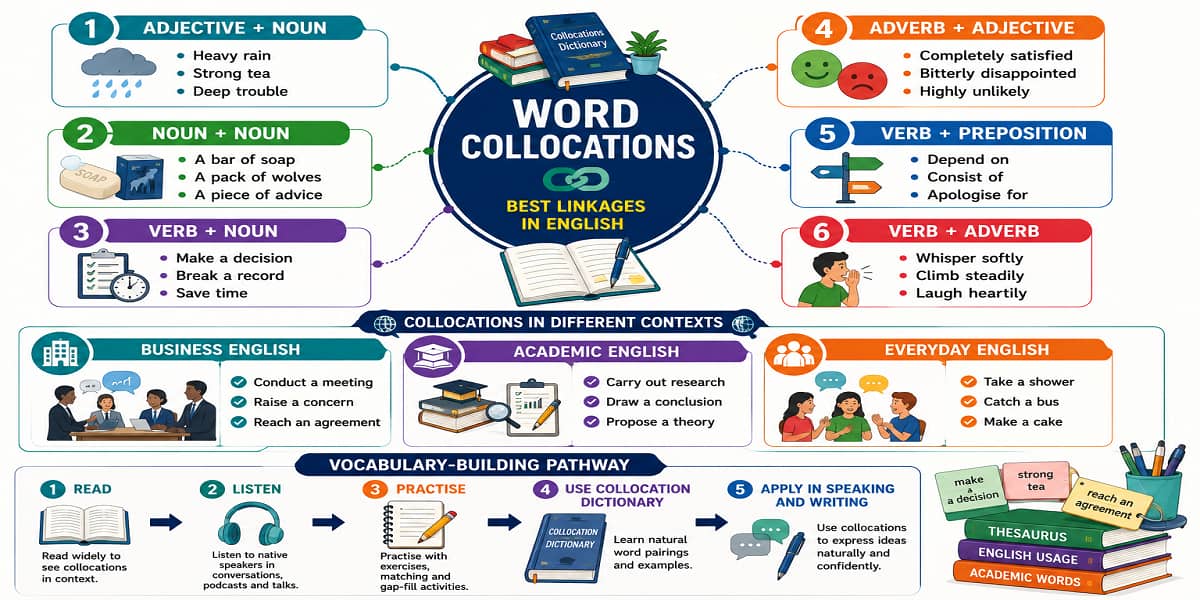
Collocations occur in different forms. Adjective + Noun combinations include expressions such as heavy rain, strong tea and deep trouble. Noun + Noun combinations include a bar of soap, a pack of wolves and a piece of advice. Verb + Noun collocations include make a decision, break a record and save time.
Other common types include Adverb + Adjective combinations such as completely satisfied, bitterly disappointed and highly unlikely; Verb + Preposition combinations such as depend on, consist of and apologise for; and Verb + Adverb combinations including whisper softly, climb steadily and laugh heartily.
Correct use of collocations makes communication sound more natural and fluent. It improves reading and listening comprehension because learners recognise familiar word patterns in spoken and written English. Collocations also help speakers and writers express ideas more precisely, reducing ambiguity and demonstrating advanced language proficiency.
Collocations are used in many real-life contexts. In Business English, examples include conduct a meeting, raise a concern and reach an agreement. In Academic English, learners may carry out research, draw a conclusion and propose a theory. In Everyday English, common expressions include take a shower, catch a bus and make a cake.
Learners can improve their knowledge of collocations by reading books and articles, listening to proficient speakers, practising new expressions in speech and writing, using collocation dictionaries, completing exercises, learning collocations within meaningful contexts, keeping vocabulary notebooks, using flashcards and consulting language tools. Learners should avoid translating collocations directly from another language and should avoid overgeneralising expressions in inappropriate situations.
| Type of Collocation | Examples | Use |
|---|---|---|
| Adjective + Noun | Heavy rain, Strong tea, Deep trouble | Natural descriptions |
| Noun + Noun | A bar of soap, A pack of wolves, A piece of advice | Common noun combinations |
| Verb + Noun | Make a decision, Break a record, Save time | Everyday actions |
| Adverb + Adjective | Completely satisfied, Bitterly disappointed, Highly unlikely | Modify adjectives naturally |
| Verb + Preposition | Depend on, Consist of, Apologise for | Correct grammatical combinations |
| Verb + Adverb | Whisper softly, Climb steadily, Laugh heartily | Describe actions accurately |
| Context | Examples |
|---|---|
| Business English | Conduct a meeting, Raise a concern, Reach an agreement |
| Academic English | Carry out research, Draw a conclusion, Propose a theory |
| Everyday English | Take a shower, Catch a bus, Make a cake |
Worked Examples
Example 1
Scenario: A learner is given two columns of words and asked to match them to form natural collocations.
Explanation: The learner identifies combinations that commonly occur together in English, such as make a decision, break a record and save time, instead of creating unnatural word pairings.
Example 2
Scenario: Two classmates prepare a dialogue for a business meeting.
Explanation: They use appropriate collocations such as conduct a meeting, raise a concern and reach an agreement to make their conversation sound natural and suitable for the situation.
Why This Topic Matters
Mastering collocations enables learners to communicate naturally in academic, professional and everyday situations. It strengthens vocabulary development, improves reading and listening comprehension, increases confidence in speaking and writing and helps learners choose appropriate expressions according to context. Regular practice through reading, discussions, role-play, games and writing activities supports long-term language development.
Quick Practice
- Match words to form correct collocations.
- Complete sentences using appropriate collocations.
- Create a dialogue using at least five collocations.
- Write a four-paragraph essay using at least ten collocations.
- Identify incorrect collocations in a passage and replace them with appropriate ones.
Summary
Word collocations are natural combinations of words that improve fluency, accuracy and effective communication. Learning collocations in context, practising them regularly and applying them appropriately in different situations enable learners to express ideas clearly and confidently in both speech and writing.
Access NaCCA-aligned Support Packs
Download your structured NaCCA-aligned Teacher Support Pack and Student Learning Pack, designed for clarity, practicality, and reliable teaching and learning.