Definition, Introduction and Application of Basic Concept of Literature
Introduction
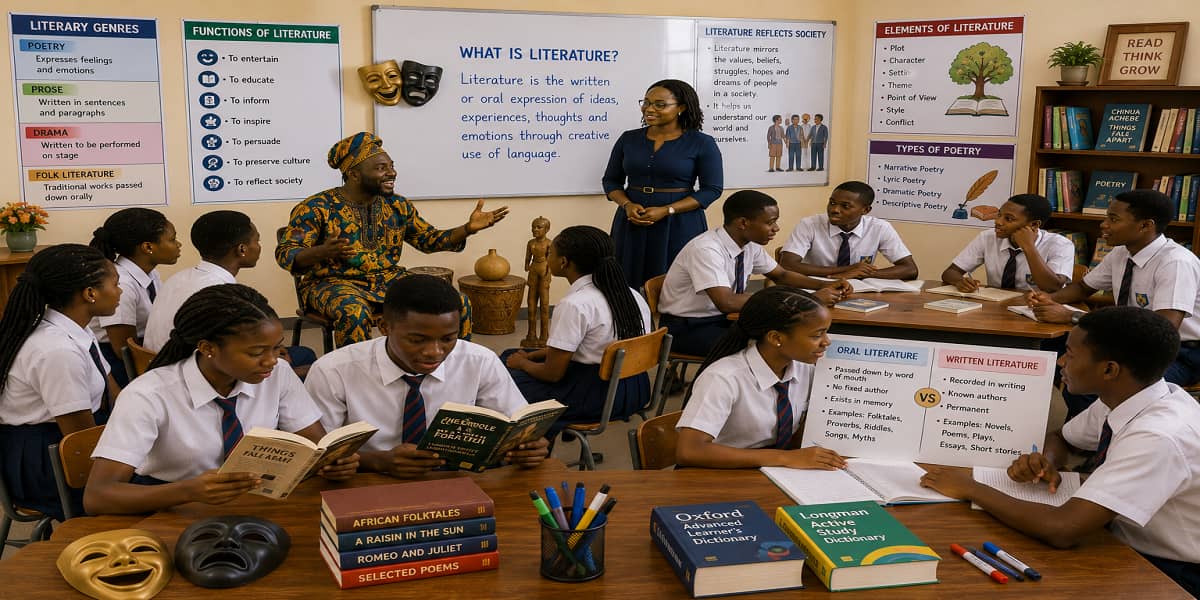
Literature is a creative and imaginative use of language that engages readers emotionally and intellectually. It includes written and oral compositions such as novels, drama and poetry, and reflects human experiences, emotions and social realities. This lesson introduces learners to the concept of literature, its types and its importance in society.
Key Concepts
- Literature: Creative and imaginative writing designed to engage readers emotionally and intellectually through genres such as novels, drama and poetry.
- Oral Literature: The earliest form of literature in which stories, songs and poems are transmitted through the spoken word from generation to generation.
- Written Literature: Literary works presented in written form, including novels, short stories, biographies, memoirs, essays and poetry.
- Creative Language: The artistic use of language to express ideas, emotions and social realities.
Explanation
Literature is a multidimensional concept that has been defined in different ways. It has been described as the product of human imagination that uses language creatively to reflect people’s relationship with their environment. Literature has also been described as a mirror that reflects the realities of society, the creative use of language to express emotions and feelings, and a work of art that educates, entertains, criticises and warns society. These definitions help distinguish literature from other forms of writing such as law, science and mathematics.
There are two distinctive forms of literature: oral literature and written literature. Oral literature is the earliest form and includes oral prose such as folktales, oral poetry such as incantations, chants and songs, and oral drama commonly found in storytelling. Written literature consists of artistic written works such as novels, short stories, biographies, memoirs, essays and poetry.
| Type of Literature | Forms | Examples |
|---|---|---|
| Oral Literature | Oral prose, oral poetry and oral drama | Folktales, incantations, chants, songs and storytelling |
| Written Literature | Artistic written works | Novels, short stories, biographies, memoirs, essays and poetry |
Literature performs many important functions. It provides entertainment, exposes people to the realities of human existence, demonstrates the beauty and power of language, creates opportunities in the world of work and introduces learners to quality education. Literature also serves as a mirror through which people learn the cultural norms of others, broadens awareness of the uncertainties of life and provides information that helps people understand the world as a global village.
| Importance of Literature | Contribution |
|---|---|
| Entertainment | Provides enjoyment through literary works. |
| Human Experience | Exposes readers to the realities of life. |
| Language Development | Demonstrates the beauty and power of language. |
| Education | Introduces learners to quality education. |
| Cultural Awareness | Helps learners understand the cultural norms of other people. |
| Global Knowledge | Provides information and broadens awareness of the world. |
Examples
Example 1
Problem: Classify the following as oral or written literature: folktale, novel, chant and essay.
- Identify whether each work is spoken or written.
- Group similar items together.
Final Answer: Oral literature: folktale and chant. Written literature: novel and essay.
Example 2
Problem: Explain one way literature differs from science or law books.
- Identify the purpose of literature.
- State how it uses language creatively.
Final Answer: Literature uses language creatively to reflect emotions and social realities, unlike subject-specific texts such as science or law books.
Application and Activities
- Explain literature in a broad sense.
- Give examples of texts considered as literature.
- Classify texts into those that can be recited, acted or read.
- Differentiate between oral and written literature.
- Discuss how literature contributes to academic, social and emotional development.
Practice
- Define literature using one of the accepted definitions.
- Distinguish between oral and written literature with examples.
- Evaluate the importance of literature in society using suitable examples.
Summary
Literature is the creative use of language to express ideas, emotions and social realities. It exists in two main forms—oral and written literature—and performs important educational, cultural and social functions. Understanding its concept, forms and importance provides learners with a strong foundation for the study of Literature-in-English and helps them appreciate literary works more effectively.
Access NaCCA-aligned Support Packs
Download your structured NaCCA-aligned Teacher Support Pack and Student Learning Pack, designed for clarity, practicality, and reliable teaching and learning.