The Concept of Money Explained for SHS 1 Economics (Semester 2, Week 8)
Money is one of the most important inventions in every economy because it makes buying, selling, saving and paying for goods and services easier than the barter system.
What You Will Learn
- The meaning of money.
- The meaning of the barter system.
- The four key functions of money.
- The different types of money used in the modern economy.
- How money is used in everyday economic activities.
Main Explanation
Money is a medium of exchange, a unit of account and a store of value that facilitates transactions and serves as a measure of economic value. It enables individuals, businesses and governments to exchange goods and services efficiently while representing the value of assets, labour and goods. Unlike the barter system, which involves exchanging goods directly for other goods without using money, modern economies depend on money to simplify transactions.
Money exists in different forms. Physical money includes coins and banknotes issued by governments and central banks. In addition to physical currency, modern economies also use digital forms of money such as electronic money and digital currencies.
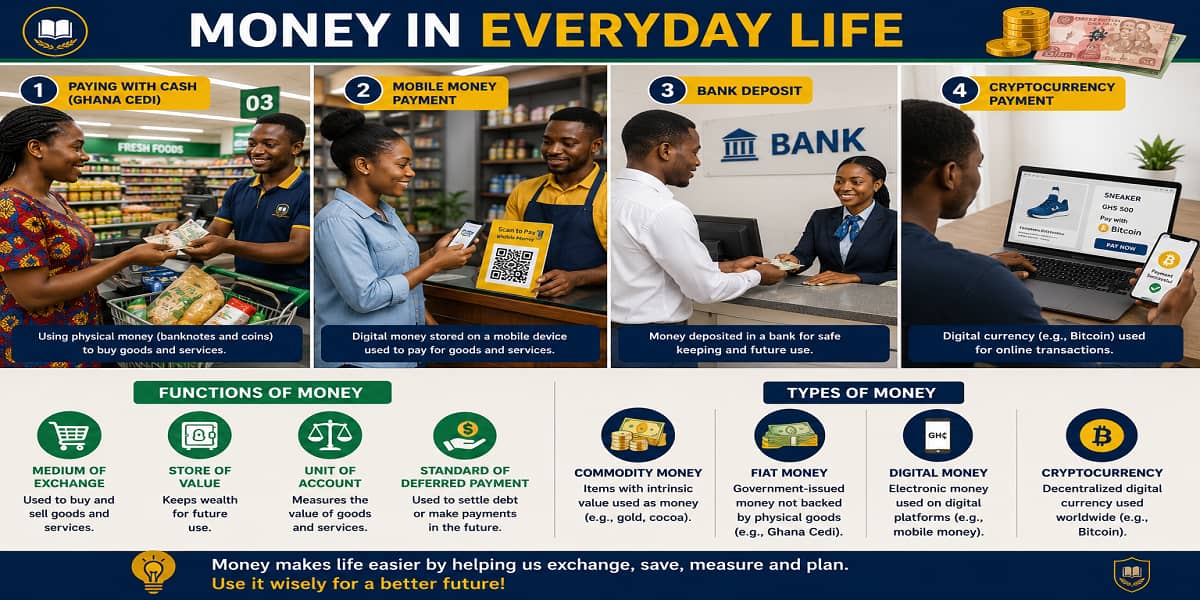
Money performs four important functions in the economy. First, it serves as a medium of exchange, making it easier to buy and sell goods and services without relying on barter. Second, it acts as a unit of account, providing a standard measure for expressing the value of goods, services, assets and debts. Third, it functions as a store of value, allowing individuals and businesses to save wealth and purchasing power for future use. Finally, money serves as a standard of deferred payment, enabling loans, contracts and other financial obligations to be settled at a later date.
Modern economies use different types of money. Currency consists of physical coins and banknotes, such as the Ghana Cedi (GH₵). Digital money includes online banking, mobile money and electronic fund transfers. Central bank money refers to reserves held by commercial banks together with physical currency. Cryptocurrencies are digital or virtual currencies secured through cryptography, with Bitcoin and Ethereum serving as examples.
| Type of Money | Description | Examples |
|---|---|---|
| Currency | Physical coins and banknotes in circulation | Ghana Cedi (GH₵) |
| Digital Money | Money stored and transferred electronically | Mobile money, online banking, electronic fund transfers |
| Central Bank Money | Reserves held by commercial banks and physical currency | Central bank reserves |
| Cryptocurrencies | Digital currencies secured through cryptography | Bitcoin, Ethereum |
Worked Examples
Example 1
Scenario: Sarah buys groceries worth GH₵100 using cash at a supermarket.
Explanation: The money serves as a medium of exchange because it enables Sarah to pay for the groceries directly without exchanging goods through barter.
Example 2
Scenario: Michael deposits GH₵5,000 into a savings account at a bank.
Explanation: The money acts as a store of value because it allows Michael to save wealth for future use while earning interest over time.
Example 3
Scenario: Kwame pays GH₵50 for an Uber ride using mobile money.
Explanation: Mobile money is a form of digital money. It performs the function of a medium of exchange by allowing payment through an electronic platform.
Why This Topic Matters
Understanding the concept of money helps learners appreciate how modern economies operate. Knowledge of the functions and types of money enables learners to understand everyday financial transactions, banking services, digital payments and the role money plays in economic development.
Quick Practice
- Define money and the barter system.
- State the four functions of money.
- Identify four types of money used in the modern economy.
- Explain the difference between physical currency and digital money.
- Give two practical examples showing how money is used in everyday life.
Summary
Money is an essential component of every modern economy. It serves as a medium of exchange, a unit of account, a store of value and a standard of deferred payment. Money exists in several forms, including currency, digital money, central bank money and cryptocurrencies. Understanding these concepts enables learners to appreciate the important role money plays in facilitating economic activities and improving the efficiency of transactions.
Access NaCCA-aligned Support Packs
Download your structured NaCCA-aligned Teacher Support Pack and Student Learning Pack, designed for clarity, practicality, and reliable teaching and learning.