The Concept of Money
Introduction
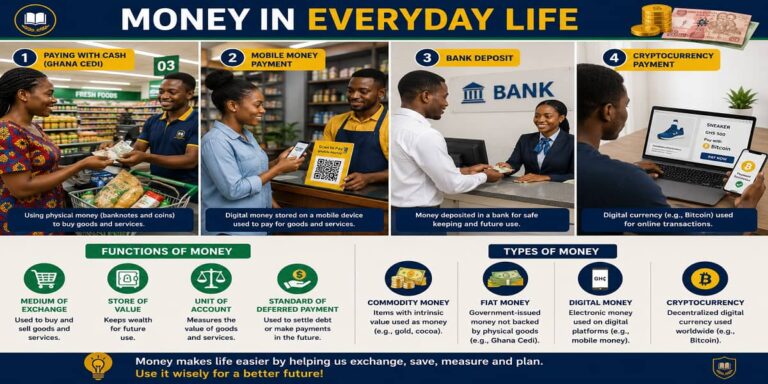
Money plays a central role in every modern economy. It facilitates the exchange of goods and services, provides a common measure of value and enables individuals, businesses and governments to carry out economic transactions efficiently. Modern economies use different forms of money, ranging from physical cash to electronic and digital forms.
Key Concepts
- Barter System: A method of exchanging goods and services directly for other goods and services without using money.
- Currency: Any form of money in circulation, including physical currency such as coins and banknotes as well as electronic forms.
- Banknotes: Paper currency issued by a central bank or government and accepted as legal tender.
- Coins: Metal currency with monetary value that can be used to pay for goods and services.
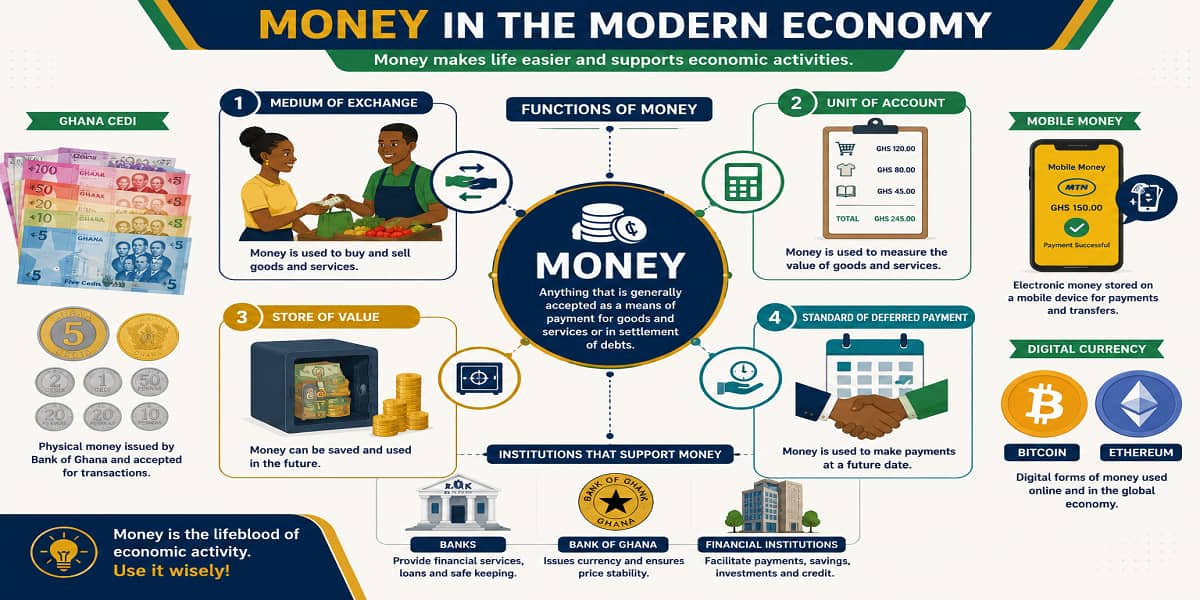
- Money: A medium of exchange, a unit of account and a store of value that facilitates economic transactions and measures economic value.
Explanation
Money is essential in modern economies because it enables the exchange of goods and services without relying on the barter system. It represents the value of goods, services, labour and assets and exists in both physical and digital forms.
The first function of money is as a medium of exchange. It is widely accepted when buying and selling goods and services and removes the difficulties associated with direct barter.
Money also serves as a unit of account. It provides a standard measure for expressing the value of goods, services, assets and debts, making comparison and valuation easier.
As a store of value, money allows individuals and businesses to save wealth and purchasing power for future use. Unlike perishable goods, money can be kept for future consumption or investment.
Money also functions as a standard of deferred payment. Loans, contracts and debts are stated in a particular currency and are settled using money at an agreed future date.
Money exists in different forms. Currency includes physical coins and banknotes issued by governments and central banks. Digital money is stored electronically and includes online banking, mobile money and electronic fund transfers. Central bank money consists of reserves held by commercial banks at the central bank together with physical currency. Cryptocurrencies are digital or virtual currencies secured through cryptography, with examples including Bitcoin and Ethereum.
| Type of Money | Description | Example |
|---|---|---|
| Currency | Physical coins and banknotes issued by governments and central banks | Ghana Cedi (GH₵) |
| Digital Money | Money stored electronically | Mobile money, online banking, electronic fund transfers |
| Central Bank Money | Reserves held by commercial banks together with physical currency | Central bank reserves |
| Cryptocurrency | Digital or virtual currency secured by cryptography | Bitcoin, Ethereum |
| Function of Money | Meaning | Benefit |
|---|---|---|
| Medium of Exchange | Used to buy and sell goods and services | Makes transactions easier than barter |
| Unit of Account | Measures the value of goods and services | Allows comparison of prices |
| Store of Value | Stores wealth for future use | Supports saving and investment |
| Standard of Deferred Payment | Used to settle debts in the future | Facilitates loans and contracts |
Examples
Example 1
Problem: Sarah buys groceries worth GH₵100 using cash.
- Identify the function of money.
- Explain why money is used instead of barter.
Final Answer: Money serves as a medium of exchange because it enables Sarah to purchase goods directly.
Example 2
Problem: Michael deposits GH₵5,000 into a savings account.
- Identify the function of money.
- Explain how money benefits him.
Final Answer: Money acts as a store of value because it preserves wealth while earning interest.
Example 3
Problem: Kwame pays GH₵50 for an Uber ride using mobile money.
- Identify the type of money used.
- State the function performed.
Final Answer: The payment uses digital money, which performs the function of a medium of exchange.
Application and Activities
- Explain the meaning of money using practical examples.
- Discuss the role money plays in everyday life.
- Identify different forms of money used in the modern economy.
- Compare barter with the use of money.
- Discuss situations where digital money is commonly used.
Practice
- Define money in your own words.
- Explain any two functions of money.
- Differentiate between two types of money used in the modern economy.
Summary
Money is a medium of exchange, a unit of account, a store of value and a standard of deferred payment. It enables efficient economic transactions and exists in several forms, including currency, digital money, central bank money and cryptocurrencies. Understanding the concept, functions and types of money helps learners appreciate its importance in modern economic activities.
Access NaCCA-aligned Support Packs
Download your structured NaCCA-aligned Teacher Support Pack and Student Learning Pack, designed for clarity, practicality, and reliable teaching and learning.