Nature and Scope of History as an Academic Discipline
Think about your own life. You know when you entered SHS, where you live, important events you have experienced and people who have influenced you. If you wanted to understand how your present life developed, you would need to consider people, time, place, events and their effects.
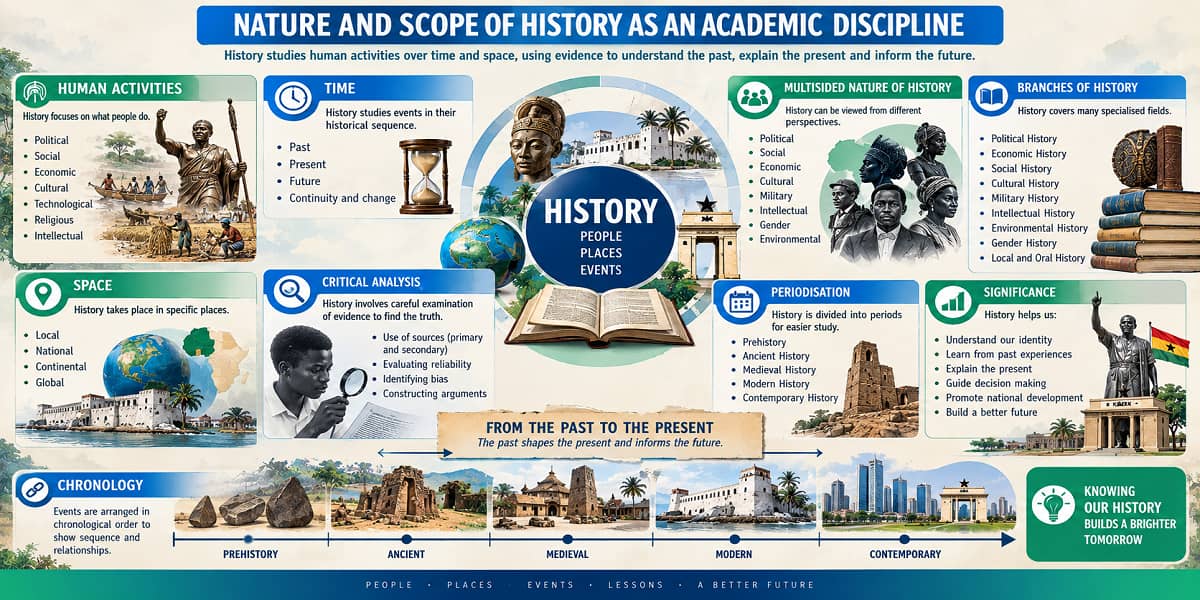
History works in a similar way, but on a much wider scale. It studies human activities through time and space, examines different aspects of human life, analyses relationships among events and uses the past to illuminate the present.
1. What Makes History an Academic Discipline?
History is not simply a collection of stories about people who lived in the past. As an academic discipline, it has particular features that guide how the past is studied and understood.
The major features include:
- History studies human activities.
- History studies human activities in time.
- History studies human activities in space.
- History is multisided.
- History involves critical analysis, not mere narration.
- History focuses on relevant human activities.
- History examines the past to illuminate the present.
2. History Studies Human Activities
The first major feature is that History deals with human activities through the ages. By examining people’s lives within their social and human contexts, History traces how humans have developed through time.
It also examines how humans have interacted with and attempted to use and control their environment. Present human institutions can therefore be understood in relation to developments from the past.
Key idea: When studying History, always ask: What were people doing, and how did their activities develop?
3. History Studies Human Activities in Time
Historical events occur at particular points or periods in time. History therefore examines the sequence of human development through time.
Time gives historical events a context. It helps us understand which events happened earlier, which happened later and how developments may be connected.
For example, when several events are placed in their correct chronological order, it becomes easier to understand the development of a historical process.
4. History Studies Human Activities in Space
Human beings do not live separately from their physical and geographical environment. History therefore examines human activities in relation to space.
The interaction between people and their environment is dynamic. It can influence political, social, economic and cultural developments.
So, when studying a historical event, it is useful to ask not only “When did it happen?” but also “Where did it happen?”
5. History Is Multisided
Human life has many connected dimensions. History is therefore not limited to political events alone.
It can examine:
- political life;
- social life;
- economic activities;
- religious life;
- literary activities;
- aesthetic activities; and
- physical aspects of human life.
These dimensions are often connected. A political event may have social or economic effects, while economic developments may influence political and cultural life.
| Dimension | What History may examine |
|---|---|
| Political | Power, leadership and political developments. |
| Social | The lives and relationships of people within society. |
| Economic | Human economic activities and achievements. |
| Religious | Religious dimensions of human life. |
| Literary and aesthetic | Human literary and aesthetic activities. |
| Physical | Human life and its physical dimensions. |
6. History Is More Than Storytelling
A historical account does not simply narrate events. History involves critical analysis of past events and processes.
This means historians examine relationships among events and try to understand their causes and consequences. They can also compare and contrast developments in different social groups to strengthen historical understanding.
Consider the difference:
Simple narration: “Event A happened, followed by Event B.”
Historical analysis: “Event A happened before Event B. What relationship existed between them? What factors contributed to Event B, and what consequences followed?”
The second approach requires deeper historical thinking.
7. History Studies Relevant Human Activities
Not every past activity receives equal attention in historical study. History focuses on human activities that are relevant to understanding contemporary issues.
This helps explain why historians select particular events, developments and experiences for detailed study. Relevance connects the investigation of the past with questions that matter to human societies.
8. History Examines the Past to Illuminate the Present
One of the most important features of History is its ability to connect past developments with present circumstances.
By examining relationships between past and present events, historical study can help us:
- understand changes that have occurred;
- appreciate developments in the present; and
- learn from mistakes of the past.
This does not mean that the past and present are identical. Rather, knowledge of the past gives us a stronger basis for understanding how the present has developed.
9. Branches of History
Because human life has many dimensions, History has developed different branches. Each branch focuses attention on particular aspects of the past while still connecting with other areas.
| Branch | Main focus |
|---|---|
| Political History | Political developments and power structures. |
| Social History | The lives and experiences of people in society. |
| Economic History | Economic activities and developments. |
| Diplomatic History | Relations and interactions involving states and political communities. |
| Gender and Women’s History | Historical experiences viewed through gender and women’s history. |
| Cultural History | Cultural aspects of human life and development. |
| Environmental History | Relationships between humans and their environment in historical contexts. |
| Trans-national History | Historical developments that cross national boundaries. |
| Global History | Historical developments considered across wider global connections. |
The branches should not be treated as completely separate compartments. The same event can be studied from several perspectives.
For example, a political event may also have economic, social and cultural dimensions. Looking at more than one branch can therefore produce a richer understanding of the past.
10. Key Concepts for Organising History
Three important concepts help us investigate and organise historical events:
- Periodisation — dividing time into distinct periods.
- Significance — judging why particular events are important.
- Chronology — arranging events according to the order in which they occurred.
Periodisation and Dating
Periodisation refers to dividing time into distinct periods so that historical events can be organised and understood more effectively.
| Term | Meaning |
|---|---|
| BC | “Before Christ”; refers to a date before the birth of Jesus Christ. |
| AD | “Anno Domini”; refers to a date after the birth of Jesus Christ. |
| BCE/CE | “Before the Common Era” and “Common Era”; corresponding to BC and AD respectively. |
| Circa (c./ca.) | Approximately or around; used when an exact date is unknown. |
| Decade | A period of 10 years. |
| Century | A period of 100 years. |
| Millennium | A period of 1,000 years. |
| Age/Era/Period | A broad period characterised by a shared pattern of life. |
For example, the 20th century refers to the years 1901–2000. A century should therefore not be confused with the number used in its name.
Significant Periods in African and Ghanaian History
| Period | Description |
|---|---|
| Pre-colonial Period | The period before colonialism in Africa. In Ghana, it extends from the earliest times to 1874, when the Gold Coast was pronounced a Crown Colony of the British. |
| Colonial Period | The period characterised by contact with the outside world, particularly Europe, and the eventual establishment of European colonial rule. |
| Post-colonial/Post-independent Period | The period after colonialism and the emergence of independent states in Africa, including the aftermath of independence. |
Historical Significance: The REC Test
Historical significance asks why an event deserves attention in the study of the past. One useful framework is REC:
| REC | Questions to ask |
|---|---|
| Relevance | Who needs to know about the event? Does it matter to one person, a family, a community, a country or the wider world? |
| Effects | Who was affected? How many people were affected? How long did the effects last? Do they continue or affect the future? |
| Consequences | How serious were the results? Did the event cause loss of life, loss of jobs, environmental harm or conflict? |
REC stands for Relevance, Effects and Consequences. It provides a structured way to judge historical importance. It is a guide rather than a rigid formula, because the importance attached to each factor can vary according to context.
Chronology
Chronology is the arrangement of events in the order in which they occurred. It helps historians understand sequence, context and possible relationships between events.
11. How the Concepts Work Together
Periodisation, significance and chronology perform different but connected jobs.
Chronology tells us when events occurred and places them in sequence.
Periodisation helps us organise historical time into meaningful periods.
Significance helps us decide why particular events deserve historical attention.
Together, these concepts help historians organise, investigate and interpret the past.
12. Practise Historical Thinking
Practice 1: Identify the Feature
Question: A learner studies how people interacted with their geographical environment during a particular period. Which feature of History is being demonstrated?
Answer: The learner is studying human activities in space, because History considers human activities within their physical and geographical environment.
Practice 2: Choose the Concept
Question: A learner arranges a series of events from the earliest to the latest. Which key concept is being used?
Answer: Chronology, because chronology arranges events according to the order in which they occurred.
Practice 3: Apply REC
Question: An event affected an entire community for several generations and produced serious consequences. Which parts of REC would you investigate?
Answer: Investigate Relevance by asking who needs to know about the event; Effects by examining who was affected and how long the effects lasted; and Consequences by examining the seriousness of the outcomes.
Practice 4: Think Across Branches
Question: Why should one historical event sometimes be studied through more than one branch of History?
Answer: History is multisided and different aspects of human life are interconnected. Studying an event through more than one branch can therefore provide different perspectives and a deeper understanding of its social, political, economic, cultural or other dimensions.
13. Quick Review
- State four features of History as an academic discipline.
- What is meant by History being “multisided”?
- Explain the difference between chronology and periodisation.
- What does REC stand for?
- State the three major key concepts in History discussed in this lesson.
- Name five branches of History.
- Explain how History can illuminate the present.
Answers:
- History studies human activities; human activities in time; human activities in space; it is multisided; it involves critical analysis; it studies relevant human activities; and it examines the past to illuminate the present.
- It means that History covers many interconnected aspects of human life rather than focusing only on political events.
- Chronology arranges events in the order in which they occurred, while periodisation divides time into distinct periods to organise and understand historical developments.
- Relevance, Effects and Consequences.
- Periodisation, Significance and Chronology.
- Political, Social, Economic, Diplomatic, Gender and Women’s, Cultural, Environmental, Trans-national and Global History. Any five are acceptable.
- History examines relationships between past and present events, helping people appreciate changes in the present and learn from mistakes of the past.
14. Final Synthesis
History is a broad academic discipline concerned with human activities in time and space. It is multisided because human life has many interconnected dimensions. It is analytical because historical study goes beyond narration to examine relationships among events and processes.
Its branches allow different perspectives on the past, while concepts such as periodisation, significance and chronology help organise and interpret historical developments.
The central idea to remember is simple: History helps us understand human development through time by investigating significant activities, their contexts, their relationships and their continuing relevance to the present.
Access NaCCA-aligned Support Packs
Download your structured NaCCA-aligned Teacher Support Pack and Student Learning Pack, designed for clarity, practicality, and reliable teaching and learning.