
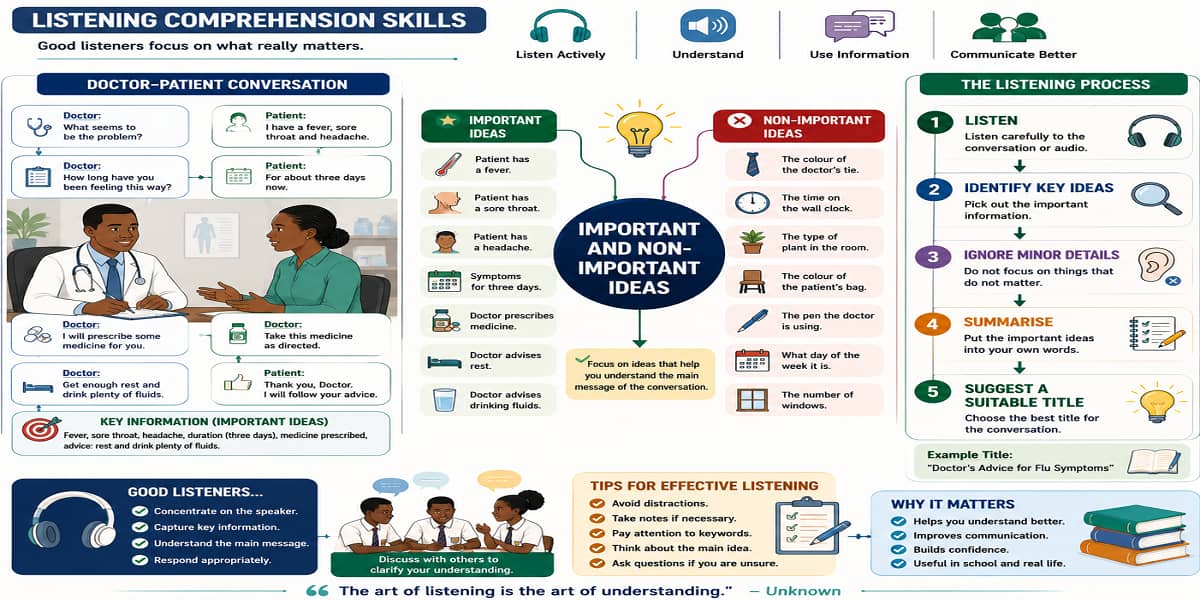
Important and Non-important Ideas
Introduction
Listening comprehension requires learners to listen critically and distinguish between important and non-important ideas in oral communication. By identifying key information, learners improve their ability to understand spoken texts, summarise ideas accurately and communicate effectively in everyday situations. This lesson develops listening skills through conversations, stories, narrations, audio recordings and videos.
Key Concepts
- Listening Comprehension: The ability to listen critically, understand spoken messages and construct meaning from oral communication.
- Important Ideas: The key information or main ideas that communicate the central message of an oral text.
- Non-important Ideas: Details that support a message but are not the main focus of the oral communication.
- Summarising: Presenting the main ideas of a text or oral communication briefly using one’s own words.
Explanation
Learners listen to level-appropriate oral texts such as conversations, stories, narrations, audio recordings and videos to identify the important ideas being communicated. Selected oral texts should reflect varied cultural backgrounds, values, interests and affiliations.
The sample conversation between a doctor and a patient demonstrates how listeners identify the central message of an oral text. The patient explains experiencing fever, sore throat, cough, headache and shivering. After examining the patient, the doctor prescribes medicine to be taken twice a day for three days and advises the patient to rest.
While listening, learners should identify what the speakers are referring to, determine the important ideas communicated, identify themes, characters and moral lessons where applicable, and suggest an appropriate title for the oral text.
Learners also summarise the oral text in their own words by focusing on the key ideas rather than unnecessary details. They work collaboratively in pairs and groups to discuss their observations before presenting their conclusions to the class.
| Listening Activity | Purpose | Expected Outcome |
|---|---|---|
| Identify the speaker’s message | Understand the central idea | Recognise the important information |
| Identify key ideas | Separate main ideas from minor details | Improve listening comprehension |
| Suggest a suitable title | Summarise the central message | Demonstrate understanding of the oral text |
| Summarise the oral text | Present the main ideas using one’s own words | Communicate information accurately and briefly |
Examples
Example 1
Problem: Listen to the conversation between the doctor and the patient and identify the main idea.
- Listen carefully to the conversation.
- Identify what the speakers are discussing.
- Select the most important information.
Final Answer: The conversation is mainly about a patient seeking medical treatment for illness and receiving advice from a doctor.
Example 2
Problem: Summarise the conversation in your own words.
- Identify the key information.
- Ignore unnecessary details.
- Write a brief summary using your own words.
Final Answer: A patient visits a doctor because of illness, receives a medical examination, is prescribed medicine and is advised to rest.
Application and Activities
- Identify the key ideas in an oral text.
- Discuss what the speaker or speakers are referring to.
- Write what was learned from the oral text, including themes, characters and moral lessons where applicable.
- Suggest a suitable title for the oral text and justify the choice.
- Summarise the oral communication using your own words.
Practice
- State what the speaker or speakers are referring to in a given oral text.
- Identify the important and non-important ideas in an audio recording or conversation.
- Summarise an oral communication by focusing only on its key ideas.
Summary
Listening comprehension enables learners to identify important ideas, distinguish them from supporting details and communicate the main message accurately. Through collaborative listening activities, learners improve their ability to identify key information, suggest appropriate titles, summarise oral texts and apply effective listening skills in everyday communication.
Access NaCCA-aligned Support Packs
Download your structured NaCCA-aligned Teacher Support Pack and Student Learning Pack, designed for clarity, practicality, and reliable teaching and learning.