
The Factors of Production
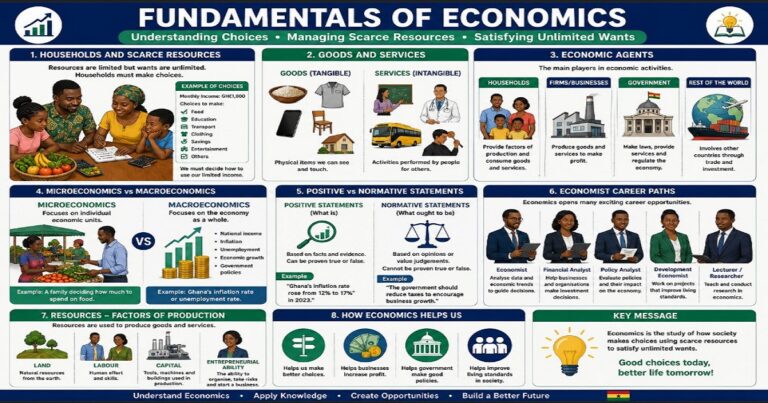
Every good or service we use requires resources to produce it. A school needs teachers, buildings and equipment. A farm needs land, labour, tools and organisation. These resources are known as the factors of production.
1. Production and Inputs
Production is the process of transforming inputs such as raw materials, labour and capital into goods or services that are desired and useful to consumers.
An input is a resource, material or other element used to produce goods or services or achieve a particular outcome.
The major factors of production are:
- Land
- Labour
- Capital
- Entrepreneurship
These factors are interdependent. They work together in the production process and are not equally available in every economy.
2. Land
Land refers to all natural resources used in production. It is described as a gift of nature.
Land includes:
- physical land;
- minerals;
- water;
- forests; and
- agricultural land.
Land is particularly important in activities such as agriculture, mining and forestry.
Example: A school farm uses agricultural land as a natural resource in production.
3. Labour
Labour is the human effort, skills and abilities applied to production.
It includes both physical and mental work.
| Type of Labour | Meaning |
|---|---|
| Physical labour | Manual work involving physical effort. |
| Intellectual labour | Mental and creative work. |
An Economics teacher, for example, provides intellectual labour. A person’s skills and abilities can affect the productive capacity of an economy.
4. Capital
Capital refers to man-made resources used in production.
Examples include:
- machinery;
- equipment;
- tools;
- buildings; and
- infrastructure.
Capital helps increase productivity and efficiency in production.
Capital can be divided into two types:
| Type | Meaning | Examples |
|---|---|---|
| Physical capital | Tangible assets used in production. | Machinery, equipment, tools and buildings. |
| Financial capital | Funds available for investment. | Savings in a bank account. |
5. Entrepreneurship
Entrepreneurship is the ability to organise and combine the other factors of production to create goods and services.
An entrepreneur:
- organises resources;
- combines land, labour and capital;
- takes risks;
- makes strategic decisions; and
- innovates.
Entrepreneurship can help introduce new products and services and create job opportunities.
Example: Creating a new product requires entrepreneurial ability to bring resources together and turn an idea into a productive activity.
6. Technology in Production
Technology represents knowledge, innovation and technical skills that improve productivity and contribute to economic advancement.
Technological advancement can improve the productivity of the other factors of production and contribute to increased economic output.
For example, digital applications and equipment can support production by improving how resources are used.
7. How the Factors Work Together
Production normally requires a combination of resources rather than one factor working alone.
Consider a school farm:
- Land: the agricultural land.
- Labour: the human effort used on the farm.
- Capital: tools, equipment and other man-made resources used in production.
- Entrepreneurship: the organisation and coordination of the resources.
Technology can improve how these factors are used.
8. Classifying Resources
Use the following examples to practise identifying the factors of production.
| Resource or Ability | Factor | Reason |
|---|---|---|
| Rain | Land | It is a natural resource. |
| Sunlight | Land | It is a natural resource. |
| School farm | Land | It represents agricultural land used in production. |
| Economics teacher | Labour | The teacher supplies human intellectual effort. |
| School nurse | Labour | The nurse supplies human effort and skills. |
| Laptop | Capital | It is a man-made resource used for productive activity. |
| Projector | Capital | It is equipment used in productive activity. |
| Sewing machine | Capital | It is equipment used in production. |
| Oven | Capital | It is man-made production equipment. |
| Savings in a bank account | Capital | It represents financial capital available for investment. |
| Visionary skills | Entrepreneurship | They support entrepreneurial decision-making and organisation. |
| Negotiation ability | Entrepreneurship | It supports the entrepreneur’s ability to organise and manage resources. |
| Creating a new product | Entrepreneurship | It demonstrates innovation. |
Note: Technology is an important contributor to production, but it is presented separately as knowledge, innovation and technical skills that improve the productivity of the other factors.
9. Check Your Understanding
1. Identify the four factors of production.
Answer: Land, labour, capital and entrepreneurship.
2. Why is land called a gift of nature?
Answer: Because it consists of natural resources used in production.
3. What is labour?
Answer: Labour is the human effort, skills and abilities applied to production.
4. Give two types of capital.
Answer: Physical capital and financial capital.
5. What is entrepreneurship?
Answer: It is the ability to organise and combine the other factors of production to create goods and services.
6. How can technology affect production?
Answer: Technology can improve the productivity of other factors of production and contribute to increased economic output.
10. Apply the Concept
A person wants to start a small production activity.
Question: Why would the person need more than one factor of production?
Answer: Production depends on resources working together. Land, labour, capital and entrepreneurship are interdependent and combine to make production possible.
Question: What happens if the person has equipment but no one with the required skills to use it?
Answer: The equipment alone cannot complete the production process. Human labour and other necessary factors must be combined with the capital.
11. Final Synthesis
Production transforms inputs into goods and services. The main factors of production are land, labour, capital and entrepreneurship.
Land provides natural resources. Labour provides human effort and skills. Capital provides man-made resources used in production. Entrepreneurship organises and combines the factors while involving risk-taking, decision-making and innovation.
Technology adds knowledge, innovation and technical skills that can improve the productivity of these factors.
The central lesson is simple: production succeeds when available resources are efficiently combined and utilised to create useful goods and services.
Access NaCCA-aligned Support Packs
Download your structured NaCCA-aligned Teacher Support Pack and Student Learning Pack, designed for clarity, practicality, and reliable teaching and learning.