The Factors of Production Explained for SHS 1 Economics (Sem. 1 – Week 8)
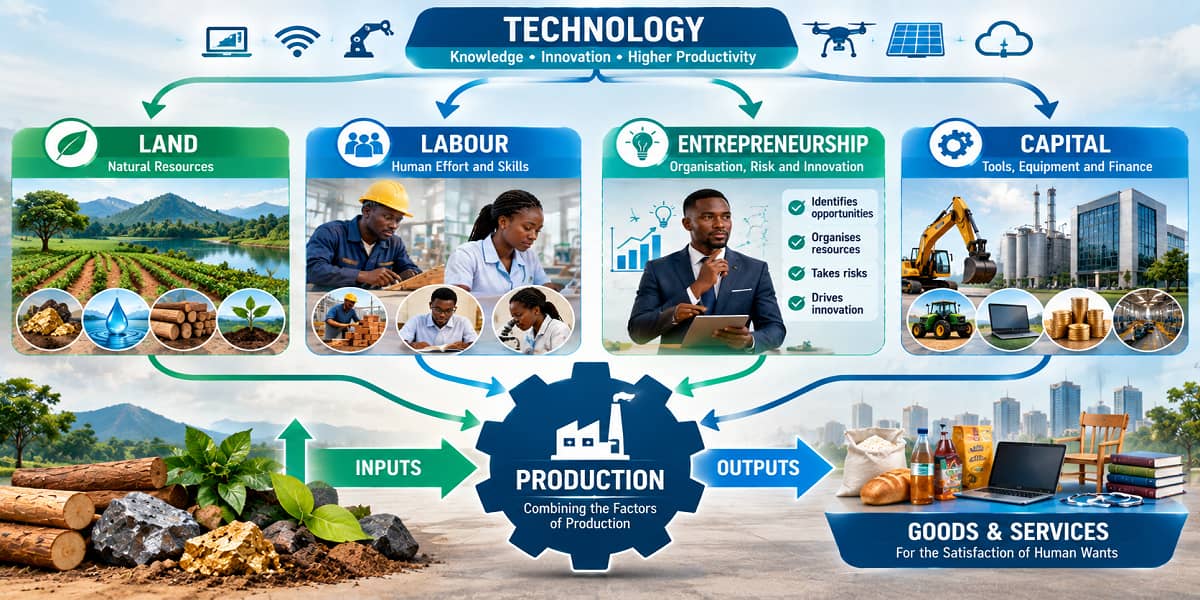
Before a loaf of bread reaches a consumer, resources have already been brought together. Someone provides natural resources, people contribute their skills, equipment supports the work, and someone must organise the entire process.
Economics groups these essential resources into the factors of production: land, labour, capital and entrepreneurship.
Production Begins With Inputs
Production is the process of transforming inputs into goods or services that are desired and useful to consumers.
An input is a resource, material or other element used to produce goods or services or achieve a particular outcome.
The factors of production are therefore the building blocks that make productive activity possible.
Land Is More Than the Ground Beneath Us
In Economics, land includes all natural resources used in production. It is a gift of nature.
That includes physical land, minerals, water, forests and agricultural land.
Consider agriculture. The land itself matters, but so do the natural resources that support productive activity. The same factor is also important in industries such as mining and forestry.
Human Ability Is Labour
A production process also requires people.
Labour represents the human effort, skills and abilities applied to production. It includes both physical and mental work.
| Physical Labour | Intellectual Labour |
|---|---|
| Manual physical effort. | Mental and creative skills. |
An Economics teacher contributes intellectual labour, just as other workers contribute their own forms of human effort and skill.
The quantity and quality of labour available can significantly influence an economy’s productive capacity.
Capital Helps People Produce
Capital consists of man-made resources used in production.
Machinery, equipment, tools, buildings and infrastructure can all contribute to production.
Capital has two forms in this topic:
- Physical capital: tangible assets used in production.
- Financial capital: funds available for investment.
A sewing machine, projector or oven illustrates physical capital. Savings in a bank account represent financial capital.
Capital matters because it can increase productivity and efficiency in the production process.
The Organising Force: Entrepreneurship
Even with land, labour and capital available, productive activity still requires organisation.
Entrepreneurship is the ability to organise and combine the other factors to create goods and services.
An entrepreneur takes risks, makes strategic decisions, innovates and brings together land, labour and capital.
Creating a new product is one example of entrepreneurial activity. Visionary and negotiation abilities can also support this role.
Technology Changes What Resources Can Do
The modern production process is increasingly influenced by technology.
Technology represents knowledge, innovation and technical skills that improve productivity and contribute to economic advancement.
Its importance lies partly in its ability to enhance the productivity of the other factors.
A technological improvement can therefore change how effectively available resources are used and may contribute to increased economic output.
Production Is a Team Effort
The four main factors are interdependent. This means they work together.
Consider a school farm.
| Factor | Role in the Farm |
|---|---|
| Land | Provides the agricultural land and natural resources. |
| Labour | Provides human effort, skills and abilities. |
| Capital | Provides tools and equipment used in production. |
| Entrepreneurship | Organises and combines the resources. |
Technology can then improve the way these resources are used.
Can You Identify the Factor?
Try classifying these examples: rain, an Economics teacher, a laptop, savings in a bank account, a sewing machine, visionary skills, negotiation ability and a school farm.
The key is to ask what each resource represents.
- Is it natural? Think land.
- Is it human effort or skill? Think labour.
- Is it a man-made production resource or investment fund? Think capital.
- Does it involve organising, innovating or coordinating resources? Think entrepreneurship.
Why Efficient Use Matters
Factors of production are not equally available in every economy. Their distribution and utilisation can vary.
Efficient allocation and utilisation are therefore important for economic development and growth.
This makes the study of production more than a list of definitions. It is also about understanding how available resources can be combined and used effectively.
A Production Puzzle
Imagine that a business has excellent equipment but does not have people with the required skills. The equipment alone cannot complete the production process.
Now imagine skilled workers without the necessary equipment or other resources. Their productive capacity may also be constrained.
The lesson is clear: production depends on combination and coordination.
Technology and the Modern Economy
Technology has become an important part of production in the 21st century.
It represents more than machines. Knowledge, innovation and technical skills can change how effectively the other factors are used.
Technology can therefore strengthen productive capacity by improving productivity and supporting economic advancement.
Think Like an Economist
Look at any productive activity around you and ask four questions:
- What natural resources are being used?
- What human effort and skills are involved?
- What man-made resources support the activity?
- Who organises and combines the resources?
Then ask a fifth question:
How could technology improve the productivity of these resources?
Key Ideas at a Glance
| Factor | Core Meaning |
|---|---|
| Land | Natural resources used in production. |
| Labour | Human effort, skills and abilities. |
| Capital | Man-made resources and financial funds used in production. |
| Entrepreneurship | Ability to organise and combine the other factors. |
Final Takeaway
Every productive activity depends on resources.
Land supplies natural resources. Labour contributes human effort and skills. Capital provides man-made resources and investment funds. Entrepreneurship organises and combines these resources through decision-making, risk-taking and innovation.
Technology adds knowledge, innovation and technical skills that can improve the productivity of the factors.
Understanding these relationships helps us see production not as the work of a single resource, but as a coordinated process in which different factors work together to create goods and services.
Access NaCCA-aligned Support Packs
Download your structured NaCCA-aligned Teacher Support Pack and Student Learning Pack, designed for clarity, practicality, and reliable teaching and learning.