Characters, Themes, Language and Style in Prose Explained for SHS 1 Literature-in-English (Sem. 1 – Week 6)
A fictional story can tell us about people, but it can also tell us something about the society those people inhabit. It can present ideas that emerge from human experience and use carefully selected language to make those ideas meaningful.
That is why character, theme, language and style deserve to be read together. Characters can model aspects of society, themes can reflect what happens in society, and language choices can influence how readers experience both.
Society as Material for Literature
The lesson material describes society as the raw material from which writers derive their themes. This provides a useful starting point for understanding literary themes.
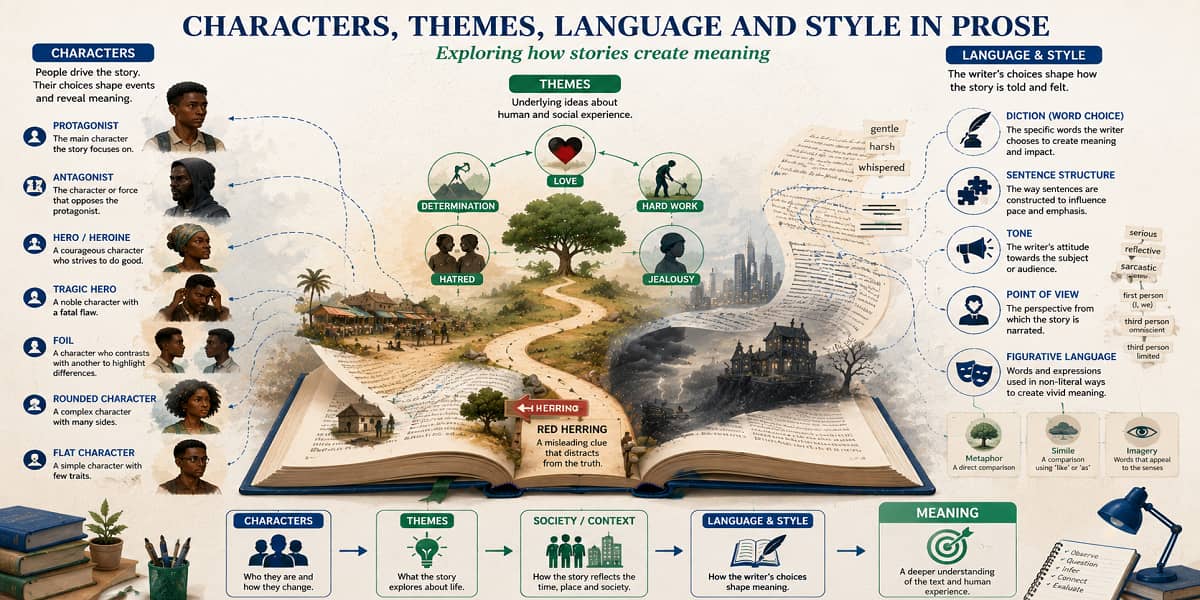
Human existence contains experiences such as love, hatred, determination, hard work and jealousy. These experiences can become themes in fictional works.
A theme, therefore, does not simply appear as a label attached to a story. It can emerge from the experiences and situations represented in the work.
Characters Give Social Ideas a Human Face
Characters are used to model happenings or hidden aspects in society. Through their experiences, relationships and actions, readers can examine situations represented by the writer.
The material uses Francis in Buchi Emecheta’s The Second Class Citizen as an example of a character reflecting how some cultures treat women. The example demonstrates how character analysis can move beyond asking who a person is in a story and towards asking what that character reveals about the context and society represented.
Not Every Character Has the Same Function
One of the first steps in character analysis is recognising the different roles characters can play.
| Character Type | What Makes It Distinctive? |
|---|---|
| Protagonist | The main character and usual focus of the story. |
| Antagonist | Opposes the main character. |
| Hero/Heroine | A main character who often faces conflicts and trials. |
| Tragic Hero | Has heroic virtues as well as a tragic flaw. |
| Foil | Highlights the protagonist’s qualities through contrasting actions and attitudes. |
| Rounded Character | Develops or changes as the plot unfolds. |
| Flat Character | Does not change greatly from beginning to end. |
These categories give readers different ways to describe how a character functions and develops.
Character Development Can Change Our Reading
Consider the difference between a character who remains almost the same throughout a narrative and one whose behaviour develops considerably as events unfold.
The first can be examined as a flat or one-dimensional character. The second may be a rounded character, particularly when the change reveals a complex and multi-sided nature.
This distinction encourages readers to follow characters across the plot rather than judging them from one isolated moment.
Can a Character Be Both Good and Bad?
Literary characters can contain contradictions. A character may display qualities that readers admire while also behaving in ways that readers criticise.
For that reason, character analysis should be evidence-based. Rather than declaring that a character is simply “good” or “bad”, identify actions and qualities that support both sides of the interpretation.
This approach can also help readers understand why some characters feel more complex and convincing than others.
From Theme to Thematic Meaning
Theme is a central idea. The material connects themes with what happens in society, using examples such as love, hatred, determination, hard work and jealousy.
But a strong literary discussion can go beyond naming one word.
For instance, determination may be a general theme. The next step is to examine what the text actually says or suggests about determination. This develops the general theme into a thematic statement grounded in the work.
That distinction is useful because two readers may identify the same general theme while interpreting its specific meaning differently based on the evidence they notice.
Character and Theme Meet in Context
A useful analytical chain is:
Character → Experience → Social Context → Theme
A character experiences events within a particular context. Those experiences can reveal something about society, while the broader idea emerging from them can contribute to the theme.
This does not mean that every character represents society as a whole. Instead, characters provide literary situations through which readers can examine particular aspects of social life.
Language Is Part of Meaning
Once we understand what characters and themes contribute, another question becomes important: How does the writer communicate all this?
The answer leads to style.
In literature, style refers to the way an author uses language to convey ideas by creating a distinctive voice and tone. It includes word choice, sentence structure and figurative language, among other elements.
These choices can create mood, imagery and meaning.
Diction: Why Word Choice Matters
Diction is the choice of words a writer uses to convey an idea, a point of view or to tell a story.
Imagine two passages describing the same event. Even without changing the event itself, changing the words can change the way the reader experiences it.
That is why literary analysis asks not only, “What does the writer say?” but also, “Why these words?”
Sentence Structure Shapes Presentation
Sentence structure concerns how the basic grammatical elements are employed in writing to enhance meaning.
When analysing sentence structure, examine the construction of sentences and connect your observation to meaning. Avoid simply labelling a sentence pattern without explaining its contribution to the passage.
Tone Reveals Feeling and Stance
Tone refers to the revelation of feelings, opinions and stance through choice of words.
The source makes an important distinction: tone can belong to the writer, but it can also belong to a created character. The material refers to Nick Carraway, the narrator in The Great Gatsby, and also mentions Abena’s point of view in The Kaya Girl by Mamle Wolo and Nelly Dean’s tone in Wuthering Heights by Emily Brontë.
When studying tone, therefore, ask who is expressing the feeling, opinion or stance and what word choices reveal it.
Point of View Controls Perspective
Point of view is the perspective through which a narrator tells a story. The material identifies first person, second person, third person and omniscient point of view, with second person described as rarely used.
Point of view can therefore influence the relationship between the narrator, the characters and the reader. It is one of the ways style shapes how a fictional world is presented.
Figurative Language Goes Beyond the Literal
Figurative language is the non-literal use of language that emphasises, clarifies and embellishes written and spoken language.
Its importance lies in what it contributes. A literary analysis should identify the figurative expression and then explain how the non-literal language contributes to emphasis, clarity, embellishment, mood, imagery or meaning.
Humour and Suspense Change the Reading Experience
Some language and narrative devices influence how readers experience a fictional work. The material specifically draws attention to humour and suspense.
Humour can shape the reader’s response to events, while suspense can build anticipation.
When analysing suspense, consider:
- Conflict — what opposing forces or situations create uncertainty?
- Pacing — how does the movement of the narrative contribute to anticipation?
- Red herrings — are there clues that deliberately mislead readers?
- Atmosphere — what emotional environment surrounds the events?
- High stakes — what makes the outcome important or uncertain?
The material also introduces Hitchcock’s term MacGuffin, described as a deliberately irrelevant clue, with examples including the diamonds in To Catch a Thief, the body in Rope and another body in The Trouble with Harry.
When Language and Character Work Together
A character can be understood through actions and experiences, but the language used to present that character also matters.
Word choice can reveal feelings or stance. Tone can shape our perception of the character. Point of view can determine the perspective from which we receive the character’s experiences. Figurative language can make descriptions more vivid.
This creates another useful analytical chain:
Character → Language → Reader’s Understanding
The character is the subject of representation; language is part of the means of representation.
A Practical Method for Close Reading
When faced with an unfamiliar fictional passage, try the following sequence:
- Identify the characters. Determine who is central and what roles others play.
- Look for development. Ask whether important characters change.
- Identify the central idea. Consider the theme emerging from the text.
- Connect character and context. Ask what social or contextual aspect the characters reveal.
- Examine diction. Notice significant word choices.
- Examine sentence structure. Consider how sentence construction contributes to meaning.
- Identify tone. Look for feelings, opinions or stance.
- Determine point of view. Identify the narrator’s perspective.
- Look for figurative language. Consider its contribution to meaning.
- Notice humour or suspense. Where present, explain how these devices affect the reader.
The Evidence Matters
Literary analysis becomes more convincing when interpretations are supported by details from the text.
If you claim that a character is changing, identify the behaviour that demonstrates the change. If you identify a theme, connect it to the experiences and events that support it. If you identify a particular tone, point to the words that reveal the feeling or stance.
This approach helps transform an opinion into an interpretation supported by textual evidence.
A Collaborative Way to Learn
Character and theme analysis can benefit from discussion. In group work, learners can compare interpretations of major and minor characters, rounded and flat characters, and the development of main and sub-themes.
Groups can also turn general themes into thematic statements and present how characters and themes reflect context and society.
A short dramatic sketch can provide another way of understanding character. The learning material proposes a 10–15-minute sketch depicting the characters studied.
Writing with Style
Understanding style is not only about analysing other writers. Learners can experiment with style themselves.
For example, one paragraph can focus on descriptive language while another uses short, simple sentences incorporating exaggerations or proverbs.
After writing, the important question is: What did the chosen language and style contribute to the meaning?
A Final Analytical Framework
| Area | Central Question |
|---|---|
| Character | Who is presented, and what role does the character play? |
| Development | Does the character change as the plot unfolds? |
| Theme | What central idea emerges? |
| Context and society | What aspect of society does the work reveal? |
| Diction | Why has the writer selected these words? |
| Sentence structure | How does sentence construction enhance meaning? |
| Tone | What feelings, opinions or stance are revealed? |
| Point of view | Through whose perspective is the story narrated? |
| Figurative language | How does non-literal language emphasise, clarify or embellish meaning? |
Conclusion
To analyse fictional prose well, readers need to look at both what is represented and how it is represented.
Characters provide human experiences through which readers can examine context and society. Themes express central ideas connected to those experiences. Language and style determine many of the ways those ideas reach the reader.
The result is a richer way of reading. Instead of asking only what happened in a story, ask who experienced it, what idea it reveals, what society it reflects, and how the writer’s language makes that meaning possible.
Access NaCCA-aligned Support Packs
Download your structured NaCCA-aligned Teacher Support Pack and Student Learning Pack, designed for clarity, practicality, and reliable teaching and learning.