Revenue: Concepts and Calculation of Total, Average and Marginal Revenue Explained for SHS 2 Economics (Sem. 1 – Week 9)
When a business sells a product, the money received from those sales is its revenue. Understanding revenue allows us to move beyond simply asking how many products were sold and examine how much income those sales generate.
Revenue Is Not the Same as Profit
Revenue is the total income generated from sales. Profit is different: it is what remains after costs and taxes have been deducted from revenue.
Revenue may come from the firm’s main activities, known as operating revenue, or from secondary activities, known as non-operating revenue.
A Simple Revenue Relationship
The starting point is straightforward:
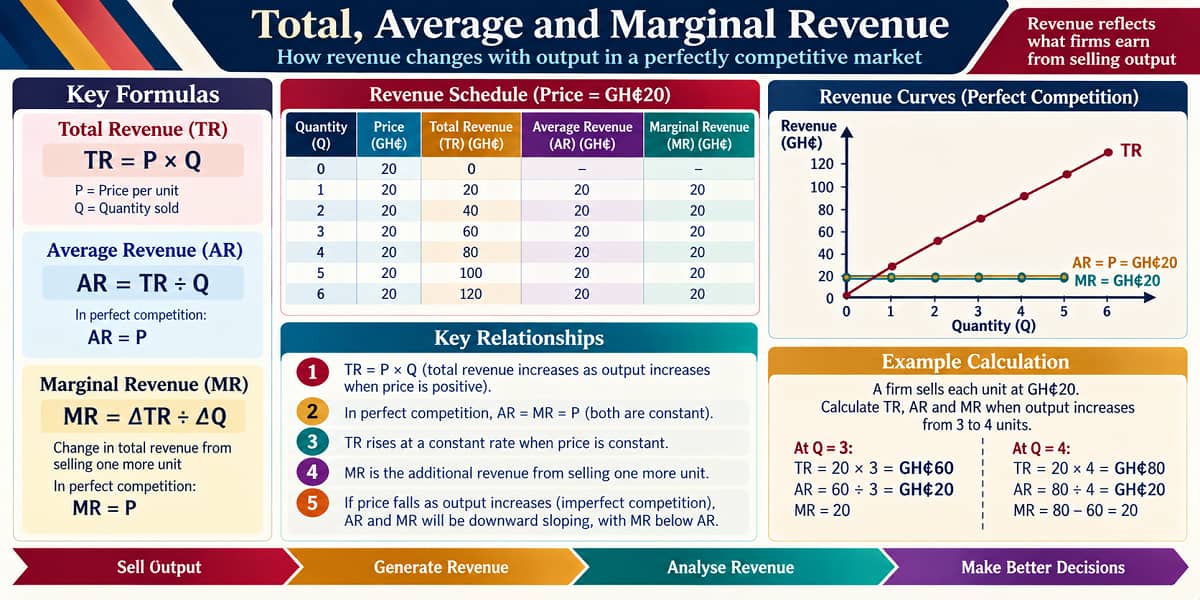
TR = Price × Quantity Sold
For example, a bakery selling 10,000 loaves at GH₵20 each receives:
TR = 10,000 × GH₵20 = GH₵200,000
If it also sells 2,000 pastries at GH₵10 each:
TR = 2,000 × GH₵10 = GH₵20,000
Three Questions About Revenue
Economists use three related measures to examine sales income:
| Question | Measure | Formula |
|---|---|---|
| How much income did all sales generate? | TR | P × Q |
| How much income was generated per unit? | AR | TR ÷ Q |
| How much extra income came from additional sales? | MR | ΔTR ÷ ΔQ |
From Total to Average
Suppose a seller earns GH₵1,000 from selling 100 bowls of fufu.
TR = GH₵1,000
Revenue per bowl is:
AR = GH₵1,000 ÷ 100 = GH₵10
Average revenue therefore converts total sales income into an amount earned per unit.
What Does the Next Sale Add?
Marginal revenue asks a different question: how much additional revenue results from selling more?
If revenue rises from GH₵500 at 50 bowls to GH₵1,000 at 100 bowls:
MR = (GH₵1,000 − GH₵500) ÷ (100 − 50)
MR = GH₵500 ÷ 50 = GH₵10
So each additional bowl in this example contributes GH₵10 of marginal revenue.
A Useful Pattern
Consider a product sold at GH₵10 per unit:
| Quantity | Price | TR | AR | MR |
|---|---|---|---|---|
| 1 | GH₵10 | GH₵10 | GH₵10 | GH₵10 |
| 2 | GH₵10 | GH₵20 | GH₵10 | GH₵10 |
| 3 | GH₵10 | GH₵30 | GH₵10 | GH₵10 |
| 4 | GH₵10 | GH₵40 | GH₵10 | GH₵10 |
| 5 | GH₵10 | GH₵50 | GH₵10 | GH₵10 |
Here, each additional unit adds GH₵10 to total revenue. Therefore, both AR and MR remain GH₵10 in this example.
Revenue and Production Decisions
Revenue information becomes particularly useful when considered alongside cost. Marginal revenue can be compared with marginal cost when a firm is considering whether to increase production. The topic therefore connects sales income with production decisions.
Try It Yourself
A trader sells 80 units of a product at GH₵15 each.
TR = GH₵15 × 80 = GH₵1,200
Therefore:
AR = GH₵1,200 ÷ 80 = GH₵15
If revenue was GH₵900 when 60 units were sold, then:
MR = (GH₵1,200 − GH₵900) ÷ (80 − 60)
MR = GH₵300 ÷ 20 = GH₵15
Key Ideas
- Revenue is income received from selling goods and services.
- TR is total sales income.
- AR is revenue per unit sold.
- MR is the additional revenue resulting from an increase in quantity sold.
- Revenue should not be confused with profit.
- MR can be compared with MC when considering changes in production.
Access NaCCA-aligned Support Packs
Download your structured NaCCA-aligned Teacher Support Pack and Student Learning Pack, designed for clarity, practicality, and reliable teaching and learning.