Relationship Between Plot, Subplots and Conflict Explained for SHS 1 Literature-in-English (Sem. 1 – Week 8)
Every memorable story has movement. Characters want something, obstacles stand in their way, events become more complicated, and eventually the story reaches a decisive point before moving towards its end.
That movement is shaped by plot. But plot does not work alone. Conflict supplies the dramatic struggle that drives development, while subplots can add secondary narratives that influence or reflect the main story.
Plot Is the Architecture of a Story
Plot is a literary element that provides the structure of a story. It determines how events and actions are arranged so that the narrative develops rather than simply becoming a random sequence of happenings.
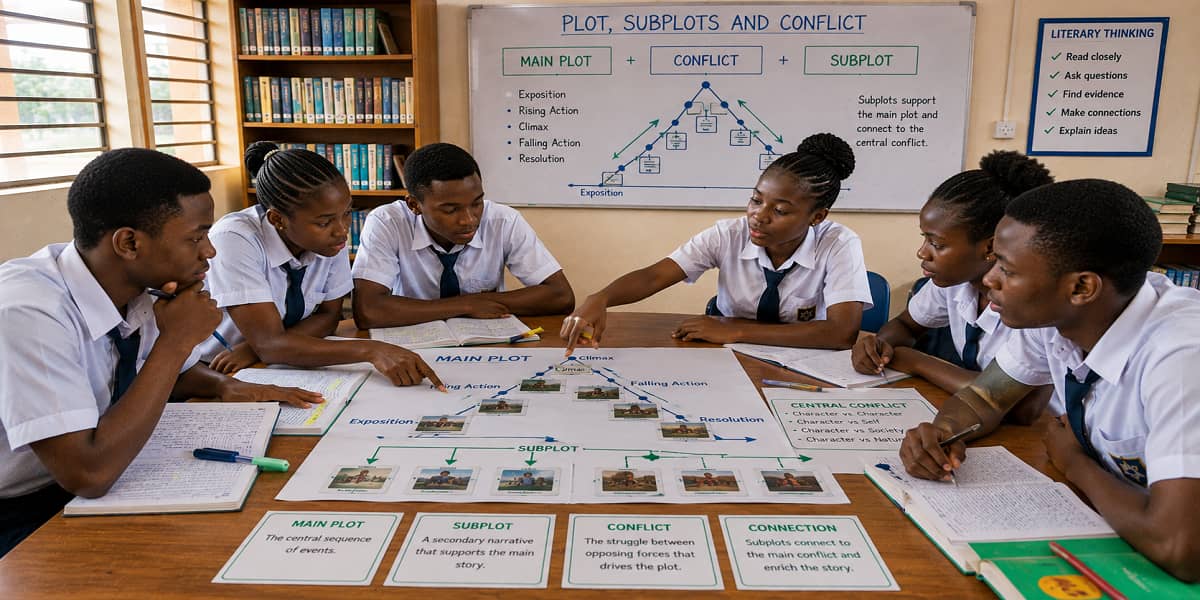
The plot diagram in the weekly material presents five major stages: exposition, rising action, climax, falling action and resolution. The exposition introduces characters and setting; the rising action involves the main character facing conflicts; the climax is the most exciting part of the story; the falling action presents events leading towards the end; and the resolution marks the end of the story.
Conflict Is What Makes the Story Move
The weekly material defines conflict as the dramatic struggle between two forces which helps the development of the plot.
This gives conflict a central position in narrative structure. Without some form of dramatic struggle, there is generally little reason for the story to develop.
Think of plot as the path of the story and conflict as one of the forces pushing the story along that path.
Conflict creates struggle. Struggle creates action. Action develops plot.
Subplots Add Another Narrative Layer
A subplot is a minor story or digression within a main story or main plot.
It may involve the main characters or other characters whose narrative interaction influences the development of the main plot. It may also reflect what is happening in the main plot in a comic or tragic way.
That last point is important. A subplot is not necessarily an unrelated side story. Its relationship to the main narrative can be significant.
Main Plot Versus Subplot
| Main Plot | Subplot |
|---|---|
| Central story. | Secondary story or digression. |
| Usually revolves around the protagonist and his or her conflict. | May involve the protagonist, other characters or both. |
| Provides the principal narrative line. | Can influence the main narrative line. |
| Contains the central conflict and development. | Can increase, complicate or reflect the central conflict. |
Romeo and Juliet: A Clear Illustration
The weekly material uses Romeo and Juliet to illustrate the relationship.
The main plot follows the love story between Romeo and Juliet. Alongside it, the story of the two families, the Montagues and Capulets, functions as a subplot.
The family narrative increases the conflict surrounding the young lovers’ forbidden romance. The example therefore shows that a subplot can become an important force in the development of the main story.
The relationship can be summarised as:
Main plot: the lovers’ story.
Subplot: the conflict involving the two families.
Effect: the subplot increases the conflict surrounding the central romance.
Why the Difference Matters
If a reader identifies only the main story, an important part of the narrative structure may be missed. Secondary characters and events can sometimes explain why the central conflict becomes more intense.
This is why a useful question when reading prose is not simply “What else happens?” but:
“What does this secondary story do to the main story?”
Follow the Protagonist
A practical way to locate the main plot is to follow the protagonist.
Ask:
- Who is the central character?
- What conflict does this character face?
- Which major events grow out of that conflict?
- Where does the action reach its climax?
- How is the conflict eventually brought towards resolution?
The answers create a basic map of the main plot.
Then Look Sideways
Once the main narrative has been identified, look for other story lines.
A possible subplot may centre on another character. It may contain its own sequence of events while remaining connected to the larger narrative. Its importance becomes clearer when we examine its influence on the main plot.
Look for:
- secondary characters with significant narrative interactions;
- events that affect the protagonist’s circumstances;
- stories that increase the central conflict; and
- secondary narratives that reflect the main action in a comic or tragic way.
The Plot Pyramid as a Reading Tool
The plot diagram can be used as more than a picture of story structure. It can become a reading tool.
| Stage | Question for the Reader |
|---|---|
| Exposition | Who and what are introduced at the beginning? |
| Rising Action | How do conflict and action develop? |
| Climax | Where does the story reach its decisive or most exciting point? |
| Falling Action | What events lead towards the end? |
| Resolution | How does the story end? |
Subplots Can Intersect the Main Plot
Imagine drawing the main plot as one line and a subplot as another. At certain points, the two lines may meet.
Those meeting points can be especially important because the subplot has begun to influence the central narrative.
A useful analytical sequence is:
Secondary narrative → interaction → effect on conflict → development of main plot.
This is one of the clearest ways to demonstrate the relationship among the three concepts.
Conflict Is a Bridge Between Plot and Subplot
Conflict can connect the main and secondary narratives.
A subplot may introduce circumstances that intensify the protagonist’s struggle. Alternatively, a secondary narrative may reflect the same kind of struggle in another context.
In either case, conflict helps explain why the subplot matters to the larger story.
Reading for Narrative Evidence
Good literary analysis requires evidence. If you claim that a subplot increases the conflict, identify the events that demonstrate the increase.
If you say that the plot has reached its climax, identify the event or point at which the outcome becomes clear.
If you identify the main plot, show how it revolves around the protagonist and his or her conflict.
Evidence changes a general statement into an analytical argument.
A Practical Reading Map
When studying a prescribed prose text, create three columns in your notes:
| Main Plot | Subplot | Conflict |
|---|---|---|
| Record the central events involving the protagonist. | Record secondary narratives and characters. | Record the struggles that drive or complicate the action. |
Then draw arrows showing where the subplot affects the conflict or where the conflict causes the main plot to develop.
From Analysis to Storytelling
The same framework can be used when writing a story.
Start with a protagonist and a central conflict. Build the action through the stages of plot. Then consider whether a subplot can add another layer to the narrative.
The subplot should have a meaningful relationship with the main story rather than simply adding unrelated events.
A Short Story Blueprint
- Exposition: Introduce the characters and setting.
- Central conflict: Establish the dramatic struggle.
- Rising action: Develop the struggle through events.
- Subplot: Introduce a secondary narrative connected to the main story.
- Climax: Bring the central action to its most exciting or decisive point.
- Falling action: Present events leading towards the end.
- Resolution: End the story.
This follows the plot structure represented in the weekly material.
Learning Through Performance
One effective way to understand plot and subplot is to act out key scenes from a selected prose text.
Role-playing can make the narrative relationships visible. One group can identify the central story while another identifies the secondary narrative. After the performance, the class can discuss how the two strands interact.
Create a Visual Representation
A drawing can show the relationship among plot, subplot and conflict more clearly than a paragraph alone.
Start with the main plot at the centre. Place the protagonist and central conflict on the main line. Then add the subplot and use arrows to show where it influences the central narrative.
Such a visual representation can reveal relationships that are easy to overlook during ordinary reading.
The Creative Challenge
The weekly material asks learners to create a short story referring to the plot structure represented by the plot pyramid. A more demanding extension is to create a song that tells a story using the same structure and includes a moral lesson.
These activities demonstrate that understanding narrative structure is not only useful for literary analysis. It can also support creative expression.
Three Questions That Unlock the Structure
When you are unsure how to analyse a prose narrative, return to three questions:
What is the main story?
Identify the protagonist and central plot.
What is the struggle?
Identify the conflict that drives development.
What other story is influencing this one?
Identify the subplot and explain its relationship with the main plot.
These questions can turn a complicated narrative into a manageable analytical structure.
Final Perspective
Plot, subplots and conflict are best understood as interacting elements.
Plot gives the story its structure. Conflict provides dramatic struggle and helps the plot develop. Subplots introduce secondary narratives that can influence the main story or reflect its events in a comic or tragic way.
The example of Romeo and Juliet makes the relationship especially clear: the central love story is complicated by the subplot involving the Montagues and Capulets, and that secondary narrative increases the conflict surrounding the forbidden romance.
When reading prose, therefore, do not stop at asking what happened. Ask how the events are organised, what conflict drives them, which secondary stories are involved, and how those stories connect. That is the beginning of serious prose appreciation.
Access NaCCA-aligned Support Packs
Download your structured NaCCA-aligned Teacher Support Pack and Student Learning Pack, designed for clarity, practicality, and reliable teaching and learning.