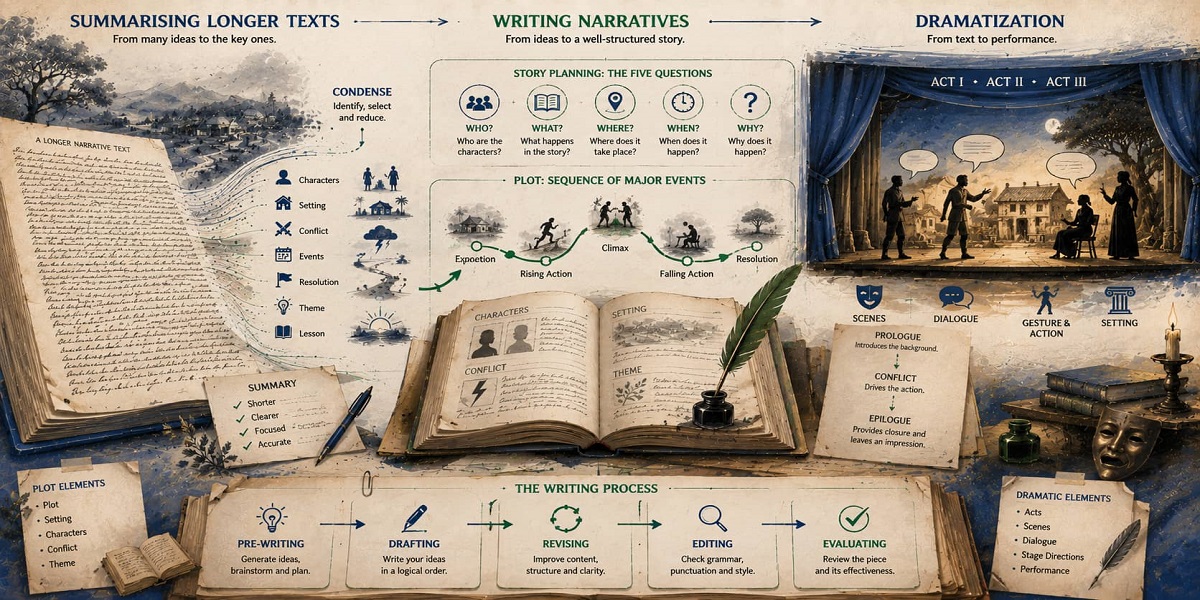
Summarising Longer Texts and Writing and Dramatizing Narratives
Reading a long literary text involves more than remembering everything that happens. A skilled reader can identify the important ideas, organise them and express them briefly in their own words. A skilled writer can also turn ideas into a coherent narrative by developing a setting, plot and characters. A narrative can then be brought to life through dramatisation.
This lesson develops three connected skills: summarising longer texts, producing narrative pieces and dramatizing portions of narratives.
1. What Is a Summary?
A summary is a shortened account of a text that presents its important ideas without unnecessary details.
A literary summary begins with an introductory sentence stating the title, author and main point of the text.
A good literary summary is written in your own words. It contains only ideas from the original text. Your personal ideas and opinions should not be added when summarising a literary text.
What a Literary Summary Contains
- The title of the text.
- The author’s name.
- The main point or central idea of the text.
- The important events or ideas.
- Relevant characters.
- The important conflict.
- What the writer seeks to achieve with the text.
What a Summary Avoids
- Personal opinions.
- Unnecessary details.
- Ideas that are not found in the original text.
- Long explanations of minor events.
- Copying the original text instead of using your own words.
2. Why Summarising Requires Careful Reading
You cannot produce a reliable summary without first understanding the text. A long story may contain many characters, events and descriptions, but not every detail has equal importance.
The summariser must distinguish between the main ideas and the supporting details.
For a narrative, this means paying attention to the characters, important events, conflict and the direction of the plot.
3. Five Steps for Summarising a Longer Text
The weekly material presents five recommended steps for producing a summary.
- Read the text in detail.
- Break the text down into sections.
- Identify the key points in each section.
- Put the key points together to make the summary.
- Check the elements in the summary.
Step 1: Read the Text in Detail
Begin by reading carefully. You need to understand the text before deciding what should appear in your summary.
For a narrative, identify the characters, setting, important events and conflict.
Step 2: Break the Text into Sections
A long text can be easier to manage when it is divided into meaningful sections. A section may correspond to a chapter, an important stage of the story or a major change in events.
Step 3: Identify the Key Points
Ask what the reader must know from each section to understand the story.
Focus on events and ideas that contribute to the development of the narrative rather than collecting every detail.
Step 4: Combine the Key Points
After identifying the important points, connect them into a coherent shortened account.
The summary should read as a continuous piece of writing rather than as a disconnected list of notes.
Step 5: Check the Summary
Check whether the summary identifies the relevant characters, conflict and what the writer seeks to achieve with the text.
4. A Summary Is Not a Personal Response
Suppose a story describes a character facing a difficult decision. A summary should report the important development in the story. It should not become an opportunity to explain whether you personally agree with the character.
Compare the two approaches:
| Summary Writing | Personal Response |
|---|---|
| Reports the important ideas and events. | Expresses personal reactions or opinions. |
| Uses the writer’s ideas from the text. | Adds the reader’s own ideas. |
| Uses your own words to present the original ideas. | May evaluate, criticise or judge the text. |
Keep these purposes separate when writing a literary summary.
5. Chapter-by-Chapter Summarising
One useful way of managing a long prose text is to produce a chapter-by-chapter summary.
For each chapter, record:
- the important characters;
- the major events;
- the conflict or change in circumstances;
- the important development in the plot; and
- the key point of the chapter.
Once all the chapters have been summarised, the summaries can be combined into a shorter account of the whole work.
6. Summary Planning Grid
| Section/Chapter | Characters | Key Events | Conflict/Development | Main Point |
|---|---|---|---|---|
| Section 1 | Who matters? | What happens? | What changes? | What should be retained? |
| Section 2 | Who matters? | What happens? | What changes? | What should be retained? |
| Section 3 | Who matters? | What happens? | What changes? | What should be retained? |
7. From Summary to Narrative Writing
Summarising helps you understand how stories are constructed. Narrative writing asks you to use that understanding to create your own story.
When producing a narrative piece, the writing process includes:
- Pre-writing
- Drafting
- Revising
- Editing
- Evaluating
The weekly material presents these as stages to consider when producing a narrative piece with elements such as plot and setting.
8. Pre-Writing
Pre-writing is the first preparation a writer undertakes before producing the first draft.
It helps the writer:
- select an appropriate topic;
- gather important details;
- organise thoughts; and
- prepare the ingredients needed for the writing.
Good preparation reduces confusion during drafting because the writer already has an idea of what the story will contain.
9. Drafting
Drafting is the stage at which the writer develops a complete first version of the piece.
During drafting, pay attention to:
- setting;
- plot;
- character and characterisation;
- conflict; and
- point of view.
The first draft does not have to be perfect. Its purpose is to develop the complete version that can later be improved.
10. Revising
Revising takes place after the first draft has been written.
It involves improving the work through:
- additions;
- corrections;
- rephrasing; and
- checking whether the goals of the writing have been achieved.
Revision therefore looks at the quality and effectiveness of the writing as a whole.
11. Editing
Editing focuses on correcting errors and making words and sentences clearer, more precise and more effective.
When editing, examine your language carefully. Look for unclear sentences, unnecessary wording and errors that interfere with meaning.
12. Evaluating
Evaluating means reading the entire work thoroughly and assessing its effect.
The weekly material identifies areas such as diction, sentences, style and structure as matters to consider during evaluation.
13. The Writing Process at a Glance
| Stage | Main Purpose |
|---|---|
| Pre-writing | Choose, gather and organise ideas. |
| Drafting | Develop the complete first version. |
| Revising | Improve content through additions, corrections and rephrasing. |
| Editing | Correct errors and improve clarity, precision and effectiveness. |
| Evaluating | Assess the complete work, including diction, sentences, style and structure. |
14. Building an Effective Setting
A narrative needs a convincing setting. The setting should help readers understand where and when the story occurs.
The weekly material recommends several approaches.
Use Sensory Details
Use the five senses and colour to help readers experience the setting.
Think about what characters can see, hear, smell, taste and feel.
Use Description Instead of Narration
Give readers meaningful descriptive details rather than simply telling them that a place is beautiful, frightening or busy.
Use Concrete Locations
Choose specific, concrete locations instead of relying only on abstract descriptions.
Indicate Time and Moments
Make clear when events occur and how the passage of time relates to the story.
Incorporate Imagery
Use imagery to create a clearer impression of the setting.
Focus on Relevant Details
Include details that matter to the story. Too many unnecessary details can distract the reader.
15. The 5 Ws of Story Writing
When developing a narrative, five questions provide a useful framework:
- Who?
- What?
- Where?
- When?
- Why?
The weekly material uses these questions to cover both plot and setting.
| Question | What It Helps You Establish |
|---|---|
| Who? | The people or characters involved. |
| What? | What happened or what event disrupted the normal line of activities. |
| Where? | The location of the events. |
| When? | The time when the events occurred. |
| Why? | The reason the event happened. |
16. Developing the Plot with the 5 Ws
Before writing, answer the five questions in note form.
Who? Identify the main character or characters.
What? Identify the event that disrupts the normal line of activities.
Where? Identify the location.
When? Identify the time.
Why? Identify the reason the event happens.
These answers give you a basic narrative framework from which you can develop the plot and setting.
17. Story Planning Template
| Question | Your Planning Notes |
|---|---|
| Who? | Main character(s) and other important characters. |
| What? | The important event that disrupts normal activities. |
| Where? | Specific location. |
| When? | Time, period or moment. |
| Why? | Reason behind the important event. |
18. From Planning to a Narrative
Once the five questions have been answered, organise the information into a story.
Start with the setting and characters. Introduce the situation. Then develop the event that disrupts the normal line of activities. Allow the plot to develop through the characters’ responses and actions.
As you write, remember that the five Ws are a planning tool. The finished narrative should read naturally rather than like a list of questions and answers.
19. Example of a Narrative Planning Idea
Imagine that you want to write about a young character who discovers something unexpected during an ordinary day.
Your planning could begin with:
- Who? A young main character and relevant supporting characters.
- What? An unexpected event interrupts the normal day.
- Where? A specific location.
- When? A clearly established time.
- Why? A reason that explains the unexpected event.
From these notes, you can develop the characters, setting and plot into a complete narrative.
20. Organising Events
The visual organiser on page 51 presents a useful sequence of main events and supporting details. It encourages the writer to organise events in order and add relevant details to each one.
A simple sequence is:
Main Event 1 → Main Event 2 → Main Event 3 → Main Event 4
Under each main event, add supporting details that help readers understand what happened.
21. The Importance of Supporting Details
A narrative should not contain only a list of major events. Supporting details make those events clearer and more meaningful.
The organiser shown in the weekly material encourages writers to add details describing events through the five senses: sight, hearing, taste, touch and smell.
Use details that contribute to the story rather than filling the narrative with unnecessary description.
22. Using Digital Tools in Narrative Writing
A narrative can be developed with digital tools. The weekly material encourages learners to produce drafts of short stories using digital tools and to reconstruct narratives into creative forms such as animations, storytelling sessions and review blogs or vlogs.
The important principle is that technology should support the organisation and presentation of the narrative.
23. Creativity, Culture and Ethical Language
Narrative writing allows writers to connect meaningfully with different cultures and experiences.
When creating stories with others, writers should:
- tolerate and be sensitive to one another;
- use language ethically;
- be creative and original; and
- show integrity and honesty.
Creative writing should communicate ideas without relying on harmful stereotypes or careless representations.
24. What Is Dramatization?
Dramatization involves using a script with accompanying actions as in a play or movie.
It engages learners with literature through reading, discussion and presentation of a poem, story or play.
By studying a plot and roles, you can develop a better understanding of characters and themes.
25. From Narrative to Performance
A written narrative tells events through prose. A dramatization brings selected portions of those events to life through actions, dialogue, roles and performance.
This means that the writer or performer must decide which parts of the narrative are most suitable for dramatic presentation.
26. Seven Steps for Dramatizing a Narrative
The weekly material gives a sequence for turning narrative material into a dramatic presentation.
- Select the type of narrative.
- Briefly summarise and identify the main plot.
- List the key characters.
- Divide the narrative into acts and scenes.
- Focus on actions and introduce dialogue.
- Add dramatic devices such as musical interludes, prologue and epilogue.
- Dramatize portions of the narrative with attention to setting.
27. Select the Narrative
Begin with a written narrative or prescribed story that you want to dramatize.
Select a portion that contains meaningful action and characters. The chosen section should be manageable enough to perform while still communicating an important part of the narrative.
28. Identify the Main Plot
Before performing, make sure you understand the story.
Briefly summarise the narrative and identify its main plot. If the selected portion includes a subplot, identify how that subplot connects with the larger narrative.
29. Identify the Characters
List the key characters who appear in the selected portion.
For each character, understand the role the character plays in the action. This makes it easier to decide how the character should speak and act during the performance.
30. Divide the Narrative into Acts and Scenes
Group major events and incidents into manageable dramatic sections.
A scene can focus on a particular event or interaction. Several connected scenes can form an act.
This organisation helps the audience follow the development of the narrative.
31. Turn Description into Action
Written narratives often contain descriptions that cannot simply be read aloud during a performance.
When dramatizing, focus on actions. Show what characters are doing and allow dialogue to communicate what they say.
Body language, gestures and facial expressions can also communicate meaning.
32. Introduce Dialogue
Dialogue allows characters to speak directly to one another.
When adapting narrative material, identify important exchanges and turn them into natural spoken interactions while preserving the meaning of the selected narrative.
33. Dramatic Devices
The weekly material identifies devices such as:
- Musical interludes
- Prologue
- Epilogue
These can help shape the presentation of the dramatized narrative.
34. Setting in Dramatic Performance
The setting should remain visible in the performance.
Think about how the location, time and atmosphere can be communicated through the arrangement of the performance space, movement and relevant actions.
The goal is to help the audience understand where and when the dramatic events are occurring.
35. Dramatizing a Subplot
A subplot can provide an especially interesting portion for dramatization because it may involve a distinct group of characters and events while remaining connected to the main narrative.
First identify the subplot. Then determine:
- the characters involved;
- the key events;
- the conflict or tension;
- the connection to the main plot; and
- the scenes that can be performed.
36. Performance Skills
When performing a scripted drama, pay attention to:
- voice;
- body language;
- gestures;
- facial expressions;
- actions; and
- appropriate movement.
The meaning of a dramatic scene is communicated through more than words.
37. From Reading to Performance
A useful sequence for transforming a narrative into a performance is:
Read → Summarise → Identify Plot → Identify Characters → Select Scenes → Add Dialogue → Rehearse → Perform.
Each stage depends on understanding the previous one.
38. Integrated Practice: Read, Summarise and Dramatize
Choose a portion of a narrative text.
- Read it carefully.
- Identify its important events.
- Write a short summary.
- Identify the main plot.
- Identify any subplot.
- List the characters.
- Identify the setting.
- Divide the events into scenes.
- Convert important actions and interactions into dramatic form.
- Rehearse and present the scene.
This activity brings together the three major skills of the week.
39. Practice: Summarise a Paragraph
Choose a paragraph from a literary text.
First identify its main point. Remove details that are not essential to understanding that point. Then express the remaining idea in your own words.
Answer check: A successful summary should retain the original paragraph’s important idea while avoiding personal opinions and unnecessary details.
40. Practice: Build a Narrative
Create a short narrative by answering the five questions:
- Who is involved?
- What happens to disrupt normal activities?
- Where does it happen?
- When does it happen?
- Why does it happen?
Use the answers to create a coherent story with a recognisable plot and setting.
41. Practice: Create a Story Map
Organise your story into major events and supporting details.
| Sequence | Main Event | Supporting Details |
|---|---|---|
| First | What begins the story? | Details that establish the event. |
| Next | What happens next? | Details that develop the action. |
| Then | What important event follows? | Relevant sensory or narrative details. |
| Finally | How does the story move towards its ending? | Details that support the final event. |
42. Practice: Dramatize a Scene
Select a scene from a narrative.
Identify the characters, actions and setting. Write or adapt dialogue where appropriate. Decide where the scene begins and ends, then perform it using suitable gestures, voice modulation and body language.
After the performance, explain how the scene contributes to the larger narrative.
43. Review Questions
Recall
Question 1: What is a summary?
Answer: A summary is a shortened presentation of the ideas of a text in the writer’s own words. A literary summary begins with the title, author and main point and contains only ideas from the original text.
Question 2: List the five recommended steps for summarising a longer text.
Answer: Read the text in detail; break it into sections; identify the key points in each section; put the key points together; and check the summary for character identification, conflict and what the writer seeks to achieve.
Question 3: What are the five stages of producing a narrative piece?
Answer: Pre-writing, drafting, revising, editing and evaluating.
Question 4: What are the 5 Ws of story writing?
Answer: Who, what, where, when and why.
Question 5: What is dramatization?
Answer: Dramatization involves using a script with accompanying actions as in a play or movie to engage with literature through reading, discussion and presentation.
Conceptual Understanding
Question: Why should a summary be written in your own words?
Answer: A summary presents the original text’s important ideas in a shortened form. Using your own words demonstrates that you have understood and reorganised those ideas rather than simply copying the original text.
Question: Why is pre-writing important?
Answer: Pre-writing helps the writer select a topic, gather important details and organise thoughts before beginning the first draft.
Question: What is the difference between revising and editing?
Answer: Revising improves the draft through additions, corrections and rephrasing and checks whether the goals have been achieved. Editing focuses on correcting errors and making words and sentences clearer, more precise and effective.
Strategic Reasoning
Question: How would you turn a long narrative into a summary?
Answer: Read the narrative carefully, divide it into sections, identify the key points in each section, combine those points into a coherent shortened account and check that the summary retains relevant characters, conflict and the writer’s main purpose without adding personal opinions.
Question: How would you prepare a narrative for dramatization?
Answer: Select the narrative, summarise it, identify the main plot and key characters, divide important events into acts and scenes, convert important actions into dramatic presentation with dialogue, add appropriate dramatic devices and present the selected portions with attention to setting.
Extended Critical Thinking
Question: How can summarising, narrative writing and dramatization work together?
Answer: Summarising develops the ability to identify and organise the important parts of a narrative. Narrative writing uses understanding of plot and setting to create a new story. Dramatization then transforms selected narrative events into performance through characters, actions, dialogue, setting and dramatic devices. Together, the three processes require the learner to understand, reorganise, create and present narrative meaning.
44. Final Synthesis
A strong summary is selective: it keeps the important ideas and removes unnecessary details. A strong narrative is organised: it develops characters, setting and plot through a deliberate writing process. A strong dramatization is purposeful: it selects meaningful narrative portions and transforms them into actions, dialogue and performance.
The central process can be remembered as:
Understand → Select → Organise → Write → Improve → Evaluate → Perform.
When you can move confidently from reading a long narrative to summarising it, from planning ideas to writing your own narrative, and from written narrative to dramatic performance, you demonstrate a deeper understanding of how stories are constructed and communicated.
Access NaCCA-aligned Support Packs
Download your structured NaCCA-aligned Teacher Support Pack and Student Learning Pack, designed for clarity, practicality, and reliable teaching and learning.