Summarising Longer Texts and Writing and Dramatizing Narratives Explained for SHS 1 Literature-in-English (Sem. 1 – Week 9)
Stories can be read, shortened, recreated and performed. The ability to move between these forms is an important part of literary understanding. A reader may first encounter a long prose work, reduce it to its essential ideas in a summary, use narrative principles to create a new story, and finally transform part of a narrative into a dramatic performance.
Week 9 brings these activities together through three related areas: summarising longer texts, producing narrative pieces, and dramatizing portions of narratives.
The Art of Saying More with Less
A literary text can contain many characters, events and descriptions. A summary cannot reproduce all of them. Its purpose is to preserve the important ideas while presenting them in a much shorter form.
A literary summary begins with an introductory sentence that states the title, author and main point of the text. It is written in the summariser’s own words and contains only ideas from the original text. Personal ideas and opinions do not belong in the summary.
This makes summarising an exercise in judgement. The reader must decide what is essential and what can be left out without destroying the meaning of the original work.
Summary Is an Act of Selection
Imagine a long narrative as a large landscape containing many details. The summary is not a photograph of every object in that landscape. It is a carefully selected view that allows another reader to understand the central features.
For literary narratives, useful elements to retain include:
- important characters;
- major events;
- central conflict;
- important developments in the plot; and
- what the writer seeks to achieve with the text.
The challenge is to retain meaning without reproducing the entire narrative.
Five Moves from Reading to Summary
- Read in detail.
- Break the text into sections.
- Identify the key points in each section.
- Combine the key points.
- Check the finished summary.
These five steps provide a practical way of handling longer texts. }
Why Sectioning Helps
Long narratives can become difficult to manage when treated as one enormous block of information. Dividing the work into sections allows the reader to ask a smaller question at a time: What is the important point here?
A chapter-by-chapter approach is especially useful. Once each chapter has been reduced to its essential ideas, the individual summaries can be connected into a broader account of the work.
The Summary Should Not Become an Opinion Essay
One of the most important boundaries in summary writing is the difference between reporting and evaluating.
If the original narrative describes a character’s actions, a summary reports the relevant actions. If the reader believes the character behaved badly, that judgement belongs to a personal response, not to the summary itself.
In a literary summary, fidelity to the original ideas matters.
From Reading Other Stories to Writing Your Own
Literature does not only teach us how to read stories. It can also teach us how stories are constructed.
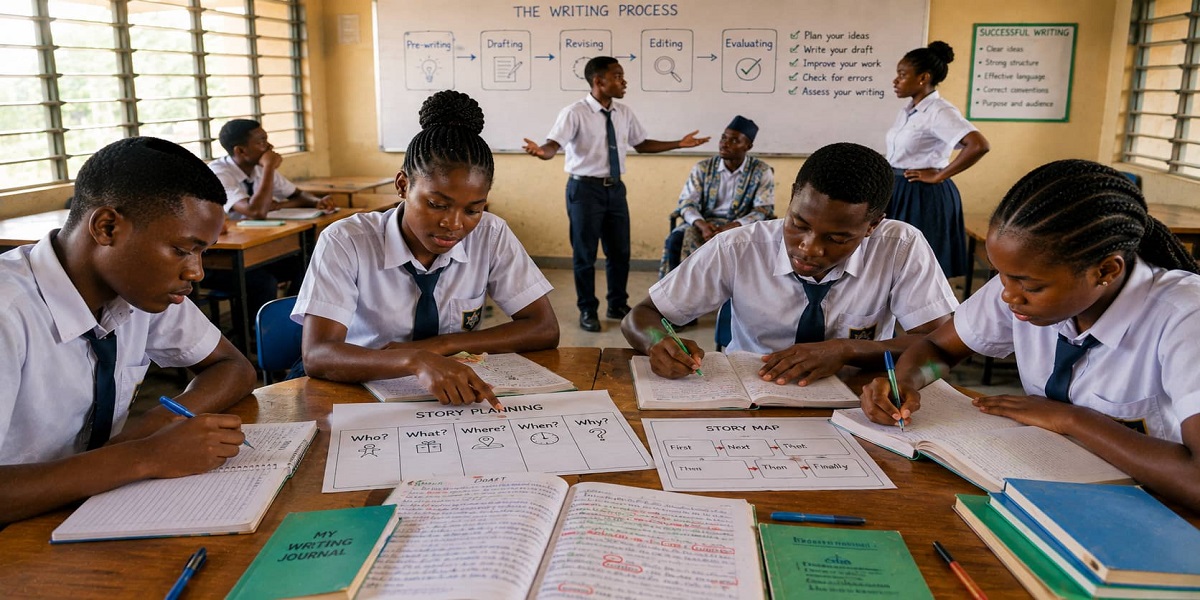
When creating a narrative, the weekly material identifies five stages of the writing process: pre-writing, drafting, revising, editing and evaluating.}
Pre-Writing: Before the First Sentence
Pre-writing is the preparation stage. The writer selects a topic, gathers details and organises thoughts before beginning the first draft.
This stage can prevent a common problem in narrative writing: beginning with an interesting idea but not knowing where the story should go next.
Drafting: Give the Story a Body
Drafting develops the complete first version of the narrative.
At this point, the writer considers elements such as:
- setting;
- plot;
- character and characterisation;
- conflict; and
- point of view.
The first draft is a working version. Its value lies in giving the writer something concrete to improve.
Revising: Improve the Story’s Ideas
Revision occurs after the first draft. It involves additions, corrections and rephrasing, as well as checking whether the goals of the writing have been achieved.
Revision therefore asks broader questions about the story. Is something missing? Does an event need clarification? Could an idea be expressed more effectively?
Editing: Improve the Language
Editing focuses on errors and clarity. Words and sentences should become clearer, more precise and more effective.
The distinction is useful: revision improves the developing work; editing improves the correctness and clarity of its expression.
Evaluating: Read the Whole Work Again
Evaluation involves reading the entire work thoroughly and assessing the effect of features such as diction, sentences, style and structure. }
At this point, the writer steps back and considers the work as a complete narrative.
The Setting Has to Be Seen
A narrative setting becomes more effective when readers can form a clear impression of the environment.
The weekly material suggests six useful principles for creating setting:
| Technique | Purpose |
|---|---|
| Sensory details | Uses the five senses and colour to make the environment more vivid. |
| Description | Creates the environment through meaningful description rather than merely narrating it. |
| Concrete locations | Gives the reader a specific sense of place. |
| Time and moments | Establishes when events occur. |
| Imagery | Strengthens the reader’s mental picture of the setting. |
| Relevant details | Keeps description focused rather than excessive. |
The Five Questions Behind a Story
A simple framework can help a writer organise both plot and setting:
Who? What? Where? When? Why?
The weekly material uses these five questions as a foundation for creating a short narrative.
Who identifies the people involved.
What identifies what happens to disrupt the normal line of activities.
Where establishes the location.
When establishes the time.
Why identifies the reason the event happens.
These questions may appear simple, but together they provide the basic coordinates of a story.
Turning Five Answers into a Story
Suppose a writer has identified a character, an unexpected event, a location, a time and a reason. These answers can become the skeleton of a narrative.
The writer can then develop supporting details, character actions and successive events until the skeleton becomes a complete story.
The important point is that planning comes before expansion.
The Story Map
The visual organiser included on page 51 presents a sequence of four major events—First, Next, Then and Finally—with supporting details attached to each event.
This kind of organiser helps a writer see the narrative as a chain of meaningful events rather than as disconnected sentences.
It also encourages the writer to add supporting details and to use sensory information when describing events.
From Narrative to Digital Creativity
A narrative does not have to remain on a page. The weekly material suggests reconstructing narratives into creative forms such as animations, storytelling sessions and review blogs or vlogs.
It also encourages the use of digital tools in producing drafts of short stories.
These possibilities expand the ways in which a narrative can be communicated while retaining its essential story elements.
Culture and Responsible Storytelling
Creative narrative work can connect writers with different cultural experiences. The weekly material emphasises meaningful connections with varied cultures, cultural and global citizenship, awareness of personal biases and stereotypes, ethical language, creativity, originality, integrity and honesty. }
This means that creative freedom should be accompanied by responsibility in the way people, communities and experiences are represented.
When a Story Leaves the Page
Dramatization provides another transformation.
The weekly material defines dramatization as using a script with accompanying actions as in a play or movie. It engages learners with literature through reading, discussion and presentation, while studying plot and roles can deepen understanding of characters and themes.
Seven Steps from Narrative to Drama
- Select the type of narrative.
- Briefly summarise it and identify the main plot.
- List the key characters.
- Divide major events into acts and scenes.
- Focus on actions and introduce dialogue.
- Add dramatic devices such as musical interludes, prologue and epilogue.
- Dramatize selected portions with attention to setting.
This sequence is provided directly in the weekly material.
Why Summarising Comes First
It may seem surprising that summarising is part of the process of dramatization. The connection is logical.
Before deciding which scenes to perform, you need to understand the story. Summarising helps identify the main plot and the important events. Once those are clear, it becomes easier to select the portions that can be transformed into scenes.
In that sense:
Understanding the narrative → identifying its important parts → selecting scenes → dramatizing them.
Scenes, Actions and Dialogue
A prose narrative may describe an action in several sentences. A drama has to make that action visible.
The dramatizer therefore shifts attention from description towards action and dialogue.
Characters speak. They move. They react. They use gestures and expressions. The audience sees the events unfold.
Bringing Setting into Performance
Setting does not disappear when a story becomes a performance. It becomes something that must be communicated through the dramatic presentation.
The weekly material specifically asks learners to dramatize portions of narrative texts while focusing on setting.
The performance should therefore help the audience understand the environment in which the selected events take place.
Dramatizing a Subplot
A subplot can make an effective dramatic excerpt because it may contain its own characters and events while remaining connected to the larger narrative.
To dramatize one, identify:
- the subplot;
- the characters involved;
- the key events;
- the setting;
- the actions;
- the dialogue; and
- the subplot’s relationship with the main story.
Performance Is Also Interpretation
Dramatization is not simply memorising lines. Choosing where a character moves, how a line is delivered, what gesture accompanies an action and which scenes are selected involves interpretation.
The weekly material therefore encourages learners with strong understanding to make creative choices about bringing narrative excerpts to life and to organise and direct performances with increasing independence.
A Complete Narrative Workflow
The three areas of Week 9 can be connected into one workflow:
| Stage | Main Question |
|---|---|
| Read | What does the narrative say? |
| Summarise | What are the essential ideas and events? |
| Plan | Who, what, where, when and why? |
| Draft | How will the story become a complete narrative? |
| Revise and Edit | How can the writing become clearer and more effective? |
| Evaluate | How well do diction, sentences, style and structure work together? |
| Dramatize | Which narrative portions can be transformed into actions and dialogue? |
A Practical Challenge
Choose a narrative text and create a chapter-by-chapter summary. Then select one important portion and turn it into a dramatic scene.
Your work should demonstrate the connection between understanding and creation.
First, show that you understand the original narrative through the summary. Next, identify the main plot and relevant characters. Then decide how the selected portion can become a scene.
Another Challenge: Create Your Own Story
Start with the 5 Ws. Use your answers to build a story plan.
Then create a first draft that includes plot and setting. Revise it, edit it and evaluate the finished work.
Finally, select a portion that could be performed. Convert important descriptions into actions and dialogue and consider how the setting can be communicated to an audience.
What Strong Narrative Work Looks Like
A strong summary is concise without losing the essential meaning.
A strong narrative has organised events, a clear setting and purposeful characters and conflict.
A strong dramatic adaptation makes the narrative visible and audible through actions, dialogue, gestures, voice and setting.
All three require the same underlying ability: understanding how meaning is organised in a story.
Final Takeaway
Week 9 moves from reading to creating and performing.
When you summarise, you identify and communicate the essential ideas of an existing text. When you write a narrative, you use planning, drafting, revising, editing and evaluation to construct your own story. When you dramatize, you transform selected narrative portions into actions, dialogue and performance.
The journey can be remembered simply:
Read deeply. Select carefully. Organise clearly. Write purposefully. Revise thoughtfully. Edit precisely. Perform creatively.
These skills help transform literature from something that is merely read into something that can be understood, created, shared and brought to life.
Access NaCCA-aligned Support Packs
Download your structured NaCCA-aligned Teacher Support Pack and Student Learning Pack, designed for clarity, practicality, and reliable teaching and learning.