
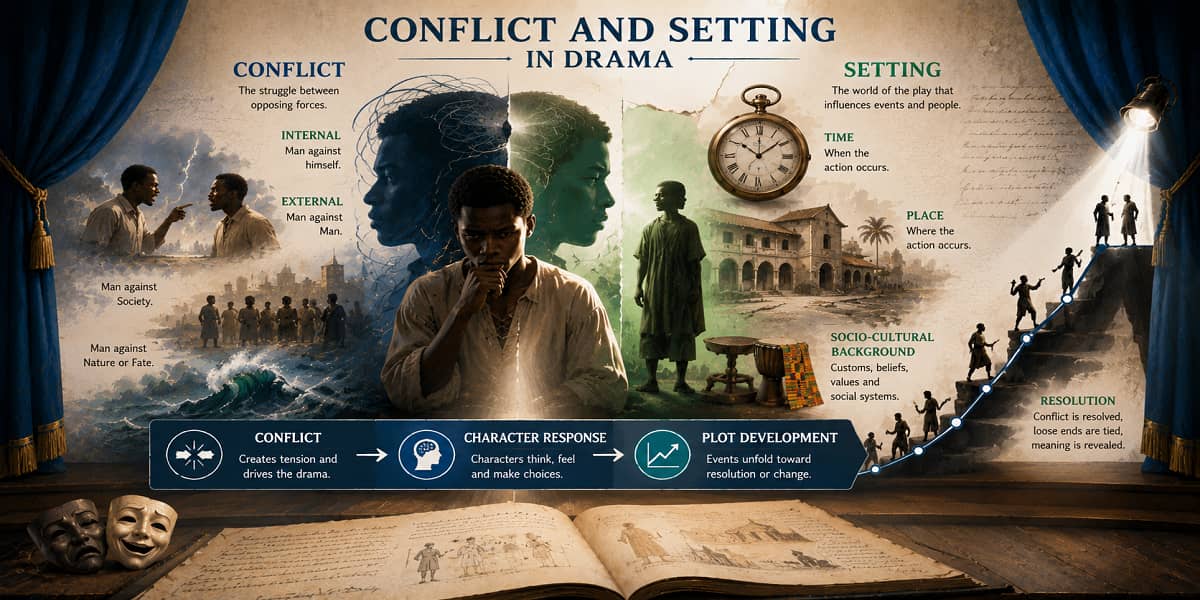
Conflict and Setting in Drama Explained for SHS 1 Literature-in-English (Sem. 1 – Week 12)
Why does a drama keep us watching? Often, the answer lies in two powerful forces working together: conflict and setting.
Conflict places characters in situations where opposing forces must be confronted. Setting gives those struggles a time, place and socio-cultural environment. Together, they help transform a sequence of events into a developing dramatic experience.
Conflict Is the Pressure Behind the Story
Conflict is defined as two opposing forces within or among characters. In drama, that opposition creates tension and helps drive the narrative forward. It can also reveal deeper meaning while exposing characters’ motivations, values and weaknesses.
That makes conflict more than a problem inserted into a story. It is a mechanism through which characters are tested and the plot develops.
Two Directions of Struggle
The first distinction to make is between internal and external conflict.
| Internal Conflict | External Conflict |
|---|---|
| The struggle takes place within the mind of a character. | The character struggles against an outside force. |
| The character may be torn between opposing feelings or goals. | The outside force may be another person or another external force. |
| The material gives Ato in Ama Ata Aidoo’s Dilemma of a Ghost as an example. | The material gives Julius Caesar, Things Fall Apart and The Gods Are Not to Blame as examples of external conflict. |
External Conflict Has Different Forms
External conflict is not limited to one character fighting another.
The material identifies man against man, man against society and man against nature or fate (divine force).
These categories help readers identify the force against which the character is struggling.
Conflict Reveals Character
Conflict can be thought of as a test of character.
When characters face opposing forces, their motivations and values become visible through their responses. Their weaknesses may also become apparent.
For a student of drama, this creates a useful analytical question:
What does this conflict reveal about the person experiencing it?
The answer may tell us something important about the character’s goals, values or weaknesses.
Conflict Also Reveals the Direction of the Plot
A conflict introduces opposition. Characters respond to that opposition, and those responses create or influence subsequent events.
The relationship can be viewed as:
Opposition → Response → Consequence → Further Action
This is why conflict is described as an element that drives the narrative forward. Without the pressure created by opposition, the sequence of events would have less dramatic force.
Why Audiences Stay Engaged
Conflict creates uncertainty. The audience wants to know what the characters will do, whether their problems will be resolved and what consequences will follow.
The weekly material therefore describes conflict as the element that holds the audience’s attention throughout the play.
The Importance of Textual Evidence
Identifying conflict is only the first step in literary analysis.
A stronger response demonstrates why a particular conflict belongs to a particular category. This is where evidence from the dramatic text becomes important.
The weekly material specifically asks learners to categorise conflicts using evidence and to use the PEE format when highlighting conflicts in given texts.
PEE: A Simple Way to Build an Argument
| Step | Purpose |
|---|---|
| Point | State the conflict you have identified. |
| Evidence | Use relevant evidence from the text. |
| Explanation | Explain what the evidence shows and how the conflict affects the narrative. |
PEE turns a label into an argument. Instead of merely writing “This is internal conflict”, the learner explains the opposing feelings or goals and connects them to the evidence.
Now Consider the World Around the Characters
Conflict does not occur in a vacuum. Every dramatic action takes place somewhere and at some time.
Setting tells the time, place and socio-cultural background of a story or drama piece. It also helps create atmosphere or mood.
So, if conflict tells us about the struggle, setting tells us about the circumstances surrounding that struggle.
Setting Is More Than a Location
It is tempting to think of setting simply as “where the story happens”. The definition in the weekly material is broader.
Setting includes:
- time;
- place; and
- socio-cultural background.
This broader understanding is important because the circumstances of a dramatic world can influence language, atmosphere, characters and events.
Setting Can Shape Language
The material uses August Wilson’s Fences to illustrate the connection between setting and language. The story is set in an African American community, and the material associates this setting with the use of Negro slang.
The example demonstrates an important literary principle: the social and cultural environment of a work can influence the choice of words through which its world is represented.
Setting Builds Atmosphere
Setting can create the atmosphere or mood of a story, play or novel.
Think about the difference between merely knowing that a scene occurs in a particular place and being able to imagine that environment vividly. The latter experience depends on the details through which the setting is presented.
Sensory Details Make Places Vivid
The weekly material explains that a setting employing sensory details can paint a vivid picture in the reader’s mind.
This means that details associated with the environment can make the dramatic world more immediate and engaging to the reader.
Realistic Worlds Can Create Engagement
A setting that mimics a realistic world can readily engage readers emotionally and intellectually.
The significance of this idea is that setting contributes to the reader’s relationship with the dramatic world. The more meaningful the environment becomes, the more fully the reader can engage with the action taking place within it.
Setting Can Reinforce Themes
Setting can enhance the impact of a story and reinforce its underlying themes through careful descriptive language and attention to detail.
This gives setting a deeper literary function. It can participate in the meaning of a work rather than simply appearing behind the characters.
Specific Places Create Connection
The weekly material identifies places such as cities, hospitals, villages and schools as examples of specific locations that can help establish a deeper connection with the reader.
A clearly established place gives readers a more definite sense of the world in which the dramatic action occurs.
Setting Can Influence Character Behaviour
One of the most important connections is between setting and character.
The material explicitly states that setting influences the behaviour of characters.
This means that when studying a character’s actions, it can be useful to ask what features of the surrounding environment may be relevant to those actions.
What Happens If the Setting Changes?
Here is a useful literary experiment: take a dramatic text and change its setting.
Move a village setting to an urban setting. Move an ancient setting to a contemporary one.
Then ask what happens to the story.
The weekly learning activity specifically encourages learners to adapt settings in prescribed texts and discuss how the changes affect the development of the plot and characters.
Changing Place Can Change Action
A change from village to urban setting does not merely change the scenery. It changes the circumstances in which the characters operate.
Because setting can influence character behaviour and contribute to plot development, changing the setting can alter how characters respond and how the story develops.
Changing Time Can Also Matter
The same principle applies when moving a drama from an ancient setting to a contemporary one.
The time period is part of setting. Changing it changes the surrounding circumstances, which can affect character behaviour and the development of events.
Conflict and Setting Belong Together
Conflict and setting are different literary concepts, but they are connected within the dramatic world.
Setting establishes the circumstances. Characters act within those circumstances. Their actions and responses generate or intensify conflict. Conflict then helps move the plot forward.
A useful conceptual chain is:
Setting → Circumstances → Character Behaviour → Conflict → Plot Development
This chain should not be treated as a rigid formula for every drama. Instead, it is a useful way of seeing how the elements can interact.
Reading Drama Through These Two Lenses
When approaching a dramatic passage, begin with two sets of questions.
Questions About Conflict
- What opposing forces are present?
- Is the conflict internal or external?
- What form does the external conflict take?
- What does the conflict reveal about the characters?
- How does it move the plot forward?
Questions About Setting
- When does the action take place?
- Where does it take place?
- What is the socio-cultural background?
- What atmosphere or mood does the setting create?
- How does it influence language?
- How does it influence character behaviour?
- How does it contribute to the plot?
- How does it reinforce themes?
A Collaborative Way to Study a Drama
The weekly material encourages learners to work in groups when identifying conflicts and examining how they move the plot forward. It also encourages discussion of the significance of setting in selected dramatic texts.
Group analysis can be especially useful because different readers may notice different forms of conflict or different effects of setting.
The important condition is that interpretations should remain connected to evidence from the text.
Debating Difficult Conflicts
An interesting question is which type of conflict is more difficult to resolve.
Internal conflict may involve competing feelings or goals within one person’s mind. External conflict may place a character against another person, society, nature or fate.
A useful debate should not depend only on personal preference. Consider the nature of the opposing forces and support the argument with evidence from dramatic texts.
Conflict as a Tool for Critical Reading
Once you identify conflict, you can begin to interpret the drama more deeply.
What motivates the character? What values are being tested? What weakness becomes visible? What event follows the conflict?
These questions move literary study from simple identification towards analysis.
Setting as a Tool for Interpretation
The same is true of setting.
Instead of simply stating, “The drama is set in a village,” ask what the village setting contributes. Does it affect the characters? Does it contribute to the atmosphere? Does it influence the development of the plot? Does it help reinforce an underlying theme?
The significance lies in the relationship between the setting and the rest of the dramatic work.
From Identification to Significance
Strong literary analysis often follows this movement:
Identify → Classify → Give Evidence → Explain Significance.
For conflict, this means identifying the opposing forces, classifying the conflict, giving textual evidence and explaining how it affects character and plot.
For setting, it means identifying the time, place and socio-cultural background, then explaining its effect on atmosphere, language, characters, themes and plot.
Mini Case Analysis
Suppose a passage presents a character who must choose between two opposing goals.
The first task is to recognise that the struggle occurs within the character. The second is to identify it as internal conflict. The third is to use evidence from the passage. The final step is to explain how the struggle affects the character and contributes to subsequent events.
Now imagine that the same passage is moved from its original setting to another environment. Ask whether the character’s behaviour and the development of events would remain unchanged.
This thought experiment demonstrates why conflict and setting should be analysed together.
The Importance of Formal, Fair Discussion
The weekly material encourages learners to use formal language, avoid personal biases and avoid cultural stereotyping when discussing dramatic texts.
Literary criticism should focus on the text and the evidence supporting an interpretation. Respectful discussion allows different perspectives to be examined without turning disagreement into personal attack.
Creative Application
Learners can also apply these ideas when developing their own written drama.
Consider what conflicts will move the plot forward and what setting will establish the circumstances in which the characters act.
A useful planning sequence is:
Choose the setting → Establish the characters → Introduce opposing forces → Develop conflict → Move the plot through character responses.
Why the Two Concepts Matter
Conflict explains the pressure within the dramatic action. Setting explains the environment surrounding that action.
When these concepts are understood together, a drama becomes easier to interpret as an organised system in which characters, circumstances, opposition and events influence one another.
Final Takeaway
Conflict and setting provide two powerful ways to understand drama.
Conflict involves opposing forces. It may be internal or external, and external conflict may take forms such as man against man, man against society, or man against nature or fate. Conflict creates tension, reveals character and moves the plot forward.
Setting establishes the time, place and socio-cultural background. It can create atmosphere, influence language and character behaviour, reinforce themes, strengthen reader connection and contribute to plot development.
The most useful question is not simply “What is the conflict?” or “Where is the story set?” It is:
“What does this conflict or setting contribute to the development and meaning of the drama?”
Answer that question with evidence, and your reading moves from identifying literary features to understanding their significance.
Access NaCCA-aligned Support Packs
Download your structured NaCCA-aligned Teacher Support Pack and Student Learning Pack, designed for clarity, practicality, and reliable teaching and learning.