Accounts of the Origin of the Guan and Ethnic Groups in the Savannah Zone of Ghana Explained for SHS 1 History (Sem. 1 – Week 5)
Where did the peoples of Ghana come from?
It sounds like a straightforward question, but historical answers are rarely that simple. Communities preserve memories of migration and settlement through oral traditions, historical narratives and other forms of evidence. Different accounts may overlap, contradict one another or emphasise different experiences.
The history of the Guan, the peoples of Ghana’s Savannah Zone, the Mole-Dagbani and the Gonja offers a useful example of why historians must listen to multiple perspectives.
The Guan and the Question of Early Settlement
The Guan are regarded as among the earliest inhabitants of present-day Ghana because many ethnic groups claim that they encountered Guan communities when they arrived.
Guan oral tradition maintains that Guan communities had established small independent states before the arrival of other ethnic groups.
Another account places their origins farther north, around the Mossi region of present-day Burkina Faso. According to this account, conflict with the Mande contributed to their movement southwards towards modern Gonjaland.
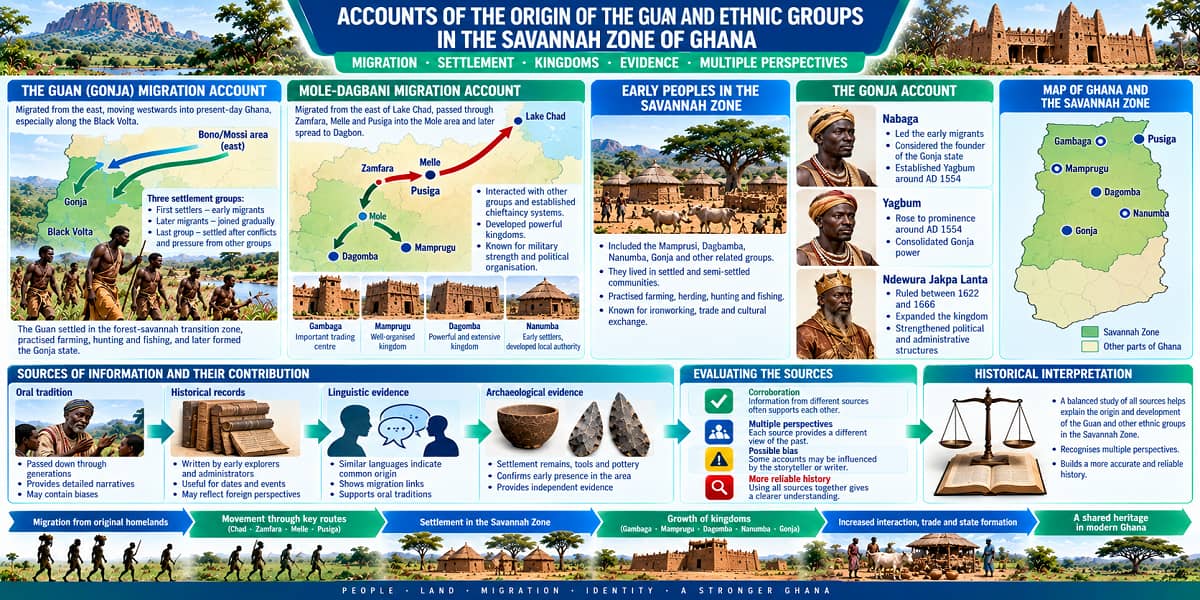
The traditions describe three Guan migration groups. One remained in Gonjaland, another settled in the Afram Plains, while a third moved towards the Lower Volta and settled at places including Larteh, Adukrom, Santrokofi, Akpafu, Effutu and Awutu.
The existence of variations in these accounts is important. It reminds us that an origin story should be investigated rather than treated as an unquestionable historical fact.
Why Origin Stories Matter
Migration accounts do more than explain movement across geographical space. They can also contribute to the identity of communities.
A story about where a group came from can help explain relationships with neighbouring communities, connections to territory and ideas about collective identity.
This is why historians need two qualities at the same time: respect for people’s traditions and critical evaluation of historical evidence.
The Savannah Zone: A Meeting Place of Peoples
The Savannah Zone contains a range of ethnic communities with their own languages, traditions and accounts of settlement.
According to oral history, early settlers or indigenous inhabitants included the Vagala, Sisala, Tampulensi and Guan, who lived along the White Volta. The Konkomba, Koma and Chamba lived east of the White Volta.
These early communities were associated with social and religious characteristics including family-based social units, the presence of the Tindana and the practice of polytheism. Apart from the Guans, the groups spoke related languages, and their political organisation was acephalous in nature.
The term acephalous is useful because it describes a political structure without a single centralised ruler.
The Mole-Dagbani Journey
Another major migration account concerns the Mole-Dagbani.
The account traces their movement from east of Lake Chad to Zamfara in northern Nigeria, then to Melle in Mali and finally to Pusiga.
From Pusiga, the Mole-Dagbani founded kingdoms including Gambaga, Mamprugu, Dagomba and Nanumba.
| Stage | Place | Historical significance in the account |
|---|---|---|
| 1 | East of Lake Chad | Starting point identified by the migration account. |
| 2 | Zamfara | Intermediate location in northern Nigeria. |
| 3 | Melle | Further stage of the migration in Mali. |
| 4 | Pusiga | Settlement point from which kingdoms were established in Ghana. |
The Gonja Story: Migration, Military Power and State Formation
The Gonja account provides another perspective on how states emerged.
Nabaga, also known as Wadh Naba, was reportedly sent by his overlord, King Mande Kaba of the Mande Kingdom, on a punitive expedition against the gold-producing town of Begho.
After reaching the Northern Zone, Nabaga refused to return. Around AD 1554, he established a military base at Yagbum.
From there, he conquered a number of states, including Guan communities, and imposed Mande or Gonja authority over them. This development formed part of the account of the foundation of the Gonja Kingdom.
Later, between 1622 and 1666, the Gonja under Ndewura Jakpa Lanta invaded Dagomba. Ndewura Jakpa Lanta was a descendant of Nabaga and became the fifth Gonja king. He expanded the kingdom considerably.
One Past, Many Perspectives
At this point, an important historical principle emerges: different accounts can describe the same past from different perspectives.
That does not mean historians should simply choose whichever story they prefer. Instead, they should examine the evidence behind each account.
Oral Tradition
Oral traditions can preserve community memories and transmit stories across generations. They can provide valuable insight into how communities understand their origins and identity.
Historical Records
Written narratives can provide another form of evidence, but historians should examine the author’s perspective, purpose and possible limitations.
Linguistic Evidence
Language relationships can contribute to the study of population movements and connections among groups.
Archaeological Evidence
Material remains can provide physical evidence of past settlement and human activity. Such evidence must be interpreted within its context.
Other Historical Expressions
Sources such as drum music can also preserve historical narratives and traditions. Their value is strengthened when they are considered alongside other forms of evidence.
From Contradiction to Investigation
Suppose two communities give different accounts of the same migration. A historian does not need to regard the difference as a problem that must immediately be eliminated.
The contradiction can become a question:
Why do the accounts differ?
Perhaps they emphasise different experiences. Perhaps they were transmitted for different purposes. Perhaps the communities remember different stages of a longer process.
The historian can then compare the accounts with other evidence.
Corroboration: Building a Stronger Picture
Corroboration means using multiple sources to develop a more comprehensive understanding of the past.
Imagine an origin story preserved through oral tradition. Researchers might compare it with historical narratives, linguistic evidence and archaeological findings.
The goal is not necessarily to make every source agree completely. Instead, historians identify what the sources support, where they differ and what remains uncertain.
The Importance of Bias
Historical accounts can contain perspectives or biases. An account may emphasise the achievements of one group, minimise another group’s role or reflect the values of the people who preserved it.
Recognising possible bias does not mean rejecting the account. It means understanding it more carefully.
This is why historical interpretation requires both critical thinking and perspective-taking.
A Practical Historical Test
When reading an origin account, ask:
- Who? Who are the people involved?
- What? What does the account say happened?
- When? When did the movement or event occur?
- Where? Where did people come from and where did they settle?
- Why? What reasons are given for the movement?
- How? How did the migration and settlement happen?
These six questions help transform a traditional narrative into an organised historical investigation.
What Can We Learn from the Different Accounts?
The Guan, Mole-Dagbani and Gonja accounts demonstrate that migration can involve different forces and experiences.
In the Guan account, movement is associated with traditions of northern origin, conflict and the establishment of settlements in different parts of Ghana.
The Mole-Dagbani account describes a long movement through several locations before the establishment of kingdoms.
The Gonja account links military activity, territorial conquest and the establishment and expansion of a kingdom.
These accounts should not simply be memorised as isolated stories. Together, they provide an opportunity to think about migration, settlement, interaction, political authority and identity.
Questions to Think About
- Why are the Guan regarded as among the earliest inhabitants of present-day Ghana?
- What are the three settlement directions described in Guan migration traditions?
- Which groups are identified as early settlers of the Savannah Zone?
- What does acephalous political organisation mean?
- What was the migration route of the Mole-Dagbani in the account?
- Which kingdoms did the Mole-Dagbani establish?
- What role did Nabaga play in the formation of the Gonja Kingdom?
- What was the significance of Yagbum around AD 1554?
- Who was Ndewura Jakpa Lanta?
- Why should historians compare different migration accounts?
Model answers:
- Many ethnic groups claim that they encountered Guan communities when they arrived, and Guan tradition states that the Guans had established small independent states before other groups arrived.
- One group remained in Gonjaland, another settled in the Afram Plains, and the third moved towards the Lower Volta and settled at places including Larteh, Adukrom, Santrokofi, Akpafu, Effutu and Awutu.
- The Vagala, Sisala, Tampulensi and Guan are identified along the White Volta, while the Konkomba, Koma and Chamba are identified east of the White Volta.
- It describes a political organisation without a centralised ruler.
- East of Lake Chad → Zamfara → Melle → Pusiga.
- Gambaga, Mamprugu, Dagomba and Nanumba.
- He established a military base at Yagbum and conquered a number of states, contributing to the foundation of the Gonja Kingdom according to the account.
- It was the location of Nabaga’s military base, established around AD 1554.
- He was the fifth Gonja king, a descendant of Nabaga, who led the Gonja invasion of Dagomba between 1622 and 1666 and expanded the kingdom.
- Comparison helps historians identify agreements, contradictions, strengths, limitations and possible biases and construct a more comprehensive understanding.
The Bigger Historical Lesson
Migration history is ultimately about more than movement from one place to another. It is also about how communities remember their past, how different groups interact and how identities and political systems develop.
The accounts of the Guan, Mole-Dagbani and Gonja demonstrate why historical knowledge benefits from multiple perspectives.
A responsible understanding of the past comes from asking questions, examining evidence, recognising perspective and comparing different accounts.
Access NaCCA-aligned Support Packs
Download your structured NaCCA-aligned Teacher Support Pack and Student Learning Pack, designed for clarity, practicality, and reliable teaching and learning.