Centralised, Non-centralised and Theocratic Political Systems in Pre-colonial Ghana Explained for SHS 1 History (Sem. 1 – Week 12)
Long before colonial rule, the communities that make up present-day Ghana were not governed through one uniform political system. Independent states and kingdoms developed different ways of organising authority, settling disputes and maintaining social order.
Three broad political systems stand out: centralised, non-centralised and theocratic systems. Understanding their differences reveals an important feature of Ghana’s pre-colonial history: political organisation reflected different social structures and ideas about authority.
When Power Had a Centre
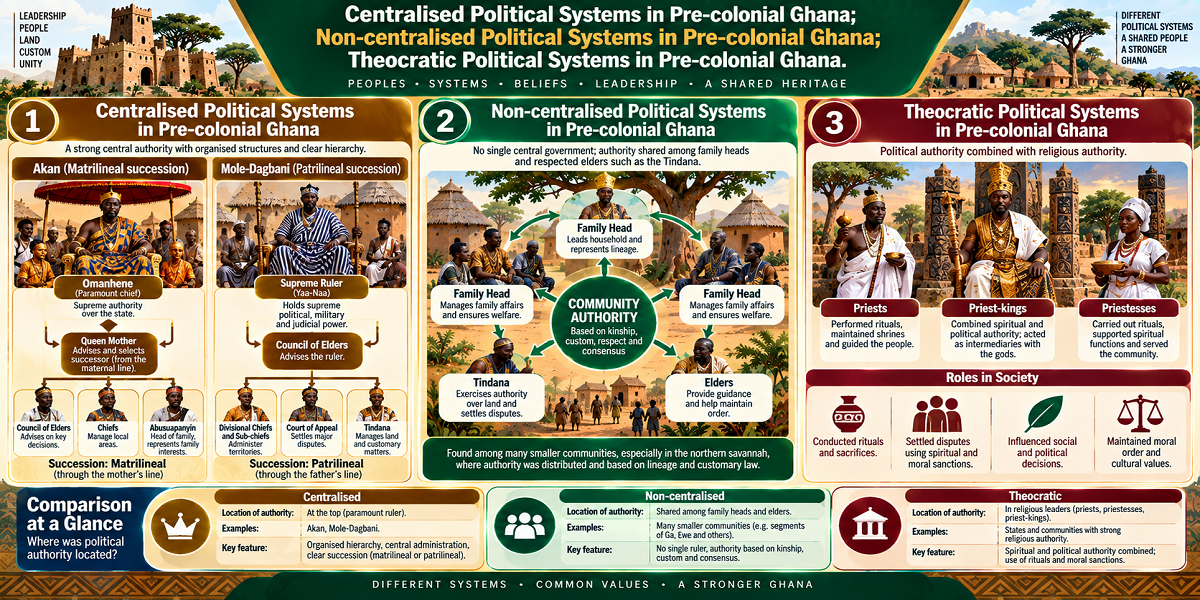
In a centralised political system, political authority was concentrated in a central governing authority. Policies, laws and decisions came from that authority, while political bodies exercising power at the local level depended on its consent.
The Akan and Mole-Dagbani are identified with this system. But even within a broad category such as “centralised”, political structures were not identical.
Among the Akan, the structure included the Omanhene, Queen Mother, Council of Elders, Divisional Chief, Community Chief and Abusuapanyin. The system also featured matrilineal inheritance to the throne.
The Mole-Dagbani structure included Supreme Rulers, a Council of Elders, Divisional Chiefs or Sub-chiefs, a Court of Appeal and the Tindana, with patrilineal inheritance of enskinment identified as a feature.
The comparison is significant. Both systems were centralised, yet the offices and succession arrangements identified within them differed.
When There Was No Central Government
Political organisation could also take a very different form. In the Savannah zone of northern Ghana, groups including the Vagala, Sisala, Tallensi, Kokomba, Koma, Tampulensi and Chamba were not organised into centralised political states during the pre-colonial period.
They were described as stateless or acephalous because they had no central government to make and enforce laws. This does not mean that these communities were without authority or social organisation.
The Tindana exercised considerable authority over the land, while family heads formed another important part of the social structure.
This distinction matters. “No central government” is not the same as “no order”. It points instead to a different way of distributing authority.
When Political and Religious Authority Were Connected
Theocratic political organisation provides another model. Here, political power was held by the priestly class. The Guan and Ga-Adangbe are identified with this system in the topic.
Priests and priestesses of local gods served as rulers. Priest-kings were highly respected and could settle disputes, with their decisions described as binding. Their authority was supported by ritual and moral sanctions.
The system therefore demonstrates how ideas about the divine could be closely connected to political authority. Religious leadership could also perform political functions.
A Three-Way Comparison
| Centralised | Non-centralised | Theocratic |
|---|---|---|
| Authority centred on a central political authority. | No central government. | Political power held by the priestly class. |
| Akan and Mole-Dagbani. | Vagala, Sisala, Tallensi, Kokomba, Koma, Tampulensi and Chamba. | Guan and Ga-Adangbe. |
| Included rulers, chiefs and councils. | Included family heads and the Tindana. | Included priests, priestesses and priest-kings. |
Political Organisation and Everyday Society
Political systems were not simply arrangements for selecting leaders. They influenced how authority operated within society. The study of centralised systems, for example, can include questions about tribute collection, justice systems and social hierarchy.
In non-centralised communities, the distribution of authority through local structures raises different questions: What roles did family heads play? How were disputes settled? How did communities maintain order without a central government?
Theocratic systems raise another set of questions: How did religious authority shape political decisions? Why were priest-kings respected? How were ritual and moral sanctions connected with political power?
These questions show why political history cannot be separated completely from social and religious history.
How Do We Know?
Studying pre-colonial political systems presents an important historical challenge: evidence is not limited to conventional written records. Oral traditions, archaeological evidence and colonial accounts can all contribute to our understanding.
But historical evidence must be evaluated critically. Oral traditions can preserve valuable knowledge, archaeological discoveries can reveal material evidence, and colonial accounts can provide historical information. Each requires careful interpretation.
A useful historian therefore asks not only, “What does this evidence say?” but also, “How reliable and useful is this evidence for answering the question?”
Why Comparison Matters
Comparison prevents us from treating “pre-colonial Ghana” as though it were one political community with one political tradition. The evidence instead points to diversity.
The Akan and Mole-Dagbani demonstrate different forms of centralised organisation. The Vagala, Sisala and Tallensi illustrate societies organised without a central government. The Guan and Ga-Adangbe illustrate a theocratic form in which priests and priestesses held political authority.
Comparing them allows learners to examine the relationship between authority, social structure and political organisation.
Questions Worth Asking Today
The historical study of these systems also invites reflection on continuity and change. How did pre-colonial political systems evolve? What elements of traditional political organisation may still be visible in Ghanaian society today? How did different communities distribute authority, and what can comparison teach us about political diversity?
These are historical questions because they require evidence, context and careful interpretation rather than simple assumptions.
The central lesson is clear: pre-colonial Ghana was politically diverse. Power could be concentrated in a central authority, distributed through non-centralised social structures, or closely connected to religious leadership. Understanding these differences gives us a more accurate picture of how Ghanaian societies organised themselves before colonial rule.
Access NaCCA-aligned Support Packs
Download your structured NaCCA-aligned Teacher Support Pack and Student Learning Pack, designed for clarity, practicality, and reliable teaching and learning.