Relationships Between Genres in Oral and Written Literature Explained for SHS 1 Literature-in-English (Sem. 1 – Week 3)
Literature does not exist in only one form. A story may be written in a book, told aloud, performed on a stage or shaped into a poem. A song can communicate the experiences of a community, while a biography can preserve the story of an individual’s life in written form.
This is why understanding literary genres involves more than memorising names. It involves recognising how different forms of literature are connected and how their methods of expression influence the way we experience them.
What Is a Literary Genre?
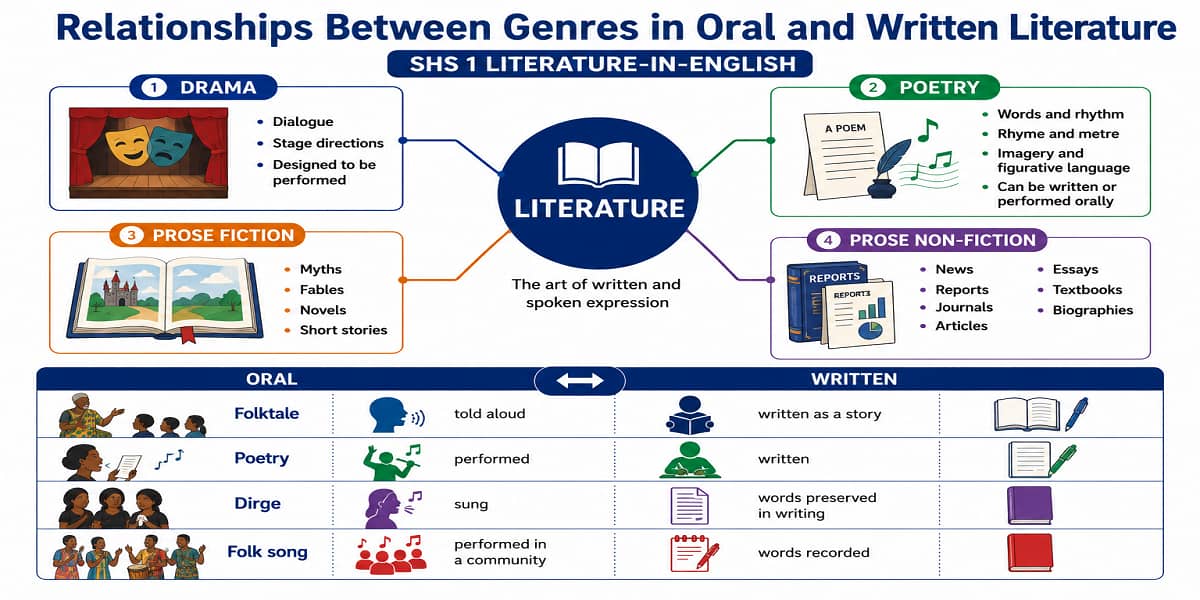
A genre is a type or form of literature with identifiable features. The major genres considered in this week’s Literature-in-English study are drama, poetry, prose fiction and prose non-fiction.
| Genre | Important Features | Examples |
|---|---|---|
| Drama | Dialogue, stage directions and performance | Plays |
| Poetry | Interplay of words, rhythm, rhyme and metre; can be performed orally | Poems, lamentations, chants and prayers |
| Prose fiction | Narrative presentation of creative or imaginative stories | Myths, fables, novels and short stories |
| Prose non-fiction | Factual or life-based presentation in prose | News, reports, journals, articles, essays, textbooks and biographies |
Oral Literature Is a Rich Literary Tradition
Oral literature includes jokes, songs, riddles, folktales, dirges, fables, legends, myths, proverbs, sayings and anecdotes.
A folktale, for instance, is an oral narrative that generally carries moral lessons and is traditionally passed from generation to generation. It may be told by the fireside and interspersed with folk songs.
A dirge serves a different purpose. It is a song of lamentation and grief used to praise, honour and mourn the dead, usually at a funeral.
Proverbs demonstrate another dimension of oral literature. A proverb is a short, well-known, wise saying representing a general truth or piece of advice.
Folk songs are traditionally associated with communities. They are characterised by features such as stanzas, refrain and melody and may exist in many versions.
Written Literature Contains Many Forms
Written literature includes novels, biographies, novellas, poetry, plays, short stories, epics and science fiction, among others.
A biography is a non-fiction account of a person’s life written by another person. It may contain information about childhood, education, career and relationships.
A short story is a short narrative with some of the features of a novel. A novel is a longer creative narrative describing human experiences through features such as plot, character and setting. Redemption Road is given as an example of a novel.
The Interesting Part: The Genres Can Connect
It is tempting to think of oral and written literature as two completely separate worlds. In practice, their relationship is more interesting.
Poetry is a good example. A poem can be written and read from a page, but poetry can also be performed orally. The material for this week identifies lamentations, chants and prayers as examples of oral performance connected with poetry.
Drama creates another bridge. A play exists as written text, but dialogue and stage directions are used because the work is designed to be performed. Once the text is performed, written language becomes spoken language accompanied by action.
Oral traditions can also appear in written literature. Myths, fables, legends, folktales, proverbs and songs can be represented or preserved through writing. The relationship therefore moves in more than one direction.
The Weaver Bird: Poetry on the Page and in Performance
The poem The Weaver Bird is a useful example for examining poetry as a form that can be written and performed.
The poem begins with the image of a weaver bird building in a house and laying its eggs on the only tree. The image develops into a more complex poetic situation involving ownership, salvation, prayers, homes, altars and old shrines.
The weaver bird built in our house
And laid its eggs on our only tree.
The poem’s language shows how a written text can depend on imagery and figurative expression while still being suitable for oral delivery. When performed, the rhythm and sound of the language become part of the audience’s experience.
Folktale and Short Story: Similar Storytelling, Different Forms
One useful comparison is between a folktale and a short story.
| Folktale | Short Story |
|---|---|
| Identified as an oral narrative. | Identified as a short narrative. |
| Traditionally passed from generation to generation. | Presented as a written literary work. |
| Generally associated with moral lessons. | Has some features of a novel in a shorter form. |
| Both are narrative forms and can communicate experiences through storytelling. | |
The comparison shows why genre relationships matter. Two forms may differ in their traditional modes of expression while sharing an important literary function.
Drama Shows the Power of Performance
Drama makes the written-to-oral relationship especially visible. Dialogue provides what characters say, while stage directions provide guidance for performance.
A written scene therefore contains more than words to be read. It provides material that can be transformed into spoken interaction and performance.
This is why learners who study drama can benefit from performing it. Performance makes the connection between the written form and its intended mode of presentation easier to experience.
What Parody Teaches Us About Literary Form
The week’s material also introduces a short extract from Henry Wadsworth Longfellow’s Song of Hiawatha and a parody called The Modern Hiawatha.
The parody takes up the rhythm and rhyme of the original while changing the language to create humour. This shows that literary forms can be transformed without losing every recognisable feature of the original.
Creating such a parody requires careful attention to sound, rhythm and word choice, as well as the humorous effect being produced.
Why This Relationship Matters to Learners
Reading
Recognising a genre gives readers clues about how to approach a work. A poem invites attention to rhythm and language, while a play requires attention to dialogue and performance.
Listening
Oral forms demonstrate how voice, sound and performance can contribute to literary meaning. A proverb, folk song or dirge can communicate more than its words alone.
Performing
Performance allows learners to experience how literary language works when spoken and acted rather than simply read.
Creating
Once learners understand genre features, they can experiment with their own poems, performances and parodies. Creativity becomes stronger when it is informed by an understanding of form.
A Useful Way to Study Any Genre
When you encounter a literary work, ask yourself five questions:
- What genre is it?
- What features identify that genre?
- Is it primarily oral, written or connected to both?
- How does its form affect the way it is experienced?
- What other literary forms does it resemble or connect with?
These questions move literary study beyond simple identification. They encourage comparison, interpretation and critical thinking.
Final Perspective
Oral and written literature should not be viewed simply as competing categories. They are related ways of creating, preserving and communicating literary expression.
A folktale and a short story can both tell stories. A poem can exist on the page and in performance. A play can begin as written dialogue and stage directions before becoming a live performance. Oral traditions can also find expression in written literature.
The study of genres therefore helps us recognise both difference and connection. Once those relationships become clear, literature becomes a richer field for reading, listening, performing and creative expression.
Access NaCCA-aligned Support Packs
Download your structured NaCCA-aligned Teacher Support Pack and Student Learning Pack, designed for clarity, practicality, and reliable teaching and learning.