Contributions of Leaders during Migration, Settlement & Reasons for the Migration Groups into Ghana Explained for SHS 1 History (Sem. 1 – Week 7)
Every migration has a human side. Behind a movement across a landscape are people making decisions, responding to difficulties, looking for opportunities and adapting to new surroundings. Ghana’s migration histories provide a useful way to explore how leadership and circumstances shaped the movement and settlement of major ethnic groups.
Leadership at the Heart of Migration
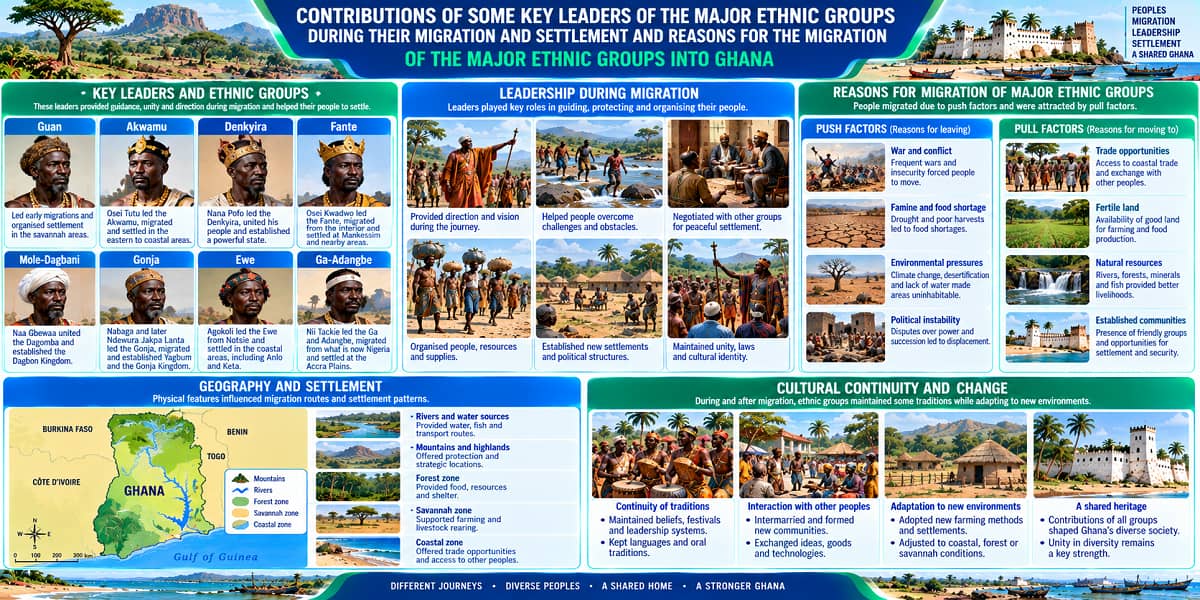
The accounts studied identify leaders associated with several major ethnic groups. Their roles could include leadership as warlords, priests and spiritual guides, while their wider responsibilities could involve finding resources, navigating obstacles, choosing settlement locations and establishing social order.
| Ethnic Group | Leader or Leaders Identified |
|---|---|
| Guan | Ataala Ofiriam |
| Akwamu | Agyin Kokobo, Otomfo |
| Denkyira | Asare |
| Fante | Boadu Akafo Brempon |
| Mole-Dagbani | Obunumankoma, Odapagyan & Oson |
| Gonja | Naa Gbewa; Sumaila Ndewura Jakpa Lanta |
| Ewe | Amega Wenya, Togbui Sri I |
| Ga-Adangbe | Ayitey, Ayikushi |
The importance of these figures is not simply that they are names to memorise. Their study allows us to ask how leadership affected migration decisions, settlement patterns and the identity of the groups that followed them.
What Makes Migration Difficult?
Imagine leading a group through unfamiliar territory. The challenges might include finding resources, navigating obstacles and bringing diverse people together. Leadership decisions could influence whether a group continued along a particular route, negotiated with others or established a new settlement.
This is why the lesson encourages cause-and-effect thinking. A decision by a leader can have consequences for the people being led.
The Two Sides of Migration: Push and Pull
People may move because conditions at home become difficult or because another place offers attractive opportunities. Historians often use the ideas of push and pull factors to organise these possibilities.
| Push: pressures encouraging departure | Pull: attractions encouraging movement |
|---|---|
| War | Trade opportunities |
| Famine | Fertile land |
| Environmental pressures | Natural resources |
| Political instability | Established communities |
These categories should not be treated as a mechanical formula. A migration could involve several factors at once, and the relative importance of those factors could vary between groups.
Geography Becomes Part of the Story
Migration takes place across real landscapes. Rivers and mountains can influence routes, while water availability and fertile land can influence settlement decisions.
Geography can therefore help explain both where people moved and where they eventually settled. It also helps explain why two groups facing movement might follow different paths.
Migration Changes Communities Too
When a migrating group reaches a new territory, the story does not end. The newcomers may encounter people already living there. The result can include conflict, interaction and cultural exchange.
Migrants can preserve important aspects of their previous way of life. Language and traditions may continue, while other practices may change as people adapt to their new environment. Migration can therefore produce a combination of cultural continuity and change.
Women Belong in the Historical Picture
Migration narratives should not be reduced to the actions of male figures. The study of this topic specifically calls for investigation into the role of women in different migration accounts.
That matters because historical leadership can be understood more fully when different participants are considered. A useful investigation asks what a female leader did, what challenges she faced, how her contribution affected migration or settlement, and how her role has been remembered.
How Should We Judge a Migration Account?
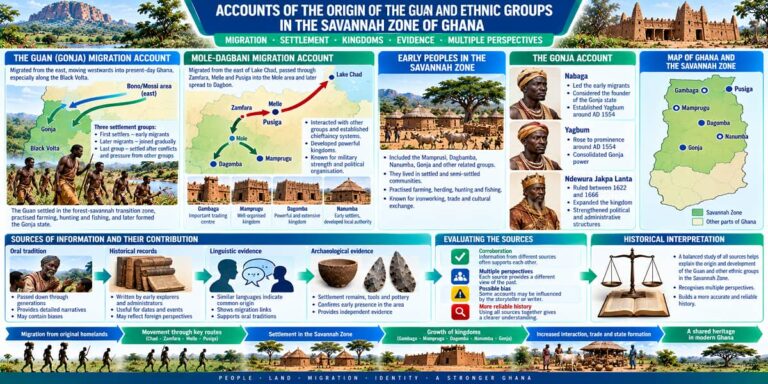
Historical accounts are not all produced in the same way. Oral histories, artefacts and written historical accounts can provide different kinds of information. Each needs careful examination.
- Source analysis: What does the evidence actually tell us?
- Reliability: What are the strengths and limitations of the source?
- Perspective: How might the account appear different to the group being described and to outsiders?
- Context: What geographical, social or political circumstances surrounded the migration?
- Significance: What lasting effects can reasonably be connected to the leader or migration?
From a Journey to an Identity
Migration accounts can help explain how ethnic groups understand their histories and identities. They connect places of origin, routes, leaders, encounters and settlements into narratives about the past.
But because accounts can contain different perspectives, studying them critically is important. A historian should be prepared to recognise discrepancies rather than forcing every account into a single version.
A Simple Historical Model
The week’s ideas can be brought together through a connected sequence:
Conditions → Decision to move → Leadership → Route → Encounter → Settlement → Adaptation → Cultural continuity and change
This model helps us see migration as a process in which causes and consequences are connected.
Questions Worth Asking
When examining the migration of an ethnic group, ask:
- Who led or guided the group?
- What challenges did the group face?
- Why did people leave their original territory?
- What attracted them to another place?
- How did geography affect their route?
- How did they interact with people already living in the area?
- What aspects of their culture continued?
- What changed after settlement?
- What different perspectives exist about the migration?
Why Week 7 Matters
The study of migration is ultimately a study of people responding to circumstances. Leaders mattered because their decisions could shape the course of movement and settlement. Circumstances mattered because war, famine, environmental pressures, political instability and opportunities could influence the decision to move.
Looking at both sides produces a richer historical picture. Migration was not simply about leaving one place for another; it involved leadership, geography, human choices, interaction and adaptation.
Key Takeaway
The migration histories of Ghana’s major ethnic groups can be better understood when leaders and migration causes are studied together. Leadership helps explain how groups navigated challenges and established settlements, while push and pull factors help explain why movement occurred. Geography shaped routes and settlement, and interaction with existing populations could produce both conflict and cultural exchange.
Most importantly, historical thinking requires us to examine these accounts from multiple perspectives, assess the evidence carefully and recognise that the past may be remembered through more than one narrative.
Access NaCCA-aligned Support Packs
Download your structured NaCCA-aligned Teacher Support Pack and Student Learning Pack, designed for clarity, practicality, and reliable teaching and learning.