Contributions of Leaders during Migration, Settlement & Reasons for the Migration Groups into Ghana
Migration Is More Than Movement
When groups moved from one place to another, their journeys involved decisions, challenges, leadership and adaptation. Leaders could help groups navigate unfamiliar environments, overcome obstacles, organise people and establish settlements.
At the same time, people did not migrate for only one reason. Warfare, environmental conditions, resources, trade opportunities and political circumstances could influence decisions to move.
1. Key Leaders During Migration and Settlement
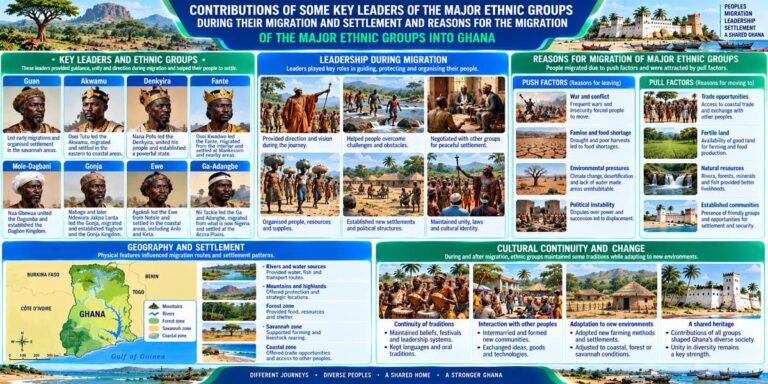
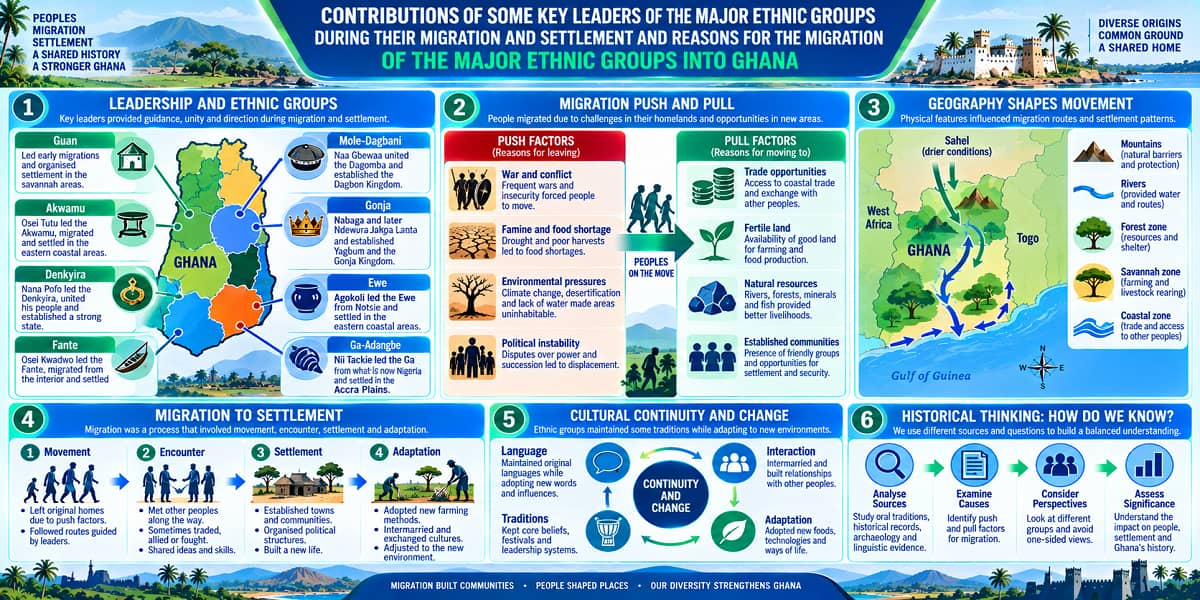
The major ethnic groups were led and guided by different figures during migration and settlement. Their roles could include serving as warlords, priests and spiritual guides. The following leaders are identified with major ethnic groups in Ghana:
| Leader | Ethnic Group |
|---|---|
| Ataala Ofiriam | Guan |
| Agyin Kokobo, Otomfo | Akwamu |
| Asare | Denkyira |
| Boadu Akafo Brempon | Fante |
| Obunumankoma, Odapagyan & Oson | Mole-Dagbani |
| Naa Gbewa | Gonja |
| Sumaila Ndewura Jakpa Lanta | Gonja |
| Amega Wenya, Togbui Sri I | Ewe |
| Ayitey, Ayikushi | Ga-Adangbe |
The names above should be understood within migration traditions and historical accounts. The information provided does not assign a single identical role to every leader. Instead, it directs attention to how leadership operated during migration and settlement.
2. What Could Leaders Do?
Leadership during migration involved practical and social responsibilities. A leader could help a group deal with unfamiliar territory, make decisions about movement, negotiate or confront challenges, and help organise settlement.
| Leadership area | Possible contribution in migration and settlement |
|---|---|
| Guidance | Helping people navigate unfamiliar lands and obstacles. |
| Decision-making | Making choices that could influence the direction of migration and settlement. |
| Organisation | Helping unite and organise diverse groups. |
| Negotiation | Using negotiation where interactions with other groups affected settlement. |
| Conflict | Responding to challenges where conflict influenced migration or settlement. |
| Settlement | Helping determine locations and establish social order. |
3. Why Did People Migrate?
Migration into present-day Ghana can be examined through the ideas of push and pull factors.
Push Factors
Push factors are conditions that may encourage people to leave their original territories. The lesson identifies examples such as war, famine, environmental pressures and political instability.
Pull Factors
Pull factors are conditions that may attract people towards another location. Examples identified include trade opportunities, fertile land, natural resources and established communities.
| Possible reason | How it could influence migration |
|---|---|
| Warfare | Conflict could push people away from their original territories. |
| Famine | Food shortages could encourage people to seek more secure places. |
| Environmental conditions | Changes in climate, water availability or land conditions could influence movement. |
| Political instability | Leadership crises or instability could encourage groups to move. |
| Natural resources | Resources in another area could attract migrants. |
| Trade opportunities | Established trade routes or commercial opportunities could draw people towards new areas. |
| Fertile land | Suitable land could encourage settlement and adaptation. |
| Established communities | Existing communities could provide an attraction for settlement. |
4. Geography Can Shape Migration
Migration routes are not random lines on a map. Geographical features such as rivers and mountains could influence the routes people followed. The availability of water and fertile land could also affect decisions about where to settle.
Geography therefore connects movement with settlement. A group might leave one territory because of environmental or political pressure while being attracted to another because of its resources, location or opportunities.
5. What Happens When Migrants Arrive?
Migration changes both the migrants and the places in which they settle. New groups could encounter existing populations. Their interactions might produce conflict, but they could also lead to cultural exchange.
Migrating groups could maintain aspects of their culture, including language and traditions, while adapting some practices to their new environment. Over time, practices could therefore show both continuity and change.
6. Look at Migration Through Cause and Effect
Consider a simple chain:
Push factor → movement → encounter with new environment → settlement → adaptation → cultural continuity and change
This helps us understand that migration is a process rather than a single event.
7. Women and Migration
Migration histories should not be examined only through male leaders. The lesson specifically requires investigation into the role of women in different migration accounts. This broadens our understanding of how migration and settlement were experienced and organised.
When studying a woman leader, ask: What role did she play? What decisions or actions are associated with her? What challenges did she face? How is she remembered? What evidence supports the account?
8. Think Like a Historian
Historical accounts of leaders and migration can differ. Oral histories, artefacts and written historical accounts may present different perspectives.
- Source analysis: Ask whether a source is reliable and what perspective it represents.
- Cause and effect: Connect leaders’ decisions with their possible consequences for migration and settlement.
- Perspective-taking: Consider the challenges leaders faced in navigating unfamiliar lands and bringing diverse groups together.
- Historical significance: Consider the lasting importance of contributions such as founding settlements, establishing social order or introducing new technologies.
9. Practice
Question 1
Name four ethnic groups and one leader associated with each in the migration accounts.
Answer: Guan — Ataala Ofiriam; Akwamu — Agyin Kokobo, Otomfo; Denkyira — Asare; Fante — Boadu Akafo Brempon.
Question 2
What is the difference between a push factor and a pull factor?
Answer: A push factor is a condition that encourages people to leave their original territory, while a pull factor is a condition that attracts people towards another location.
Question 3
Give two examples of geographical features or environmental conditions that could influence migration.
Answer: Rivers and mountains could influence migration routes. Water availability and fertile land could also influence settlement decisions.
Question 4
How could migration produce both cultural continuity and cultural change?
Answer: Migrating groups could maintain their language and traditions, showing continuity, while adapting some practices to their new environment or interacting with existing populations, producing change.
10. Final Understanding
The migration and settlement of major ethnic groups in Ghana involved people, places, decisions and changing circumstances. Leaders such as those associated with the Guan, Akwamu, Denkyira, Fante, Mole-Dagbani, Gonja, Ewe and Ga-Adangbe are identified in migration accounts.
Understanding migration also requires attention to its causes. Warfare, famine, environmental conditions and political instability could push people away, while trade opportunities, fertile land, natural resources and established communities could attract them elsewhere.
The key idea: migration is best understood by connecting leadership, causes, geography, movement, settlement and cultural change rather than studying any one element in isolation.
Access NaCCA-aligned Support Packs
Download your structured NaCCA-aligned Teacher Support Pack and Student Learning Pack, designed for clarity, practicality, and reliable teaching and learning.