Accounts of the Origin of the Akan and Major Ethnic Groups in the Coastal Zone Explained for SHS 1 History (Sem. 1 – Week 6)
Where did a people come from? For historians, this question can be much harder than it first appears. Communities preserve traditions about migration and settlement, but different accounts can tell different stories.
Week 6 brings this historical problem into focus through accounts concerning the Akan, Ga-Adangbe and Ewe. The important skill is not simply memorising a migration route. It is learning how to think about competing historical narratives.
The Akan: One People, Different Accounts
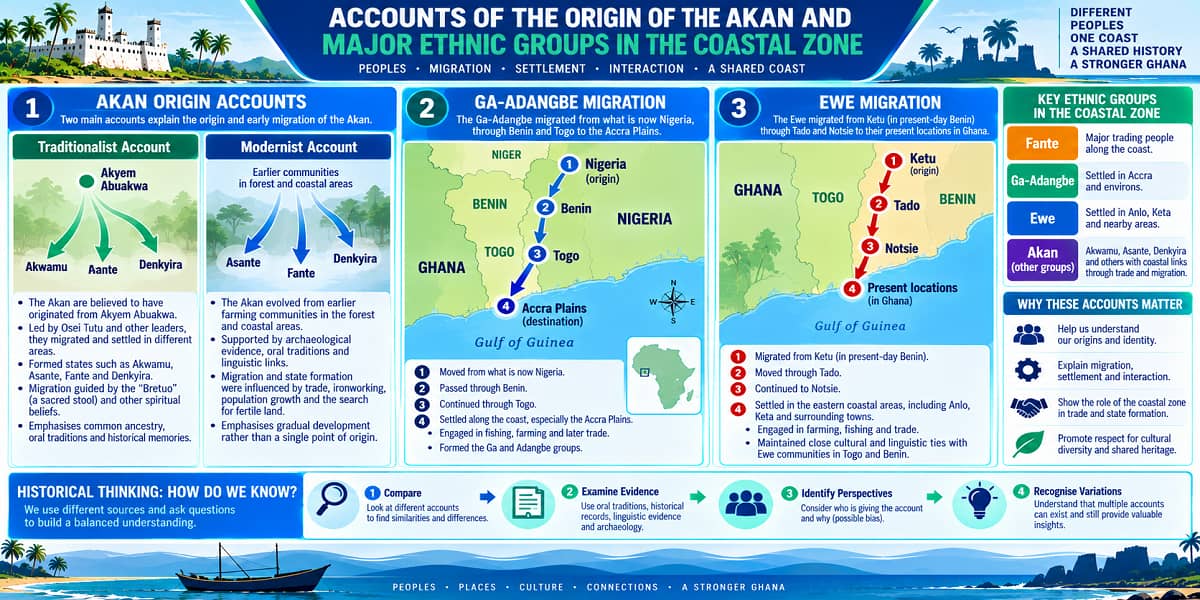
The origins of the Akan present a particular difficulty because no single account sufficiently explains exactly where they originated. Two major schools of thought are identified: the traditionalist account, associated with J. B. Danquah and Eva Meyerowitz, and the modernist theory, associated with Prof. Albert Adu Boahen and Harry Johnston.
| Traditionalist account | Modernist account |
|---|---|
| The Akan first lived in Ethiopia, later moved to Egypt, then settled in the Ancient Ghana Empire of Western Sudan before migrating into their present-day locations in Ghana. | The Akan first lived in Yorubaland in modern Nigeria, crossed the Mono and Volta Rivers, entered the Afram Plains, travelled northwards and later turned southwards to settle in the Pra-Offin basin. Different Akan groups then moved to their present sites. |
The contrast is striking: the two accounts do not merely offer slightly different versions of the same route. They give different starting points and different pathways of movement.
Why Historians Compare Accounts
A migration narrative can be important even when it contains uncertainty. Historians can ask what type of evidence is being used and what the account can—and cannot—establish.
- Oral traditions can preserve accounts passed through generations.
- Linguistic evidence can contribute to the investigation of historical relationships and movement.
- Archaeological data can provide another form of evidence for understanding the past.
These forms of evidence also require critical evaluation. Cultural context may influence oral traditions, while interpretations of archaeological findings may differ. Conflicting narratives therefore need to be compared rather than simply ignored.
From the Akan to the Coastal Zone
The coastal-zone focus turns to the Ga-Adangbe and Ewe. Their accounts provide another opportunity to examine how migration traditions describe movement, settlement and group identity.
Ga and Adangbe: From One Group to Two
The account presented describes the Ga and Adangbe as originally one group that later became divided into two groups. The Ga subgroups include Osu, La, Ga Mashi, Teshie, Nungua and Tema. The Adangbe (Dangme) subgroups include Ada, Krobo, Osudoko, Shai, Gbugla (Prampram), Kpone and Ningo.
The migration account states that the Ga-Adangbe claim migration from what is now Nigeria. They made a number of stops in present-day Benin and the Republic of Togo before eventually settling throughout the Accra Plains in southern Ghana.
The Ewe Route
The Ewe are mainly found in Ghana’s Volta Region, south-east of the Volta River, and are also found in the Republic of Togo.
The migration account follows a sequence of movements:
Ketu → Tado → Notsie → different present locations.
This sequence is useful because it shows how a migration narrative can be represented as a route. It also reminds us that a migration account may describe stages rather than a single movement from one place directly to another.
Three Questions Every Historical Reader Should Ask
1. What does the account say?
Identify the people involved, places named, route followed and major events described.
2. Where does the account come from?
Consider the type of evidence or tradition behind it. Oral traditions, linguistic evidence and archaeological data can contribute differently to historical investigation.
3. Why might accounts differ?
Different groups may preserve different perspectives. Cultural context and the purposes associated with narratives can influence how the past is remembered and interpreted.
Building a More Careful Picture of the Past
Suppose two accounts give different origins for the same people. A weak historical approach would simply choose one without examination. A stronger approach is to place the accounts side by side, identify their agreements and disagreements, consider their evidence, and acknowledge gaps or uncertainty.
| Historical task | What it involves |
|---|---|
| Source analysis | Evaluating the strengths and limitations of different forms of evidence. |
| Bias and cultural context | Considering how perspectives and cultural settings may shape narratives. |
| Comparison | Identifying similarities, differences and possible connections between accounts. |
| Interconnectedness | Considering possible historical interactions and cultural exchanges. |
| Tentative timeline | Arranging available evidence into a sequence while recognising uncertainties and possible overlaps. |
Why These Stories Matter
Origin stories can influence how communities understand themselves and their place within Ghana. That is why the study of migration narratives is not simply an exercise in drawing arrows on a map.
For the Akan, learners can investigate how the broader origin accounts relate to the histories of subgroups such as the Akwamu, Fante, Denkyira, Asante and Akyem. For the coastal zone, learners can examine the relationship between Ga and Adangbe groups and investigate different perspectives concerning Ewe and Ga-Adangbe origins.
A Historian’s Mindset
Studying migration accounts requires both curiosity and caution. Curiosity encourages us to investigate different perspectives. Caution prevents us from treating an uncertain narrative as an unquestionable fact.
The most useful questions are therefore simple but powerful: Who? What? Where? When? Why? and How?
These questions help transform a migration story into a historical investigation.
Takeaway
The Akan, Ga-Adangbe and Ewe have migration and origin accounts that provide important perspectives on the past. The accounts may vary, and that variation is itself something historians must examine. By comparing narratives, evaluating evidence, considering bias and cultural context, and constructing tentative timelines, learners can develop a more thoughtful understanding of Ghana’s migration histories.
Access NaCCA-aligned Support Packs
Download your structured NaCCA-aligned Teacher Support Pack and Student Learning Pack, designed for clarity, practicality, and reliable teaching and learning.