The Role of Buyers and Sellers and the Concept of Demand Explained for SHS 1 Economics (Sem. 1 – Week 4)
Walk through a market and you will see Economics happening in real time.
A buyer compares prices, quality and features. A seller considers costs, competition and what customers are likely to purchase. Money moves in one direction while goods or services move in the other.
Behind these everyday exchanges is one of the most important ideas in Economics: demand.
The Market Is an Exchange Relationship
A market does not have to be a physical place. It can be a shop, a local trading area or a virtual space.
What makes it a market is the interaction between buyers and sellers.
| Buyer | Seller |
|---|---|
| Purchases a good or service. | Offers a good or service for sale. |
| Makes payment. | Receives payment. |
| Seeks satisfaction. | Seeks to maximise profit. |
The possibility of exchange connects both sides.
Why Buyers Do Not Buy Randomly
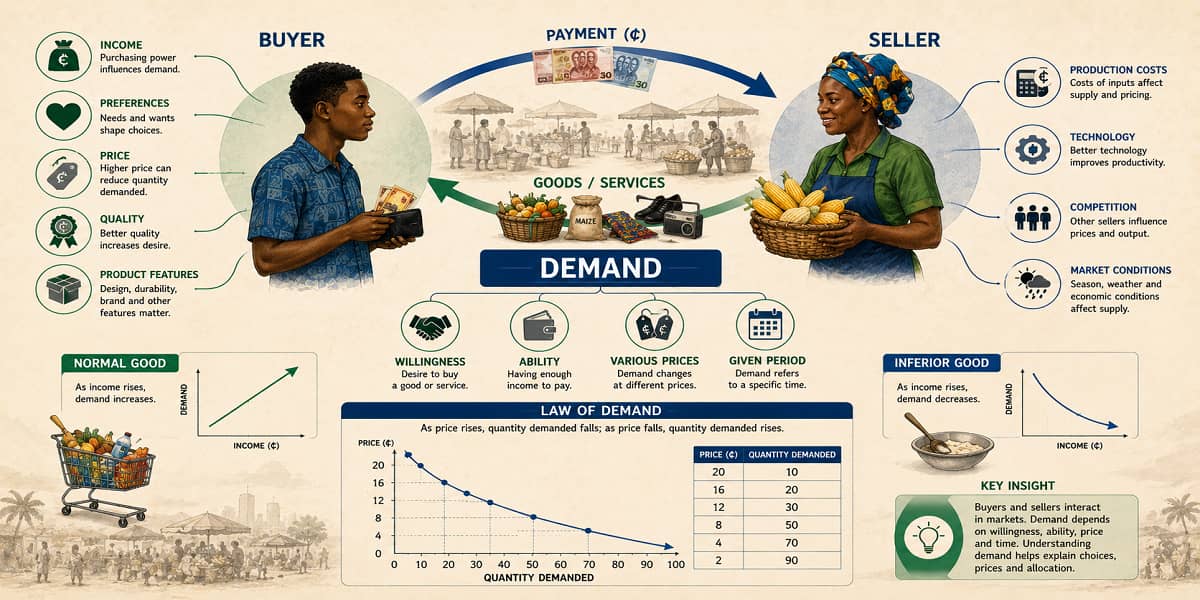
A buyer’s decision can depend on several factors: price, quality, brand, features and personal preference.
Income matters too.
When income changes, purchasing behaviour can change. Demand for a normal good increases as income rises and decreases as income falls, assuming other factors remain constant.
An inferior good behaves in the opposite direction: demand decreases as income rises and increases as income falls, other factors remaining constant.
Price Changes Can Change Buying Behaviour
There is an inverse relationship between price and quantity demanded, assuming other factors remain constant.
In general:
Higher price → lower quantity demanded
Lower price → higher quantity demanded
Price changes can also lead consumers to substitute one product for another when an alternative becomes relatively more affordable.
A GH₵1,500 Smartphone Decision
Consider a buyer with a budget of GH₵1,500.
| Option | Price | Decision |
|---|---|---|
| Brand A | GH₵1,200 | Affordable but fewer desired features. |
| Brand B | GH₵1,500 | Fits the budget and provides the desired balance. |
| Brand C | GH₵1,800 | Beyond the budget. |
The buyer chooses Brand B. The decision demonstrates that purchasing decisions are influenced not by price alone but by the relationship between price, available income and desired features.
The Seller Faces Choices Too
Sellers do not simply place a price on a product and wait.
They consider input costs, production technology, market conditions and competition.
Their objective is to make production and sales decisions that help maximise profits. Sellers seek to produce at a level where marginal revenue equals marginal cost.
A Handmade-Craft Business
Consider a craft seller offering hand-woven baskets for GH₵30 each and beaded jewellery for GH₵20 per piece.
The seller considers the time, effort and materials invested in production, together with market demand and competition.
Presentation also matters. Attractive displays and clear explanations of the qualities of handmade products can help attract potential buyers.
The seller therefore has to balance competing considerations rather than simply choosing any price.
Now We Reach Demand
Demand is the quantity of a good or service that buyers are willing and able to purchase at various prices during a given period, while other factors remain constant.
Notice the important words:
- willing;
- able;
- various prices; and
- given period.
Leaving out any of these ideas can weaken the definition.
Wanting Is Not the Same as Demanding
This is one of the most useful distinctions to remember.
A learner may strongly want an expensive item but have no money available to purchase it.
The desire exists, but the ability to purchase does not.
Therefore, the desire alone does not constitute demand.
Demand = Willingness + Ability to Purchase, considered across prices and within a period.
Purchasing Power
Purchasing power is the ability of consumers to buy goods and services with their income.
This helps explain the “able to buy” part of demand.
A person’s willingness to buy may exist, but purchasing power determines whether that willingness can be translated into an actual purchase.
Demand in an Auction
Imagine a classroom auction using school money.
Several learners want the same item. The item is offered at different prices while learners decide whether they are willing and able to buy.
A learner who wants the item but cannot afford the price does not have effective demand at that price.
The auction therefore provides a simple way to see how willingness, purchasing ability and price interact.
Demand Is About Quantity
Demand does not merely ask whether someone wants a product.
It concerns the quantity a buyer is willing and able to purchase at different prices during a specified period.
This makes demand more precise than an ordinary statement such as “I like this product” or “I want this product.”
What Happens When Price Changes?
Assuming other factors remain constant, an increase in price generally reduces quantity demanded, while a decrease in price generally increases quantity demanded.
This helps explain why sellers pay close attention to pricing decisions and why buyers compare prices before purchasing.
Buyers and Sellers Depend on Each Other
A seller needs buyers willing and able to purchase the product. A buyer needs sellers offering goods or services that meet their preferences.
Exchange becomes possible when the interests of both sides meet.
The market therefore brings together two connected decisions:
Buyer: “What am I willing and able to buy?”
Seller: “What should I offer, at what price, and in what quantity?”
Understanding Demand Through Everyday Experience
Think about a school canteen or local market.
What products do learners or customers want? What can they afford? What happens when prices change? How do sellers respond to what buyers want?
These questions turn familiar buying and selling experiences into economic analysis.
A Simple Market Investigation
Observe a market situation and identify:
- the buyers;
- the sellers;
- the goods or services being exchanged;
- the price;
- the buyers’ willingness to purchase;
- their ability to purchase; and
- how buying behaviour changes when the price changes.
This exercise helps connect the formal definition of demand with everyday market behaviour.
Key Ideas to Remember
- A market is a physical or virtual space where buyers and sellers exchange goods, services or assets.
- Buyers purchase goods and services and make payment.
- Sellers offer goods and services in exchange for payment.
- Buyers consider price, quality, brand, features and preferences.
- Sellers consider costs, technology, market conditions and competition.
- A normal good has higher demand when income rises, assuming other factors remain constant.
- An inferior good has lower demand when income rises, assuming other factors remain constant.
- Demand requires both willingness and ability to purchase.
- Demand is considered at various prices during a given period.
- Purchasing power is the ability to buy goods and services with income.
Final Takeaway
The market is a meeting point between two sides of economic activity.
Buyers bring purchasing decisions; sellers bring goods and services. Their interaction creates the possibility of exchange.
Demand gives us a precise way to understand the buyer’s side of that relationship. It is not simply wanting something. A buyer must be willing and able to purchase a quantity at different prices during a particular period.
Once you can distinguish wanting from demand, you have taken an important step towards understanding how markets work.
Access NaCCA-aligned Support Packs
Download your structured NaCCA-aligned Teacher Support Pack and Student Learning Pack, designed for clarity, practicality, and reliable teaching and learning.