
Elements of Drama and Significance of the Plot Explained for SHS 1 Literature-in-English (Sem. 1 – Week 11)
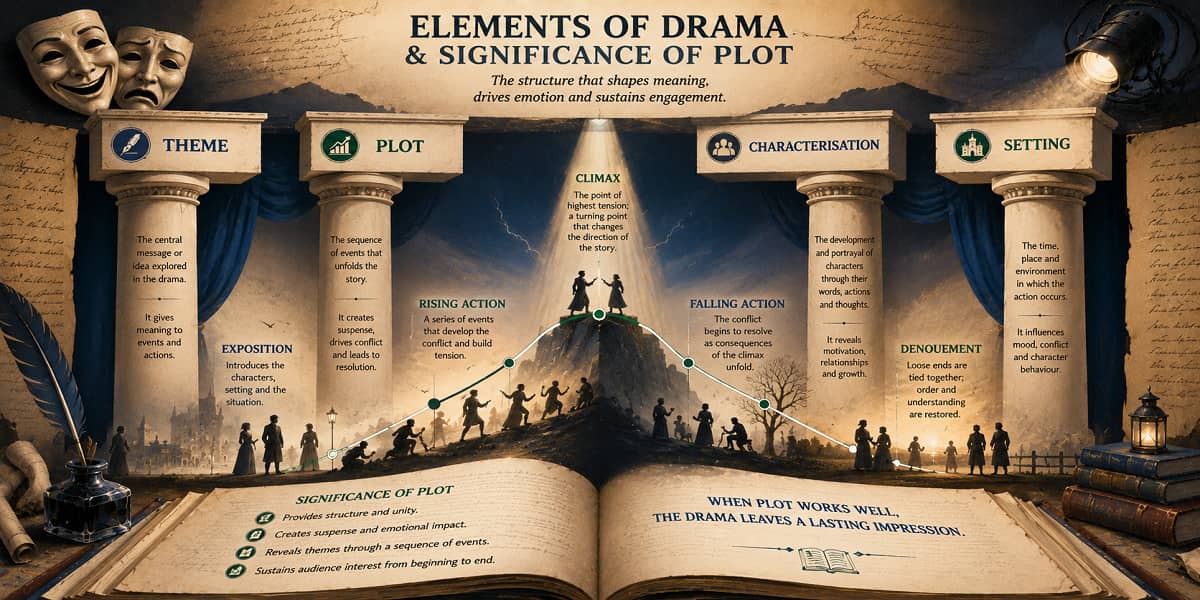
A drama is a story designed to move beyond the page. Characters act, speak, respond and interact before an audience, while events unfold through a structured sequence. To understand what makes a dramatic work effective, two questions become especially important: What elements make up the drama? and How does its plot keep the story moving?
Week 11 brings these questions together through the study of the elements of drama and the significance of plot.
Drama Is Literature in Action
Drama is the act of bringing a story to life in front of an audience. Characters and events are presented by actors through verbal and non-verbal interactions.
This means that reading drama requires attention to more than dialogue. The reader needs to think about characters, actions, setting, the sequence of events and the ideas that emerge from the complete dramatic experience.
Four Elements That Organise a Drama
| Element | Central Idea |
|---|---|
| Theme | The basic idea represented by the play. |
| Plot | The sequence of events or actions. |
| Characterisation | The way characters are modelled and managed. |
| Setting | When and where the drama unfolds. |
Theme May Be Hidden in Action
A play does not always announce its basic idea directly. The weekly material explains that theme may be explicit or implicit, and that the actions and inactions of characters help the audience deduce the theme.
This makes the audience an active participant in interpretation. What characters choose to do—and sometimes what they choose not to do—can reveal the basic idea underlying the play.
Plot Is the Drama’s Movement
If theme gives a play an underlying idea, plot gives its events a sequence.
Plot is the sequence of events or actions in a play. Its clarity and coherence are essential because the drama needs a logical and undisturbed flow.
Without meaningful organisation, individual events may fail to produce a clear sense of development. Plot connects the important events and keeps the story moving.
Characters Are More Than Names
Characterisation refers to the way characters are modelled and managed in a play.
In drama, characters become especially visible because actors bring them to life. Their verbal and non-verbal interactions become part of the audience’s experience of the story.
This is why characterisation should be considered alongside plot rather than treated as an isolated element.
Setting Gives the Story a World
Setting establishes when and where the drama unfolds.
It may involve several locations or remain confined to one place. It includes the historical and social contexts, time period and location of the story.
Setting therefore establishes the circumstances in which the characters act and the plot develops.
The Hidden Architecture of Plot
Plot is not simply “what happened first and what happened next”. The weekly material presents a five-part structure:
- Exposition
- Rising Action
- Climax
- Falling Action
- Denouement
Together, these stages create movement from the beginning of the narrative through conflict and tension towards resolution.
Exposition: Establishing the Starting Point
Exposition introduces the cast of characters and sets the stage for the conflict or plot driver at the beginning of the narrative.
It answers an important early question for the audience: Who is involved, and what situation will lead into the story’s conflict?
The exposition therefore does foundational work. It prepares the narrative conditions under which later events can occur.
Rising Action: Conflict Gathers Force
Rising action is a series of possibly linked incidents that create conflict and set the stage for the story to unfold.
Its movement is developmental. The audience encounters incidents that build the conflict and take the narrative closer to its critical point.
Climax: The Turning Point
The climax is the heated point of the story where the character has to make a decision.
The plot diagram on page 59 describes the climax as the point of highest emotion or tension and a turning point. It also depicts the movement from rising action into the climax and then towards falling action.
Falling Action: Moving Towards Resolution
After the climax, the narrative moves into falling action.
Here, subplots get resolved as the story moves from its climax towards resolution and the end.
The downward movement does not mean that the story becomes unimportant. It represents the process through which the consequences of the central dramatic development are brought towards closure.
Denouement: Clearing the Remaining Ties
Denouement is the end part of the story where all ties and locked-up issues are cleared.
It gives the plot its final sense of completion.
The Plot as a Journey
Think of the five stages as a journey:
Beginning → Development → Turning Point → Movement Towards Resolution → Closure
The five literary terms make that journey more precise:
Exposition → Rising Action → Climax → Falling Action → Denouement.
Why Plot Keeps the Story Moving
The weekly material explains that plot ensures every important element of the story is in place so that the story makes sense to the reader and keeps moving. It also contains the conflict or problem that the main character must resolve to reach a successful end.
This gives plot two important functions: organisation and
It organises important elements so the story can be followed, while simultaneously moving the conflict towards a conclusion.
Why Exposition Deserves Attention
The most dramatic moment of a story may attract the greatest attention, but the exposition deserves careful reading because it establishes the starting conditions.
If exposition introduces characters and sets the stage for the conflict, then later developments depend on the foundation it provides.
The question is not whether exposition is exciting. The better question is whether it effectively prepares the audience to understand what follows.
A Plot Can Be Mapped
Plot becomes easier to understand when its incidents are mapped onto the five stages.
| Stage | Movement of the Narrative |
|---|---|
| Exposition | Characters and the situation for conflict are introduced. |
| Rising Action | Linked incidents create and develop conflict. |
| Climax | The story reaches its heated point and turning point. |
| Falling Action | The story moves from the climax towards resolution. |
| Denouement | Remaining ties and locked-up issues are cleared. |
Drama and Prose: Shared Literary Ground
Knowledge gained from studying prose can be applied to drama. Literary elements can be identified in both forms, although drama presents its story through performance-oriented interactions.
The weekly material explicitly asks learners to review their knowledge of the elements of prose and apply it when discussing drama.
This creates an important bridge between literary forms: familiar concepts can provide a foundation for approaching dramatic texts.
Reading a Dramatic Passage Critically
When reading a passage from a prescribed drama, move through several layers of attention.
First, identify what happens. Next, consider which characters are involved and how they are presented. Then establish where and when the action takes place. Finally, consider what basic idea emerges from the action.
After that, place the incidents within the plot structure.
Textual Evidence Makes the Analysis Stronger
Identifying a plot stage is only the beginning of literary analysis.
If you classify an incident as rising action, explain how it creates or develops conflict. If you identify the climax, explain why it represents the heated point or turning point. If you identify exposition, explain how it establishes the characters and circumstances for the conflict.
The weekly learning tasks specifically require learners to identify and explain plot devices with textual evidence.
From Identification to Interpretation
There is a difference between naming a literary element and explaining its significance.
For example:
Identification: “This is exposition.”
Interpretation: “This is exposition because it introduces the characters and establishes the situation from which the conflict develops.”
The second response demonstrates understanding of function rather than simple recall.
The Five-Stage Plot Test
When you encounter a dramatic passage, ask these five questions:
- What is being introduced? — Exposition.
- What incidents are developing the conflict? — Rising action.
- Where is the heated point or turning point? — Climax.
- How does the story move towards resolution? — Falling action.
- What remaining issues are cleared? — Denouement.
This simple sequence can help you organise a complex dramatic narrative.
Story Mapping as a Thinking Tool
The weekly material encourages learners to break plot into smaller components and use story maps to highlight its significance.
A story map converts a continuous narrative into a visible structure. This can make relationships between incidents easier to discuss and explain.
It can also help learners collaborate when examining a film or prescribed text.
Learning Through Film
Another suggested approach is to watch a popular film and examine its plot structure alongside a prescribed text.
The purpose is not simply entertainment. The activity encourages attention to how plot structure contributes to the development of a narrative.
Watching a story unfold can make the movement from exposition through rising action, climax, falling action and denouement easier to recognise.
Discussion and Literary Language
When discussing drama with peers, use appropriate literary terminology.
Instead of saying only “the story gets exciting here”, identify the relevant plot stage and explain its function. Instead of saying “this is where the story ends”, consider whether the incident belongs to falling action or denouement.
Precise literary vocabulary makes literary discussion clearer.
Collaborative Interpretation
The weekly material encourages group work in which learners collaborate, communicate ethically and remain sensitive to the needs of teammates.
Literary discussion can involve different interpretations. Listening carefully to another reader’s reasoning can help you understand why that reader places an incident at a particular point in the plot structure.
A Question Worth Debating
Which part of plot is the most interesting?
There is no need to assume that every reader will choose the same stage. The important part is the reasoning behind the choice.
A strong discussion can compare the functions of exposition, rising action, climax, falling action and denouement and explain why one stage has particular appeal or significance.
Understanding the Whole Rather Than Isolated Parts
The five parts of plot should not be treated as unrelated boxes.
Exposition establishes the starting point. Rising action develops conflict. The climax becomes the heated point and turning point. Falling action moves towards resolution, and denouement clears the remaining ties and locked-up issues.
The significance of each stage becomes clearer when it is viewed as part of this larger movement.
A Complete Analytical Approach
When analysing a drama, combine the elements rather than studying them in isolation.
Consider how theme emerges from characters’ actions and inactions. Examine characterisation to understand how characters are modelled and managed. Consider setting to establish when and where the action occurs. Then trace the plot to understand how the events are organised and how conflict develops towards resolution.
Final Takeaway
Drama is a form in which stories are brought to life before an audience. Its major elements—theme, plot, characterisation and setting—work together to create the dramatic experience.
Plot is especially important because it gives events a coherent sequence and keeps the story moving. Its five major stages are exposition, rising action, climax, falling action and denouement.
The most useful habit is to go beyond identification. Do not merely name an element or plot stage. Ask what it contributes to the narrative and support your interpretation with evidence from the text.
Read the action. Identify the element. Trace the plot. Explain the function. Support the interpretation.
Access NaCCA-aligned Support Packs
Download your structured NaCCA-aligned Teacher Support Pack and Student Learning Pack, designed for clarity, practicality, and reliable teaching and learning.