Pre-colonial Ghanaian Dances and Songs; How Socio-cultural Practices affected the Development of Pre-colonial Ghanaian Societies; Changes and Continuities in Socio-cultural Practices of Ghanaians Explained for SHS 1 History (Sem. 1 – Week 11)
History is often imagined as a record of rulers, wars and major political events. But much of a society’s history can also be found in the things people repeatedly do: how they celebrate, mourn, name children, mark important stages of life, play games, sing and dance.
For pre-colonial Ghanaian societies, socio-cultural practices were important ways of expressing identity, transmitting knowledge and strengthening community life. Traditional dances and songs are especially useful because they connect performance with memory, belief and social relationships.
Dance and Song as a Cultural Archive
A cultural archive does not have to be a library of written books. A community can preserve knowledge through oral traditions, performances, objects and repeated practices. Traditional Ghanaian dances and songs provide an example of this wider understanding of historical evidence.
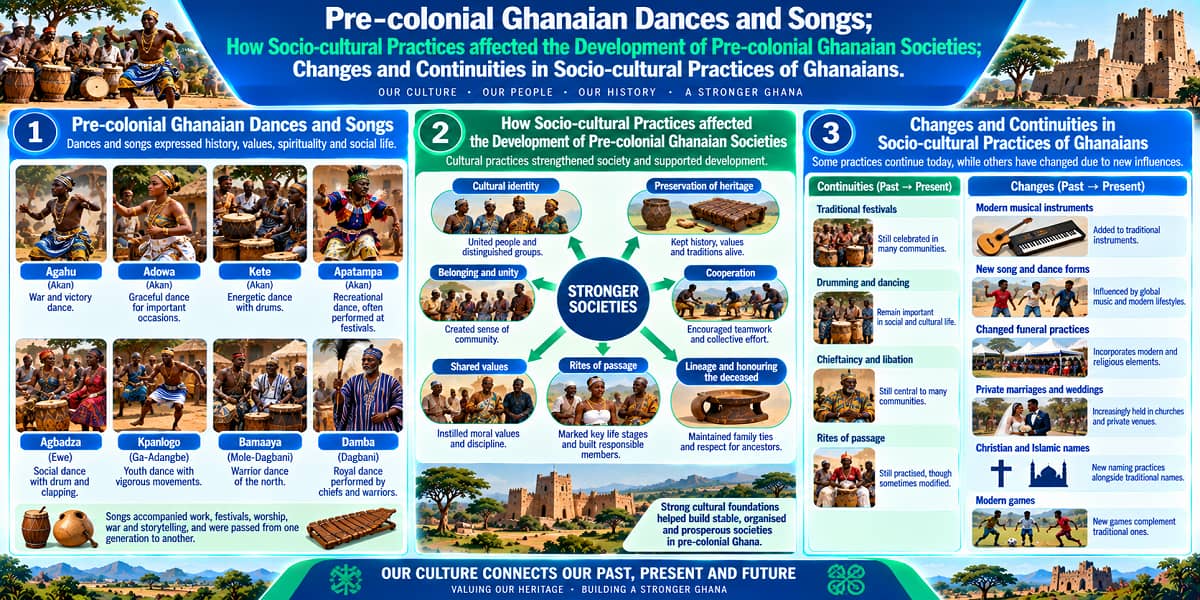
The dances identified with different groups include Agahu among the Ewe, Adowa and Kete among the Asante, Apatampa among the Fante, Kpanlogo among the Ga, Bamaaya and Damba among the Dagomba, as well as Agbadza and Borborbor among the Ewe.
| Expression | Group identified with it | What its historical study can help reveal |
|---|---|---|
| Agahu | Ewe | Cultural identity and inherited performance traditions |
| Adowa | Asante | The relationship between dance and cultural expression |
| Apatampa | Fante | Distinctive community traditions |
| Kpanlogo | Ga | The diversity of Ghanaian cultural expression |
| Bamaaya | Dagomba | The preservation of traditional performance |
The important historical lesson is not merely memorising names. A performance can be examined for its movements, costumes, instruments and lyrics. These elements may provide clues about values, beliefs, storytelling traditions and community identity.
Culture Does Social Work
Socio-cultural practices matter because they do more than express what people believe. They can also help a society function.
In pre-colonial Ghanaian societies, such practices helped to foster belonging and cooperation, preserve cultural heritage, create communal identity and shared values, identify individuals, mark transitions from childhood to adulthood, emphasise lineage continuity and honour the deceased in relation to beliefs about the afterlife.
Seen this way, culture connects the individual to a larger social world. A person does not exist only as an individual; cultural practices can position that person within a family, community and inherited tradition.
The Power of Interconnection
One of the most useful ways to understand socio-cultural organisation is to look for connections rather than isolated practices.
Consider a simple chain:
Identity → Belonging → Shared values → Cooperation → Community continuity
A naming practice can help identify an individual. A rite of passage can mark a change in social status. Marriage can connect families and lineages. Funeral practices can honour the deceased and reflect beliefs about transition into the afterlife. Music and dance can reinforce communal identity and preserve heritage.
The practices therefore become part of the social framework through which communities understand people, relationships and important stages of life.
What Happens When Culture Changes?
Ghanaian socio-cultural practices have not remained completely unchanged. The weekly historical evidence identifies several changes: expensive coffins at funerals, keeping dead bodies in mortuaries, private marriages and weddings, Christian and Islamic names for newborns, modern musical instruments, new genres of songs, new dance types and modern games.
These examples encourage an important historical distinction: change does not necessarily mean complete disappearance.
| Area | Change identified | Historical question |
|---|---|---|
| Funerals | Expensive coffins; mortuary preservation | What has changed in the way funerals are conducted? |
| Marriage | Private marriages and weddings | How has the setting or form of marriage changed? |
| Naming | Christian and Islamic names | How have naming practices developed? |
| Music | Modern instruments and new song genres | How has musical expression adapted? |
| Dance | New dance types | How has performance changed? |
| Games | Modern games | How has recreation evolved? |
Why Historians Need Evidence
When studying cultural change, it is tempting to make quick conclusions. A better historical approach is to ask questions and examine evidence.
- What changed?
- What remained?
- When did the change occur?
- What may have caused the change?
- How did the change affect people?
- What evidence supports the conclusion?
Evidence for studying socio-cultural practices can include oral traditions, artefacts, artwork and written accounts. Oral traditions are valuable for preserving cultural memory, but they also need careful interpretation. Physical objects and other forms of evidence can provide additional clues.
From Heritage to Historical Responsibility
The continuing presence of traditional dances and songs demonstrates that cultural heritage can survive across generations. At the same time, new musical instruments, genres, dances and other practices show that culture is capable of adaptation.
This creates a meaningful question for modern Ghana: How can a society adapt while retaining a meaningful connection with its heritage?
The answer requires historical awareness. Understanding continuity helps communities recognise what has endured. Understanding change helps them recognise how people have adapted to new circumstances. Neither should be studied without the other.
A Useful Lesson for Today’s Learner
Traditional dances and songs should therefore not be treated merely as entertainment. They can be approached as historical expressions. Socio-cultural practices should not be viewed merely as customs. They can be examined as structures through which communities created belonging, identity, continuity and shared values.
And when those practices change, the historian’s task is to investigate rather than simply celebrate or condemn the change. Evidence, context and comparison make it possible to understand how Ghanaian society has developed across time.
History lives not only in monuments and written records. It also lives in the practices communities preserve, adapt and pass from one generation to another.
Access NaCCA-aligned Support Packs
Download your structured NaCCA-aligned Teacher Support Pack and Student Learning Pack, designed for clarity, practicality, and reliable teaching and learning.