Centralised, Non-centralised and Theocratic Political Systems in Pre-colonial Ghana
Before Ghana was colonised by the British, many states and kingdoms were independent and developed their own political systems. These systems were not organised in exactly the same way. The major forms identified in this topic are centralised, non-centralised and theocratic political systems.
1. Three Ways of Organising Political Power
Think about a simple question: Who has the authority to make decisions and maintain order? The answer helps us distinguish the three political systems.
| Political system | Main feature | Groups identified in the topic |
|---|---|---|
| Centralised | Political power was vested in one central authority, while local authorities depended on its consent. | Akan and Mole-Dagbani |
| Non-centralised | There was no central government; authority was distributed through local social structures. | Vagala, Sisala, Tallensi, Kokomba, Koma, Tampulensi and Chamba |
| Theocratic | Political authority was held by the priestly class. | Guan and Ga-Adangbe |
The key difference is therefore the location and basis of political authority.
2. Centralised Political Systems
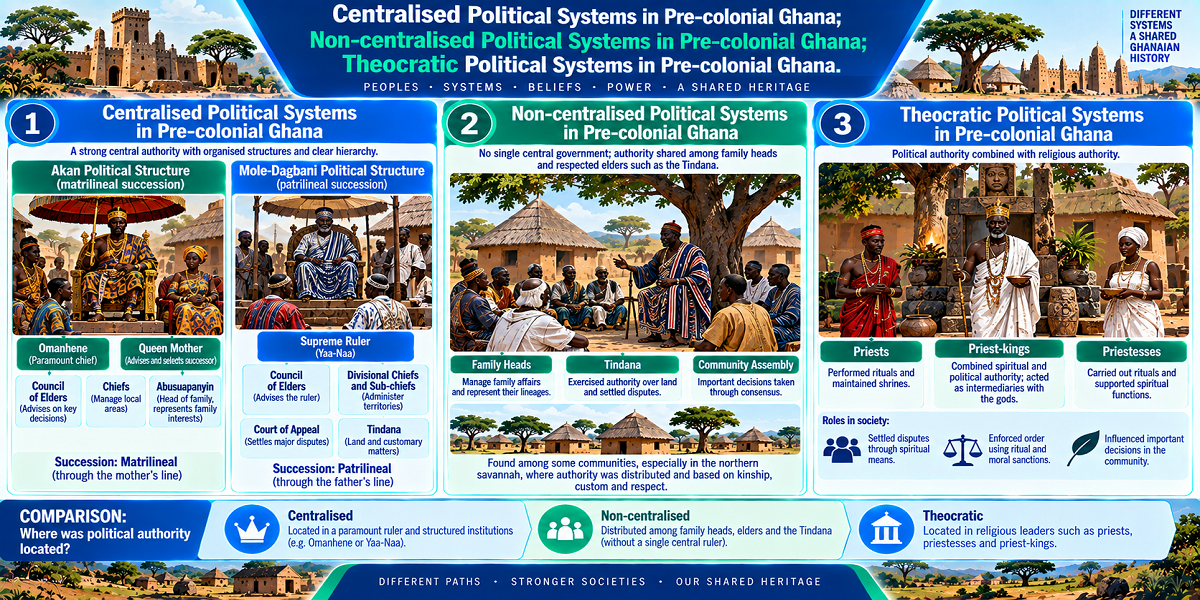
In a centralised political system, political power was vested in one person as the central governing authority. Policies, laws and decisions came from the central authority, while political authorities at the local level depended on its consent.
The source identifies the Akan and Mole-Dagbani as groups that practised centralised government.
The Akan Political Structure
The Akan system included several levels and offices:
- Omanhene
- Queen Mother
- Council of Elders
- Divisional Chief (Ohene)
- Community Chief (Odikro)
- Abusuapanyin
The Akan system also featured matrilineal inheritance to the throne.
This shows that centralisation did not mean that only one person existed in the political structure. Different offices existed within the system, but political authority was organised around a central authority.
The Mole-Dagbani Political Structure
The Mole-Dagbani system included:
- Supreme Rulers
- Council of Elders
- Divisional Chiefs/Sub-chiefs
- Court of Appeal
- Tindana
The source identifies patrilineal inheritance of enskinment as a feature of the Mole-Dagbani system.
Notice the Difference
| Akan | Mole-Dagbani |
|---|---|
| Omanhene | Supreme Rulers |
| Queen Mother | Council of Elders |
| Council of Elders | Divisional Chiefs/Sub-chiefs |
| Divisional Chief and Community Chief | Court of Appeal |
| Abusuapanyin | Tindana |
| Matrilineal inheritance to the throne | Patrilineal inheritance of enskinment |
Historical thinking: A comparison should not simply list differences. It should identify how the different offices fitted into the organisation of political power.
3. Non-centralised Political Systems
Now imagine a political system without a central government making laws and enforcing them. This describes the non-centralised, or acephalous, system discussed in this topic.
In the Savannah zone of northern Ghana, societies such as the Vagala, Sisala, Tallensi, Kokomba, Koma, Tampulensi and Chamba were not organised into centralised political states during the pre-colonial period. They were described as stateless because they had no central government to make laws and enforce them.
Authority was instead connected with local social structures. An important figure was the Tindana, who exercised considerable authority over the land. Family heads were also a feature of the political structure.
Core Features
- Presence of a Tindana.
- Stateless or acephalous character.
- No central government.
- Presence of family heads.
Here, the absence of a central government does not mean the absence of authority or social order. It means that political organisation was not concentrated in a central state government.
4. Centralised and Non-centralised: Compare Them
| Centralised system | Non-centralised system |
|---|---|
| Political power was vested in a central authority. | There was no central government. |
| Policies, laws and decisions came from the central authority. | Authority operated through local social structures. |
| Examples include Akan and Mole-Dagbani. | Examples include Vagala, Sisala and Tallensi. |
| Included recognised political offices such as rulers, chiefs and councils. | Included family heads and the Tindana. |
Quick check: If a society has no central government but has family heads and a Tindana, which system does this suggest?
Answer: A non-centralised political system.
5. Theocratic Political Systems
The third system is different from both centralised and non-centralised political organisation because political authority was associated with the priestly class.
Under the theocratic political system described in the topic, people were ruled by priests and priestesses. The source identifies the Guan and Ga-Adangbe as groups that practised this system.
Important Features
- There were no centralised states.
- Rulers were priests and priestesses of local gods.
- Priest-kings were highly respected.
- Priest-kings settled disputes and their decisions were binding.
- Priest-kings were regarded as effective political officers.
- Their powers were backed by force based on ritual and moral sanctions.
This system demonstrates the close relationship between religious authority and political authority. Religious leadership was not separate from the exercise of political power.
6. Putting the Three Systems Together
Use the question “Where was political authority located?” to distinguish the systems:
| System | Where authority was concentrated or exercised |
|---|---|
| Centralised | A central political authority, with local authorities depending on its consent. |
| Non-centralised | Local social structures, including family heads, with the Tindana exercising considerable authority over land. |
| Theocratic | The priestly class, including priests, priestesses and priest-kings. |
This comparison helps prevent a common mistake: assuming that every pre-colonial Ghanaian society used the same form of government.
7. Apply Your Understanding
Question 1
Identify two groups that practised a centralised political system.
Answer: The Akan and Mole-Dagbani.
Question 2
State three features of a non-centralised political system.
Answer: Presence of a Tindana, absence of a central government, and presence of family heads.
Question 3
Who ruled under the theocratic political system?
Answer: Priests and priestesses of the local gods.
Question 4
What is one important difference between Akan and Mole-Dagbani succession?
Answer: The Akan system featured matrilineal inheritance to the throne, while the Mole-Dagbani system featured patrilineal inheritance of enskinment.
Question 5
Why should a non-centralised society not be described as having no political organisation at all?
Answer: Although it had no central government, authority was organised through social structures including family heads and the Tindana.
8. Historical Thinking: Power and Evidence
Understanding these systems requires more than memorising names. Historians can examine oral traditions, archaeological evidence and colonial accounts, while carefully evaluating their strengths and weaknesses.
Useful questions include:
- Who exercised authority?
- How was that authority organised?
- How were decisions made?
- How were laws or social order maintained?
- What evidence supports our understanding?
- How might political systems have changed over time?
Studying political organisation also helps connect government with everyday life. The topic highlights areas such as tribute collection, justice systems and social hierarchy as ways in which centralised political systems affected society.
9. Final Synthesis
Pre-colonial Ghana contained different forms of political organisation. Centralised systems placed political power in a central authority and included the Akan and Mole-Dagbani. Non-centralised systems had no central government and relied on local social structures such as family heads and the Tindana. Theocratic systems placed political authority in the hands of priests and priestesses, with the Guan and Ga-Adangbe identified with this form.
The most important historical skill is to compare these systems by examining who held power, how authority was organised, how decisions were made, and how political structures related to society.
Remember: Pre-colonial Ghanaian societies were politically diverse. Understanding that diversity helps us appreciate the different ways communities organised authority, maintained order and connected political power with social and religious life.
Access NaCCA-aligned Support Packs
Download your structured NaCCA-aligned Teacher Support Pack and Student Learning Pack, designed for clarity, practicality, and reliable teaching and learning.