Division of Labour and Specialisation in Production Explained for SHS 1 Economics (Sem. 1 – Week 12)
Production can be organised in very different ways. One person may perform many activities, or a production process may be separated into a series of tasks handled by different people or groups.
The second arrangement introduces two important economic ideas: division of labour and specialisation.
From One Process to Many Tasks
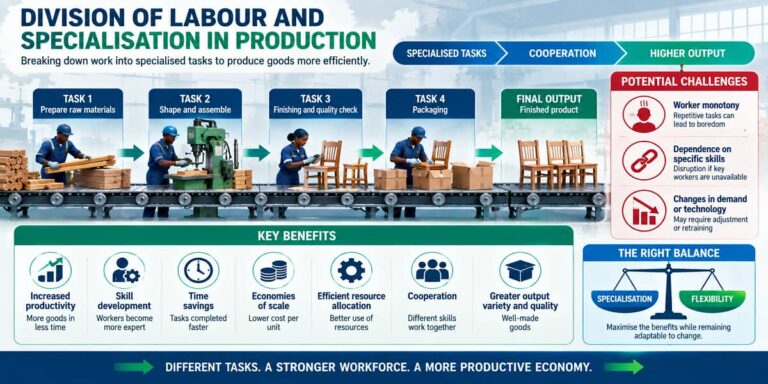
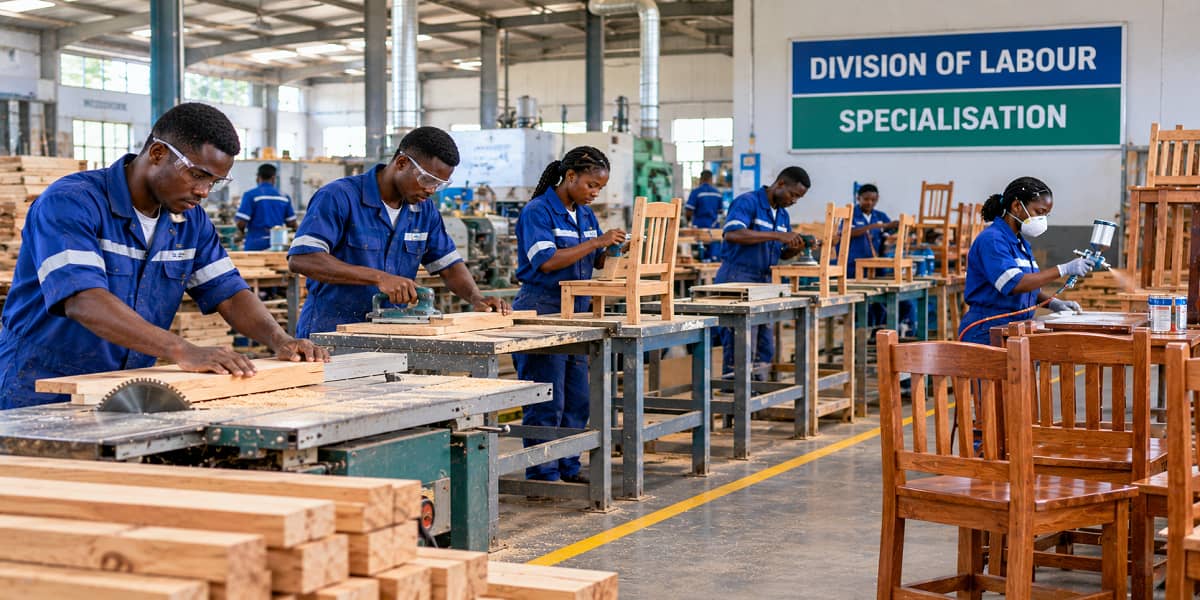
Division of labour means breaking the production of goods or services into smaller tasks and assigning those tasks to specific individuals or groups.
Instead of treating production as one large activity, it is organised into connected stages.
Specialisation takes this further. Different tasks are assigned to specific individuals or groups so that they can focus on particular areas and improve efficiency and productivity.
The relationship can be expressed simply:
Break production into tasks → assign tasks → workers focus on particular tasks → specialised skills develop.
Why Focus Can Make a Difference
When a person repeatedly concentrates on a particular task, experience and practice can develop specialised skills and knowledge.
This can improve efficiency, productivity and the quality of work.
Division of labour therefore changes not only who does what, but also how workers develop their productive abilities.
Productivity Gains
One of the major reasons for using division of labour and specialisation is the possibility of increased productivity.
Specialised workers can become more efficient in their particular tasks. They may perform them more quickly and accurately, contributing to higher overall output.
Time Is Also Saved
Imagine repeatedly switching between several unrelated activities. Time can be spent moving from one task to another.
With division of labour, workers concentrate on specific tasks. This reduces the time spent transitioning between activities and allows specialised workers to become more adept at what they do.
Skills Grow Through Practice
Specialisation can create opportunities for workers to develop specialised skills and knowledge.
With time and practice, workers may develop more efficient methods, innovative techniques and problem-solving abilities.
These developments can contribute to both productivity and quality.
Production Becomes Interdependent
Division of labour creates a network of relationships.
The output produced by one worker or department may become a necessary input for another. Workers therefore become interdependent.
This encourages cooperation, coordination and teamwork.
Resource Allocation Becomes More Focused
Different production tasks require different levels of expertise, equipment and resources.
Specialisation allows these resources to be assigned according to the requirements of particular tasks, helping to maximise their utilisation.
Economies of Scale
Specialisation can support economies of scale when businesses focus on a limited range of goods or services and produce on a larger scale.
This is one reason why specialisation is particularly relevant to organised large-scale production.
More Variety and Better Quality
Specialisation can also influence what businesses are able to offer.
Businesses may diversify production and provide a wider range of goods or services. At the same time, specialised workers can concentrate on perfecting particular tasks and processes, contributing to higher-quality output.
The Hidden Cost of Repetition
The advantages of specialisation come with limitations.
A worker who repeatedly performs the same task may experience monotony. A production system may also become dependent on particular skill sets.
These limitations matter because production does not operate in a completely stable environment.
What Happens When Conditions Change?
Changes in demand or technology can disrupt highly specialised production processes.
A system designed around a particular task structure may need to adjust when the conditions surrounding production change.
This creates an important economic tension:
Specialisation can increase efficiency, but flexibility helps production respond to change.
Finding the Balance
Long-term production success requires an appropriate balance between specialisation and flexibility.
| Specialisation can provide | Flexibility helps with |
|---|---|
| Efficiency | Changes in demand |
| Productivity | Changes in technology |
| Skill development | Adjustment when production conditions change |
| Time savings | Reduced dependence on a narrow task structure |
Reading a Production Process Economically
Suppose you observe a production process in which several people perform different activities.
Do not simply say, “They are doing different jobs.” An economic analysis asks deeper questions:
- Has the production process been divided into smaller tasks?
- Who has responsibility for each task?
- Have particular workers or groups become specialised?
- Does one task depend on the output of another?
- What efficiency benefits result?
- What risks arise if demand or technology changes?
These questions reveal the economic structure behind the organisation of production.
Division of Labour Is About Organisation
It is useful to distinguish the concepts carefully.
Division of labour describes the way the production process is broken into tasks and distributed among individuals or groups.
Specialisation describes the focused performance of particular tasks by those individuals or groups.
One concept creates the task structure; the other describes the focused productive role within that structure.
Evaluating the Strategy
Is division of labour always better?
Not necessarily.
Its benefits can be significant: higher productivity, skill development, time savings, efficient resource allocation, cooperation, economies of scale, greater variety and improved quality.
But excessive specialisation can produce monotony, dependence on particular skills and vulnerability to changes in demand or technology.
The strongest production system is therefore not simply the one with the greatest degree of specialisation. It is one that achieves an effective balance between specialised efficiency and flexibility.
Key Ideas at a Glance
| Concept | Core Idea |
|---|---|
| Division of labour | Breaking production into smaller tasks and assigning them to specific individuals or groups. |
| Specialisation | Focusing specific individuals or groups on particular tasks to improve efficiency and productivity. |
| Interdependence | Workers or departments depend on one another because their outputs are connected. |
| Flexibility | The ability of production to respond to changes in demand or technology. |
Final Takeaway
Division of labour changes the organisation of production by breaking a process into smaller tasks. Specialisation allows individuals or groups to focus on particular tasks.
The resulting efficiency can improve productivity, develop skills, save time, support economies of scale, improve resource allocation, encourage cooperation and contribute to variety and quality.
Yet specialisation has limits. Monotony, dependence on specific skill sets and disruption caused by changes in demand or technology can reduce its advantages.
Good production therefore requires both the efficiency created by specialisation and the flexibility needed to adapt.
Access NaCCA-aligned Support Packs
Download your structured NaCCA-aligned Teacher Support Pack and Student Learning Pack, designed for clarity, practicality, and reliable teaching and learning.