Discuss Short Stories and Novels of Varied Styles for Pleasure Explained for SHS 1 Literature-in-English (Sem. 1 – Week 5)
Why do people choose to read a story when nobody is forcing them to? Sometimes the answer is simple: because they want to enjoy the experience.
Reading for pleasure is reading done freely with the aim of getting satisfaction. It gives readers opportunities to experience other worlds and roles through imagination. For SHS learners, this kind of reading can also become a doorway into understanding how stories are constructed.
Reading Begins with Choice
A reader who is choosing a book has already begun making a literary decision. A library blurb or an e-book description may provide enough information to make one story seem more appealing than another.
This matters because pleasure in reading is connected to willingness. When readers have opportunities to select stories they want to explore, they can approach reading as an experience rather than only as a task.
The purpose of reading can vary. Prose may entertain, inform, educate, convey a message, explore an idea or tell a story. It may also be used to persuade, satirise, criticise or imitate or criticise a society.
What Does Context Add?
A story does not exist as a collection of isolated sentences. The author provides information that helps readers take meaning from the text. This is called context.
Context in literature may be social, psychological, emotional and so on. When readers pay attention to such information, they can better understand the circumstances surrounding the events and experiences presented.
This gives us an important distinction:
| Reading for Pleasure | Context in Literature |
|---|---|
| Concerns reading freely for satisfaction. | Concerns information that helps the reader take meaning from a text. |
One describes why or how we read; the other helps explain what surrounds the meaning of what we read.
Prose: The Form of Storytelling
Prose is the means by which a writer fulfils the basic promise to deliver a story with characters, setting, conflict and plot.
Prose has many possible purposes. It can communicate a message, inform and educate society, explore a new idea or tell a story. It can also entertain, persuade, satirise or criticise.
When the writing is imaginative and made-up, it falls within prose fiction. Prose fiction is generally based on the author’s imagination and has little or no direct fact based on reality. It normally takes a narrative form organised through chapters and paragraphs.
Six Prose Fiction Forms to Recognise
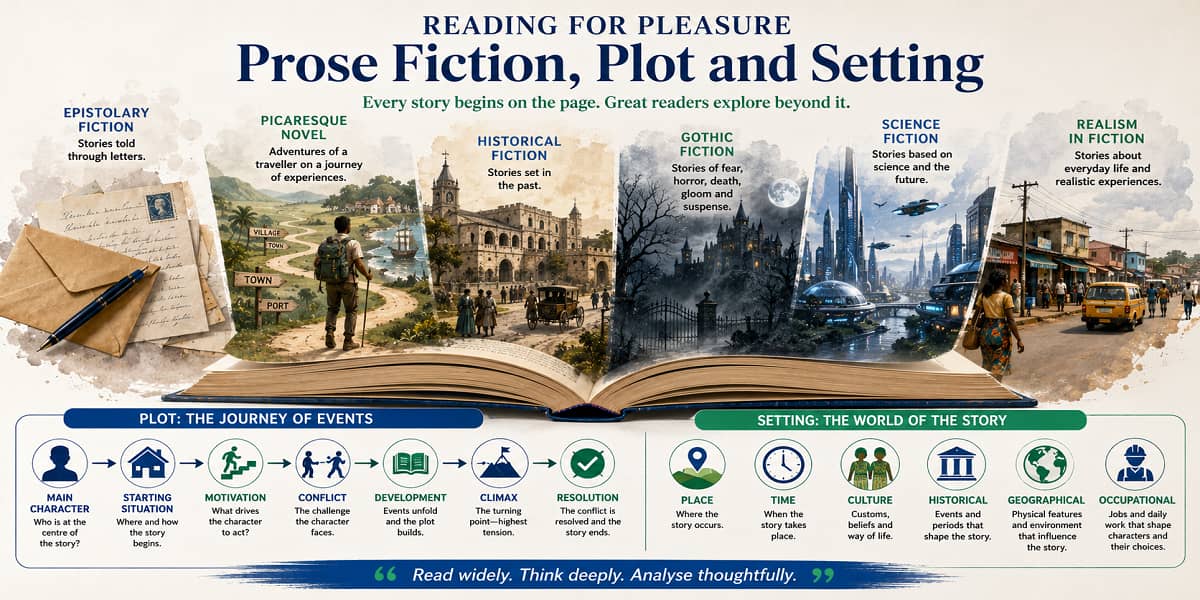
Different forms of prose fiction can be distinguished by their form and subject matter. The distinctions introduced this week include:
- Epistolary: written through an exchange of letters.
- Picaresque novel: presents the adventures of an individual, often a rascal, usually as a journey through different locations.
- Historical novel: takes its setting and main characters and events from history, whether true or imaginary.
- Gothic novel: characterised by fear, horror, death, gloom, nature, individuality and very high emotion or tension.
- Science fiction: imaginative fiction with content based in science and related to present and future events.
- Realism in fiction: a contemporary view of what “real life” reveals, while the characters are not identifiable as real people.
The labels become useful when they help readers recognise what makes one fictional text different from another.
How to Tell One Fictional Style from Another
Imagine encountering a novel presented entirely through letters. Its form gives you an important clue: it is epistolary.
Now imagine a fictional narrative built around the adventures of an individual travelling through different locations. Its journey-based structure points towards the picaresque.
A work dominated by fear, horror, death, gloom and intense emotional tension invites consideration of the Gothic style.
When science provides the basis for imaginative treatment of present or future events, the text belongs to the area of science fiction.
Recognising these differences is more useful than simply memorising definitions because it allows the reader to discuss why a particular work belongs to a particular type.
Plot: The Architecture of Events
Once a reader begins examining how a prose story is constructed, plot becomes central. Plot is the sequence of events in a story.
A practical sequence for examining plot begins with the main focus and then follows the movement of the story:
- Main character — Who is the main focus?
- Starting situation — What is happening at the beginning?
- Motivation — What does the character want?
- Conflict — What disturbs the status quo?
- Development — What happens next?
- Climax — How do events reach their peak?
- Resolution — How are things resolved?
This sequence provides a way to reduce a long narrative to its major movements without losing its basic structure.
Setting: The World Around the Events
Setting provides the time, place, culture, historical, geographical and occupational background of a story.
That definition invites readers to look much further than a place name. A setting can be revealed through physical environments, times of year, times of day and wider political, cultural, economic, social and family influences. Emotional and psychological circumstances can also form part of what surrounds the events.
| Look For | Examples of Clues |
|---|---|
| Place | Country, region, city, town, village or community. |
| Time of year | Market days, rainy season or drought. |
| Time of day | Morning, afternoon, night, office hours or close of day. |
| Social background | Political, cultural, economic, social and family influences. |
| Emotional and psychological circumstances | Situations such as departure from a family home, marriage or funeral. |
Plot and Setting Work as Partners
Plot and setting are not competing ideas. They answer different questions about the same prose work.
Plot asks: What happens, and how do the events develop?
Setting asks: Where, when and under what background circumstances do the events occur?
When these questions are combined, the reader begins to see how an author creates the world in which the story unfolds and then moves the characters through that world.
From Retelling to Analysis
There is a difference between retelling a story and analysing how it works.
A retelling might list events from beginning to end. An analytical response identifies the major incidents and asks how the author has organised them.
The same principle applies to setting. Instead of merely saying that a story takes place in a particular town or village, the reader can identify the words and phrases that reveal time, place and wider context.
This shift is important because it changes the reader’s role from someone who simply remembers events to someone who examines how the story has been created.
A Storyboard Can Make Plot Visible
A storyboard is one useful way of presenting a summary of a short story. Instead of writing every event, the reader selects major moments and arranges them in sequence.
A simple storyboard might move through:
- the main character and starting situation;
- motivation and conflict;
- major development;
- climax; and
- resolution.
This makes the structure of the plot easier to see and can also help readers discuss whether the sequence is clearly organised.
Reading with Other People
Literature becomes especially interesting when readers discuss their interpretations. A short story or novel can be read individually and then discussed with others through conversation, presentations or debate.
Group reading can also expose readers to different prose texts. Learners who finish one text can exchange texts with others and experience a variety of works. Learners who need more time can use guided questions about events and plot to support their reading.
The important principle is that discussion should help readers communicate their ideas and respond thoughtfully to the ideas of others.
Try This: The Ten-Year Memory Test
Imagine that someone meets you ten years from now and asks:
“What do you remember about that story?”
What would you say?
This question can help you move beyond a mechanical summary. You may remember a major incident, an unexpected development, an important conflict, a powerful moment or something that made the story interesting to you.
Such reflection can make literary discussion more lively and personal while still keeping attention on the text.
Apply the Method to a Prescribed Text
Choose a prescribed prose text. You may use The Second Class Citizen by Buchi Emecheta or another recommended text.
Then create two sets of notes.
Plot Notes
- Main character
- Starting situation
- Motivation
- Conflict
- Development
- Climax
- Resolution
Setting Notes
- Physical environment
- Time of year
- Time of day
- Political influences
- Cultural influences
- Economic influences
- Social influences
- Family influences
- Emotional or psychological circumstances
Compare the two sets of notes. What does the plot tell you that the setting does not? What does the setting reveal that the sequence of events alone cannot show?
Why Prose Can Be Enjoyable and Worth Studying
Reading for pleasure and literary analysis do not have to be opposites. A reader can enjoy a story while becoming increasingly curious about how it was constructed.
The pleasure comes from entering the imagined experience. The analysis comes from noticing the choices that make that experience possible.
When readers understand prose fiction, recognise its different forms and examine how plot and setting are created, they gain more ways to appreciate what they read.
Final Takeaway
Four ideas connect this week’s learning:
- Read freely and enjoy the experience. Reading for pleasure gives readers satisfaction and access to imagined worlds and roles.
- Pay attention to context. Social, psychological and emotional information can help readers take meaning from a text.
- Recognise differences among prose fiction types. Form and subject matter provide clues for distinguishing epistolary, picaresque, historical, Gothic, science fiction and realism in fiction.
- Examine plot and setting. Plot is the sequence of events, while setting provides the time, place and wider background of the story.
The strongest reading experience can therefore combine pleasure, curiosity and thoughtful examination. A story can entertain you while also inviting you to discover how its world and events have been created.
Access NaCCA-aligned Support Packs
Download your structured NaCCA-aligned Teacher Support Pack and Student Learning Pack, designed for clarity, practicality, and reliable teaching and learning.