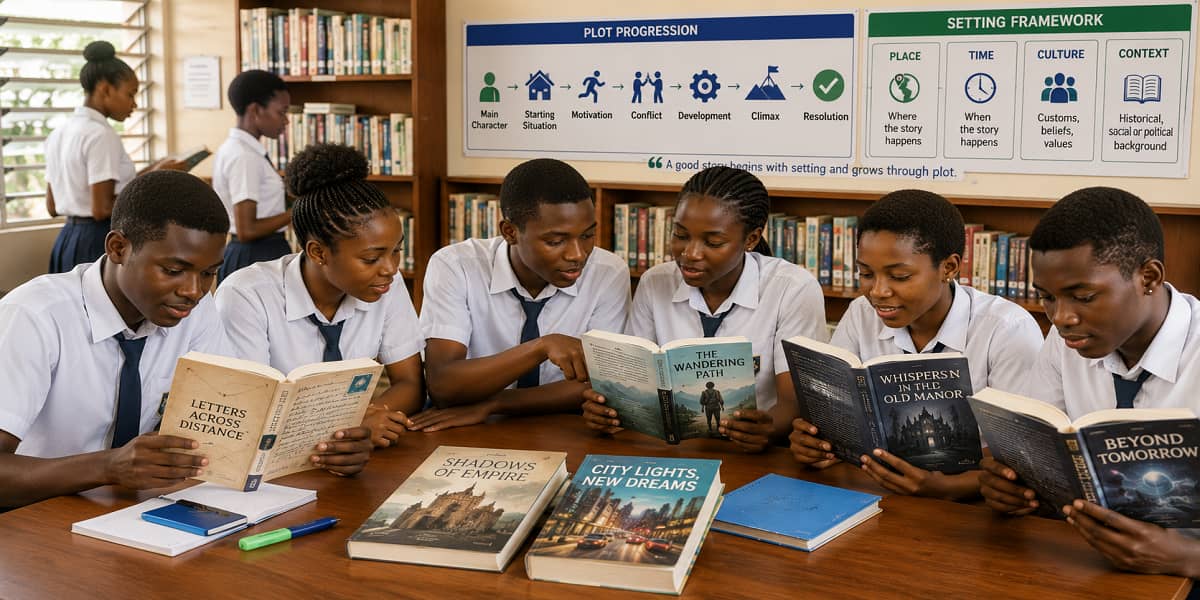
Discuss Short Stories and Novels of Varied Styles for Pleasure
Literature is not only something we study for information or examination. It can also be something we choose to read because we enjoy it. A short story or novel can take us into experiences, situations and roles that we may encounter through imagination.
This lesson introduces reading for pleasure, context in literature, prose fiction, different types of prose fiction, and the ways authors create plot and setting.
1. What Does It Mean to Read for Pleasure?
Reading for pleasure is reading that people do of their own free will with the aim of getting satisfaction. It allows readers to experience other worlds and roles through their imagination.
Reading for pleasure therefore begins with choice. A reader may look through book descriptions, choose a story that appears interesting and spend time reading it because the experience is satisfying.
The idea can be represented simply:
Choice → Reading → Imagination → Experience → Satisfaction
The pleasure of reading does not mean that the reader stops thinking. A reader can enjoy a story while also discussing its events, characters, context, plot and setting.
2. Why Do People Read?
People read for different purposes. Prose can be used to convey a message, inform and educate society, explore a new idea or tell a story. It can also be used for persuading, entertaining, satirising, criticising or imitating or criticising a society.
| Purpose | What the Reader May Seek |
|---|---|
| Entertainment | Enjoyment and satisfaction from a literary experience. |
| Information | Knowledge or understanding presented through writing. |
| Education | Learning through the ideas and experiences presented in a text. |
| Exploration | Engagement with a new idea or experience. |
| Storytelling | Following a story and its characters, setting, conflict and plot. |
| Persuasion or criticism | Engaging with an author’s attempt to persuade or criticise. |
Think About It
Think of the last story or novel you chose to read willingly. What made you choose it? Was it the description, the subject matter, the story itself or something else?
Key idea: Reading for pleasure gives the reader an active role in choosing what to read.
3. Choosing What to Read
One strategy for reading for pleasure is to allow readers to select their own stories. A reader can explore descriptions or blurbs in a library or choose from e-books.
A simple selection process can be:
- Explore available stories or novels.
- Read the blurb or description.
- Consider whether the subject interests you.
- Choose a text that you want to explore.
- Read and discuss your response to it.
The purpose is to develop an active interest in reading rather than treating every reading experience as an imposed task.
4. What Is Context in Literature?
Context in literature refers to information the author provides that helps the reader take meaning out of a text. The context may be social, psychological, emotional and so on.
Context helps a reader understand the circumstances surrounding what is presented in a literary work.
| Concept | Meaning |
|---|---|
| Reading for pleasure | Reading freely with the aim of getting satisfaction. |
| Context | Information provided by the author that helps the reader take meaning from a text. |
These concepts should not be confused. Reading for pleasure describes a purpose or manner of reading, while context concerns the information that helps us understand a literary text.
5. What Is Prose?
Prose is the means by which a writer fulfils the basic promise to a reader to deliver a story with characters, setting, conflict and plot.
The purpose of prose may include conveying a message, informing and educating society, exploring a new idea or telling a story. Prose may also persuade, entertain, satirise, criticise or imitate or criticise a society.
6. Understanding Prose Fiction
Prose fiction is a form of writing produced from the author’s imagination. It is a made-up story and generally has little or no direct fact based on reality.
Prose fiction can be written in the natural flow of regular speech. It is normally presented in narrative form through chapters and paragraphs.
Its major elements can include:
- characters;
- setting;
- conflict; and
- plot.
When reading prose fiction, these elements help us follow how the story is constructed and how its events develop.
7. Types of Prose Fiction
Prose fiction occurs in different forms and styles. The following types are introduced in this lesson.
| Type | Description |
|---|---|
| Epistolary | A novel written through an exchange of letters. |
| Picaresque novel | A novel presenting the adventures of an individual, often a rascal, usually arranged as a journey through different locations. |
| Historical novel | A novel whose setting and main characters and events are drawn from history, whether true or imaginary. |
| Gothic novel | A style characterised by fear, horror, death and gloom, as well as nature, individuality and very high emotion or tension. |
| Science fiction | A genre with content based in science but presented imaginatively, including creative treatment of science related to present and future events. |
| Realism in fiction | A contemporary view of what “real life” reveals, while the characters are not identifiable as real people. |
Check Your Understanding
Match each description with the appropriate type:
- A novel written through exchanged letters.
- A novel presenting adventures as a journey through different locations.
- A novel using history as the setting and basis for its main characters and events.
- A style involving fear, horror, death, gloom and high emotional tension.
- A fictional genre with content based in science and imagination.
Answers:
- Epistolary.
- Picaresque novel.
- Historical novel.
- Gothic novel.
- Science fiction.
8. How Can We Distinguish Prose Fiction Texts?
Different prose fiction texts can be distinguished by considering their form and subject matter.
For example, the exchange of letters points towards an epistolary form, while a story focused on a journey of adventures may be picaresque. Fear, horror, death, gloom and high emotional tension can point towards the Gothic style.
The important skill is not simply memorising labels. You should be able to connect the label with the characteristics of the text.
9. Plot: The Sequence of Events
Plot is the sequence of events in a story. Plot helps us understand how the events of a prose work develop from one stage to another.
The source provides a useful plot-writing sequence. Follow it carefully:
- Main character: Identify who is the main focus of the story.
- Starting situation: Identify the situation at the start of the story.
- Motivation: Identify what the character wants.
- Conflict: Identify what disturbs the status quo.
- Development: Identify what happens next as the story develops.
- Climax: Identify how the events come to a peak.
- Resolution: Identify how things are resolved.
This sequence gives the reader a way to organise major incidents rather than simply repeating the entire narrative.
10. From Beginning to Resolution
| Plot Stage | Question to Ask |
|---|---|
| Main character | Who is the main focus? |
| Starting situation | What is the situation at the beginning? |
| Motivation | What does the character want? |
| Conflict | What disturbs the existing situation? |
| Development | What happens next? |
| Climax | How do events reach their peak? |
| Resolution | How are things resolved? |
11. Setting: The Background of the Story
Setting provides the time, place, culture, historical, geographical and occupational background of a story.
Setting is therefore broader than simply identifying a location. A reader should examine several kinds of clues to understand the background of a prose work.
Physical Environment
Look for places such as a country, region, city, town, village or community.
Time of Year
Look for clues such as market days, rainy season or drought.
Time of Day
Look for references to morning, afternoon, night, office hours or the close of day.
Social and Cultural Influences
Consider political, cultural, economic, social and family influences that form part of the background.
Emotional and Psychological States
Setting can also involve emotional and psychological circumstances, such as departure from a family home or situations involving a marriage or funeral.
| Setting Clue | What to Look For |
|---|---|
| Physical environment | Country, region, city, town, village or community. |
| Time of year | Market days, rainy season, drought and similar clues. |
| Time of day | Morning, afternoon, night, office hours or close of day. |
| Social and cultural background | Political, cultural, economic, social and family influences. |
| Emotional and psychological background | Situations such as departure from home, marriage or funeral. |
12. How Plot and Setting Work Together
Plot and setting are important components that drive the development of prose. Plot tells us what happens in sequence, while setting gives us the background in which the story exists.
When analysing a prose text, ask two connected questions:
Plot: What are the major incidents and how do they develop?
Setting: What time, place and contextual clues surround those incidents?
This approach helps readers see that events do not appear without a background. The writer establishes circumstances in which the plot can develop.
13. Reading a Prose Text More Deeply
After reading a story or novel, do not simply repeat everything that happened. Instead, identify the incidents and details that are most important to your understanding of the work.
A useful reading process is:
- Read the prose text attentively.
- Identify the main character or main focus.
- Identify the situation at the beginning.
- Identify the character’s motivation.
- Locate the conflict.
- Trace the development of events.
- Identify the climax.
- Identify the resolution.
- Collect words and phrases that reveal time and place.
- Consider the wider social, cultural, political, economic, family, emotional and psychological context where the text provides such clues.
14. Building a Storyboard
A storyboard can help you present the summary of a short story visually. Divide the story into important stages rather than trying to illustrate every event.
| Storyboard Panel | Content |
|---|---|
| Panel 1 | Main character and starting situation. |
| Panel 2 | Character’s motivation and emerging conflict. |
| Panel 3 | Important development in the events. |
| Panel 4 | Climax or peak of the events. |
| Panel 5 | Resolution. |
A good storyboard should communicate the sequence of major events clearly.
15. Practice: Analyse a Selected Prose Text
Select a recommended prose text or an appropriate short story. Use the following questions to guide your analysis.
- Who is the main focus of the story?
- What situation exists at the beginning?
- What does the main character want?
- What disturbs the existing situation?
- What are the major developments?
- Where do the events reach their peak?
- How are the events resolved?
- What physical places are identified?
- What clues reveal the time of year or time of day?
- What political, cultural, economic, social or family influences are evident?
- What emotional or psychological circumstances form part of the background?
Answer guide: Your answers should be based on evidence from the selected prose text. Organise the plot answers according to the sequence provided in this lesson, and organise the setting answers according to the different types of setting clues.
16. Comparing Prose Fiction Types
Now practise distinguishing prose fiction by form and subject matter.
Question: A novel is presented through an exchange of letters. Which type of prose fiction is it?
Answer: Epistolary.
Question: A fictional work focuses on the adventures of an individual, often a rascal, through a journey involving different locations. Which type is it?
Answer: Picaresque novel.
Question: A fictional work is characterised by fear, horror, death, gloom and high emotional tension. Which type is it?
Answer: Gothic novel.
Question: A fictional genre has content based in science but treats it imaginatively in relation to present and future events. Which type is it?
Answer: Science fiction.
17. Chapter Summaries and Discussion
When presenting a chapter summary to classmates, focus on the important events rather than repeating every detail.
A useful summary can identify:
- the main character or focus;
- the starting situation;
- important motivations;
- major conflicts;
- significant developments;
- the climax; and
- the resolution or outcome presented in the chapter.
The learning tasks specifically invite learners to give chapter summaries to peers on The Second Class Citizen by Buchi Emecheta or another recommended text. The summary should be grounded in the text being discussed.
18. Moving Beyond Simple Retelling
A useful literary discussion does not have to become a simple repetition of the narrative. After identifying the major incidents, ask what remains most memorable about the story.
One useful question is:
“When someone in ten years asks you what you remember of this story, narrative or novel, what will you say?”
This question encourages you to focus on important incidents, passion or surprise and to express your understanding more personally and vividly.
19. Group Discussion Challenge
In a small group, choose a prose text and prepare a presentation covering both plot and setting.
Your presentation should:
- identify the main character;
- describe the starting situation;
- explain the motivation;
- identify the conflict;
- trace the major developments;
- identify the climax;
- explain the resolution;
- identify important time and place clues; and
- explain relevant contextual clues.
After the presentation, compare your interpretation with other groups. Listen carefully to their evidence and explain the reasons for your own conclusions.
20. Final Review
| Key Idea | Remember |
|---|---|
| Reading for pleasure | Reading freely with the aim of getting satisfaction. |
| Context | Information provided by the author that helps the reader take meaning from a text. |
| Prose fiction | Imaginative, made-up writing normally presented in narrative form through chapters and paragraphs. |
| Plot | The sequence of events in a story. |
| Setting | The time, place, culture, historical, geographical and occupational background of a story. |
When you read prose for pleasure, allow yourself to enjoy the experience. When you analyse it, look carefully at the choices that shape the story. Understanding both approaches can make reading more engaging and meaningful.
Access NaCCA-aligned Support Packs
Download your structured NaCCA-aligned Teacher Support Pack and Student Learning Pack, designed for clarity, practicality, and reliable teaching and learning.