Formal and Informal Language Use Explained for SHS 1 English Language (Semester 2, Week 5)
Choosing the right language for the right situation is an important communication skill that helps people express themselves appropriately and effectively.
What You Will Learn
- The meaning of formal and informal language.
- The features of each language register.
- Situations where each register should be used.
- How to communicate appropriately in different speech contexts.
Main Explanation
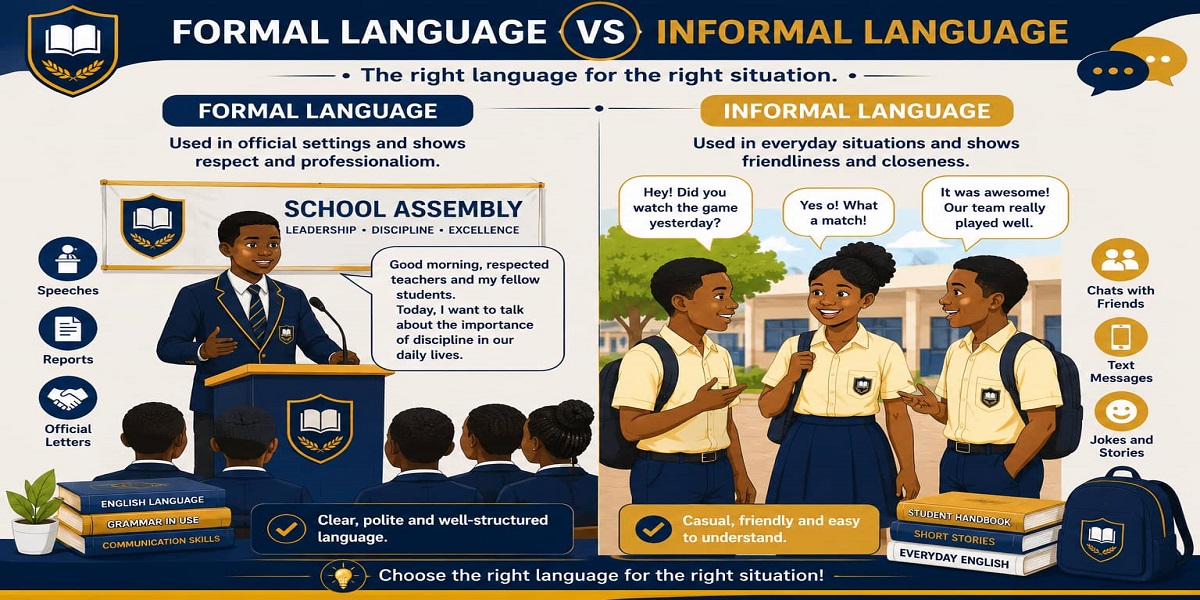
Language changes depending on the purpose of communication and the audience. Formal language is used in official situations such as speeches, debates, assemblies, prize-giving ceremonies, public speaking and professional communication. It is polite, carefully structured and avoids contracted verb forms and pidgin English. Formal language may include quotations and statistics, rhetorical questions, idioms, figurative expressions and carefully controlled humour where appropriate.
Informal language is commonly used in conversations among friends, classmates and family members. It allows people to communicate in a relaxed and personal way. Informal language may include contracted forms of words, slang, pidgin, colloquialisms, ellipses and jargon depending on the communication context. Choosing the correct register helps speakers communicate effectively while respecting the expectations of different audiences.
Learners should practise identifying appropriate language use in situations such as asking for directions, requesting a favour, describing a market scene, attending a job interview and participating in classroom discussions. Understanding these differences strengthens communication skills in both academic and everyday life.
Worked Examples
Example 1
Scenario: A student delivers a speech during a school prize-giving ceremony.
Explanation: Because the event is official, the speaker should use formal language with polite expressions and carefully structured sentences that suit the audience and occasion.
Example 2
Scenario: Two classmates discuss their homework after school.
Explanation: Since the conversation is casual and personal, informal language is appropriate while maintaining respectful communication.
Why This Topic Matters
Understanding language registers enables learners to communicate confidently in different settings, including school, community activities and everyday conversations. Selecting the appropriate language helps ensure messages are clear, respectful and suitable for the intended audience.
Quick Practice
- Explain the difference between formal and informal language.
- List four situations where formal language should be used.
- Write two short conversations, one using formal language and one using informal language.
Summary
Formal and informal language each serve important purposes in communication. Knowing when and how to use each register allows learners to communicate effectively across a variety of speech situations while matching their language to the audience, purpose and context.
Access NaCCA-aligned Support Packs
Download your structured NaCCA-aligned Teacher Support Pack and Student Learning Pack, designed for clarity, practicality, and reliable teaching and learning.